


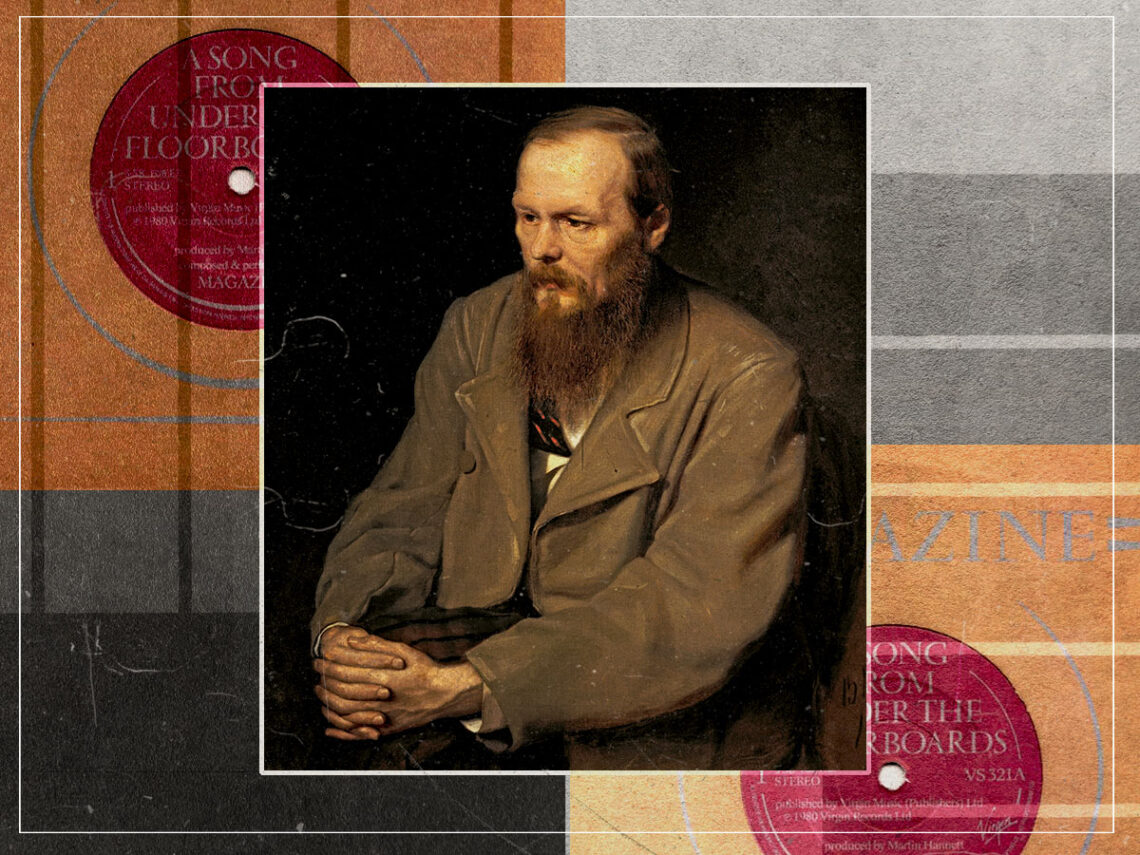
How Fyodor Dostoyevsky shaped the ultimate post-punk anthem

Your confusion is valid, but allow me to explain how Fyodor Dostoyevsky, the apical titan of Russian literature, had a crucial role in creating a post-punk masterpiece. Although the troubled writer lived in the 19th century and died in 1881, about a century before the post-punk wave, his literature kicked dominoes, the ripples of which are still felt violently today.
Famed most for his works of existential and psychological fiction, Dostoyevsky cultivated strange, often conflicted characters, such as Rodion Raskolnikov from Crime and Punishment. Using eccentric figures as such, he could exercise progressive philosophies and push the human psyche to its limits. This approach influenced 20th-century literature monumentally as a pivotal force behind the philosophical works of Aldous Huxley and the French existentialists Albert Camus and Jean-Paul Sartre.
When rock music conquered the airwaves in the 1950s and ’60s, catalysed by technological advancement and globalisation, notable musicians made their reading habits apparent in professional output and interviews. The Beat Generation’s non-conformist literature famously informed Bob Dylan, John Lennon, David Bowie and Tom Waits, but the above-mentioned authors were never forgotten.
Jim Morrison, a poet of myriad influences, named his band The Doors in the mid-1960s after The Doors of Perception, Aldous Huxley’s 1954 essay on the effects and applications of psychedelic drugs. A decade later, Iggy Pop, ‘The Godfather of Punk’, brought Dostoyevsky back in vogue after naming his first solo album The Idiot, after his and collaborator David Bowie’s favourite book by the Russian author. In 1987, Bowie was featured in an American library poster holding a copy of Dostoyevsky’s The Idiot, urging children to read.
Iggy Pop’s The Idiot arrived in 1977 during the punk zenith but lit the way for the imminent post-punk wave. Ian Curtis was particularly enthusiastic about the album. Eerily, the Joy Division singer chose The Idiot for his last record before committing suicide. When Curtis’ wife, Deborah, found his body on May 18th, 1980, the record was still spinning.
Joy Division and their fellow Manchester post-punk pioneers Magazine define the migration from punk to post-punk rather well. The former, initially named Warsaw, was formed as a punk act following a seismic performance by Sex Pistols in the city’s Lesser Free Trade Hall. Similarly, Magazine was formed by Howard Devoto, an early member of Buzzcocks and, incidentally, the man responsible for organising the Free Trade Hall concert.
Where punk, as exhibited by Sex Pistols and Ramones, shook the listener like a can of fizzy pop with its raw, provocative energy, post-punk was generally more complex, both lyrically and instrumentally. John Lydon’s arrogant anarchy seemed to be replaced by more introspective songwriting by the likes of Ian Curtis and The Cure’s Robert Smith.
A common trend among the erudite poets of the post-punk movement was an interest in existentialist fiction. Robert Smith wrote ‘Killing an Arab’ in reference to Camus’ 1942 novella The Stranger (translated to The Outsider in the UK). Likewise, Mark E. Smith wanted to name his band The Outsiders, but bassist Tony Friel’s suggestion of The Fall, the name of another Camus novel, won the casting vote.
At around the same time The Fall and The Cure laid their first tracks, Howard Devoto released his first album as the zany figurehead of Magazine. Titled Real Life, the 1978 album was a macabre smorgasbord brought to life by John McGeoch’s masterful guitar work. The album portended the gothic wave with its dark recesses, but Devoto’s knack for existential dread reached a notable peak in 1980 with ‘A Song from Under the Floorboards’, the lead single from Magazine’s third studio album, The Correct Use of Soap.
An anthem succinctly representative of the post-punk era, ‘A Song From Under the Floorboards’ was so directly influenced by Dostoyevsky that he could have claimed some credit had he not been dead for a century. The song derives its title from Dostoyevsky’s 1864 novella Notes from Underground, which is said to have been mistranslated from the intended title Notes From Under the Floorboards.
Devoto adapted phrases and motifs from the novella to create his bizarre yet captivating lyrics. Dostoyevsky famously began Notes from Underground with a sentence usually translated to English as “I am a sick man. I am an angry man. I am an unattractive man.” Devoto transplanted this for the opening line of ‘A Song From Under the Floorboards’: “I am angry, I am ill, and I’m as ugly as sin”.
Devoto refers to himself as an “insect” elsewhere in the track. In Notes from Underground, Dostoyevsky’s self-deprecating narrator discusses himself as an “insect”, a man of such baseness and indignity as to be subhuman, contrary to the “highest and the best”. Yet, the character finds furtive pride in this stature, inspiring Devoto’s line, “My force of habit, I am an insect / I have to confess I’m proud as hell of that fact”. This perfectly placed lyric encapsulates the archetypal outlook of creators and consumers of gothic and post-punk music.
If you have yet to read Notes from Underground, I recommend it as a short and inspiring read. Just make sure you couple the experience with Howard Devoto’s appreciative ode below.
