


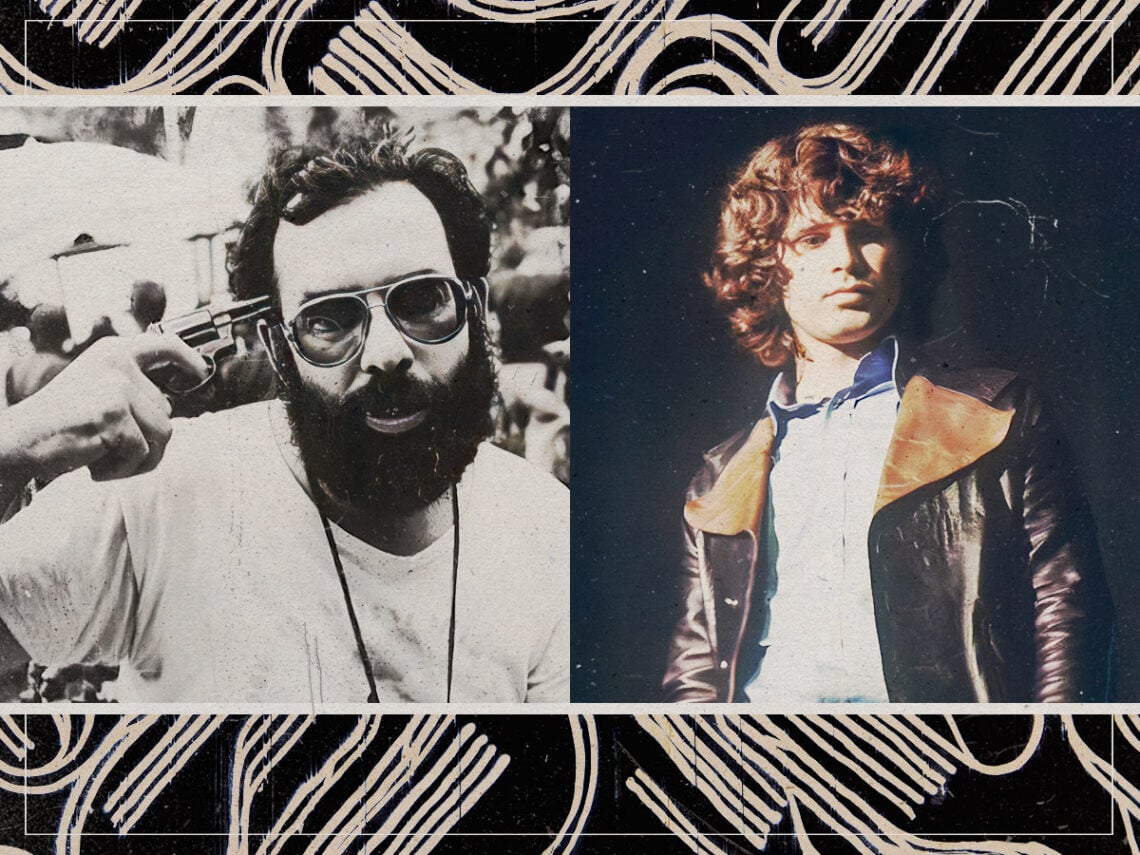
Exploring the friendship between Francis Ford Coppola and Jim Morrison

Few movies have shaped popular culture as much as Francis Ford Coppola’s seminal gangster flick, The Godfather, released in 1972. It was a cinematic phenomenon, signalling a new era of filmmaking defined by rich storytelling, unafraid to dive into the more brutal aspects of humanity and society.
Coppola had no idea the film would take on such influential status upon its release, and he initially hesitated to direct it. Reflecting on this period of his career, he once told Howard Stern, “There had been a few Mafia movies before, and they had all been flops. So all the big directors turned them down.” Yet, in keeping with the New Hollywood era’s penchant for pessimism, Coppola made a violent and powerful film – reflective of the cultural move away from ‘60s optimism – that ended up racking in millions of dollars at the box office.
However, before Coppola was a heavyweight champion in the world of filmmaking, he studied theatre at Hofstra College, finding vital inspiration in the form of his professor Dorothy Arzner, a former Hollywood director and screenwriter. Yet, one school was not enough. Coppola moved to the other side of the country to study at UCLA Film School just three years before releasing his first feature, Dementia 13, in 1963.
At UCLA, he became friends with Jim Morrison, who soon became the enigmatic frontman of The Doors. Morrison was a film enthusiast, making several shorts as a student, although he never managed to work on anything with Coppola. Afterwards, Morrison spent his post-grad life taking lots of drugs and writing lyrics, which would come to form some of the band’s staple songs.
Morrison’s lyrics often spoke of disillusionment and chaos, with his final album with The Doors, L.A. Woman, released in 1971, just a year before the release of The Godfather. The album truly cemented the end of the once-promising ‘60s. While Morrson’s lyrics weren’t always miserable, many of the songs on L.A. Woman express his fascination with America’s dark yet alluring nature.
Songs such as ‘Riders on the Storm’ convey themes of violence, murder, and fading optimism. Many people argue that the ‘60s truly came to an end with the Tate-LaBiana murders that took place in 1969, and many of Morrison’s lyrics on his final album evoke this changing atmosphere among the artists and stars that were once hopeful.
In many ways, Morrison’s lyrics fit nicely into this new era of pop culture, where filmmakers were capturing the violent and harsh yet simultaneously romanticised realities of American life through their work.
Coppola recalled his friendship with Morrison in The Globe and Mail, “I knew Jim Morrison pretty well, and I know he drank a lot, but in those days we couldn’t afford a glass of wine. He was a very shy, sweet, brilliant guy. And he went out with my sister [Talia Shire].”
He also discussed his recollections of the band’s early days. “When he started the Doors, I was working as a screenwriter. One night, they all came to my house and asked if I had any connections that could help them. They brought me their record, and I listened to ‘Light My Fire’. Two years later, they were a big deal.”
Sadly, Morrison died in 1971 due to heart failure, which likely resulted from his addiction to alcohol. He was never able to watch The Godfather, but Coppola placed The Doors’ song ‘The End’ in Apocolypse Now.
