


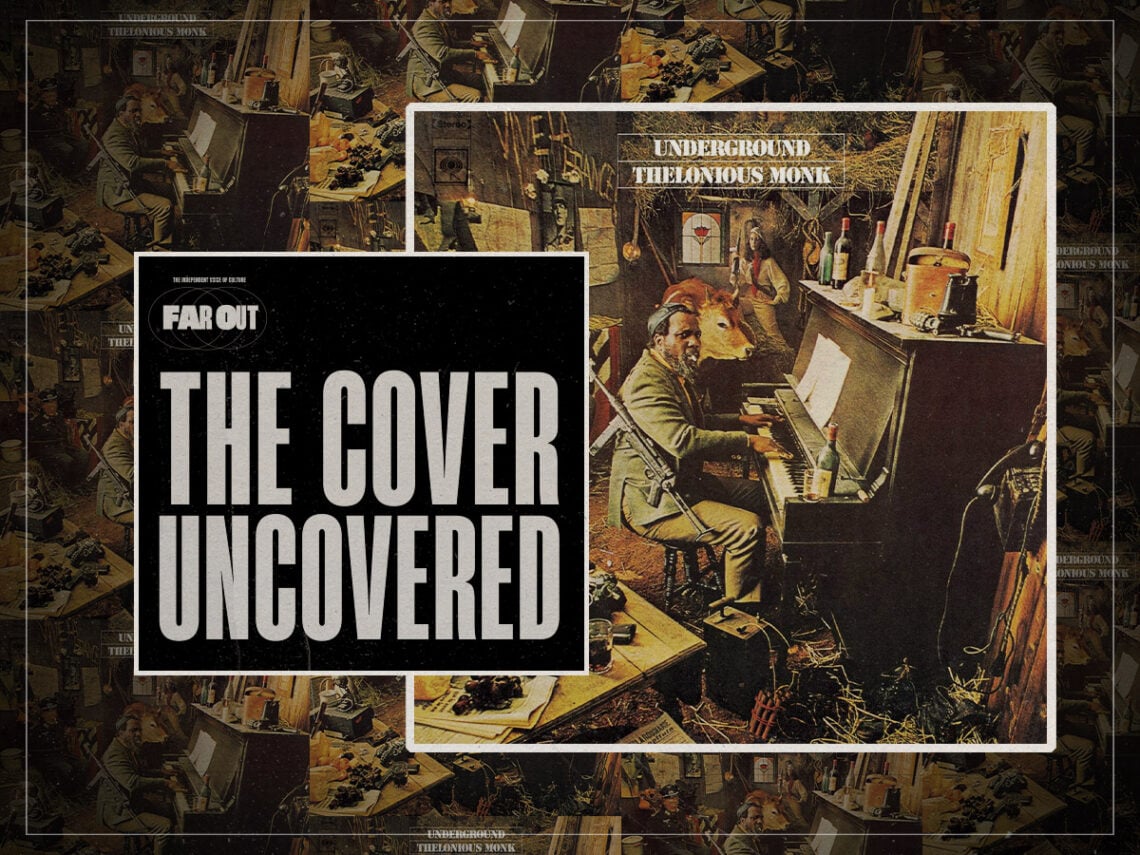
The Cover Uncovered: The chaotic French Resistance-inspired scene of Thelonious Monk’s ‘Underground’

For a long period of time, jazz album covers all seemed to follow a similar pattern, were highly stylised and featured at least one of a number of different points of interest. Simple portraits of the artist, often in action, accompanied by striking fonts, colourful design and a litany of exclamation marks were all mainstays, and Thelonious Monk, one of the most celebrated jazz pianists of all time, fit into the mould in this regard for a large portion of his career.
However, the changing nature and perceptions of jazz in 1968, twinned with the fact that a new vanguard were ushering in different sounds that aimed to help jazz join forces with the world of rock music, meant that jazz designs began to take a different shape, with highly conceptual pieces being used instead of the more uniformly recognisable styles that had been omnipresent in the 1950s and before.
Monk was truly one of the elder statesmen of jazz, particularly within the bebop scene, but by the end of the 1960s, he knew that he also had to move with the times and put out something that was going to resonate with younger audiences who were following the new ‘underground’ – and what better way to do this than with an album actually titled Underground.
Stylistically, the album doesn’t stray too far away from what he’d made a name for himself for, but you can see how the folks at Columbia Records wanted Monk to inject some new life into his work, prompting him to reimagine some of his most beloved titles in a newer style while adding in a few more contemporary originals. However, the most notable and radical shift is not in the music, but in the cover art, which referenced a different underground movement that had happened a couple of decades before.
With Columbia’s art director John Berg on board to guide photographers Steve Horn and Norman Griner, the trio decked out the studio with French Resistance imagery, with many provocative props, and Monk sat front and centre at a piano, dressed in full French Free Army regalia and armed with an assault rifle.
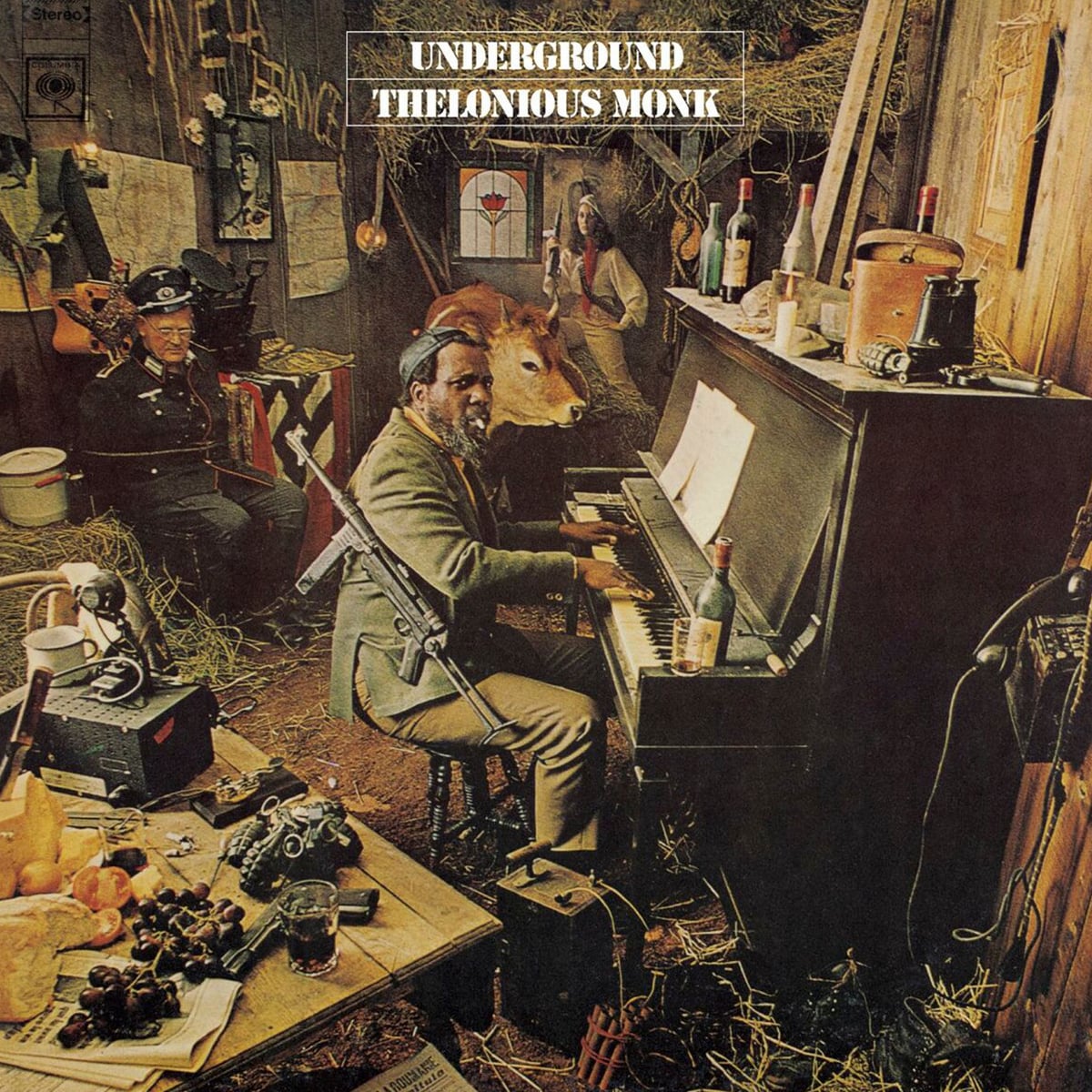
Why, you might ask? The photograph was intended as a tribute to Monk’s friend and patron, Baroness Pannonica de Koenigswarter, a member of the Rothschild family of nobility, who herself had been part of the French Freedom Army in World War II. Her likeness is depicted on the cover, and she was reported to have been the one to have escorted Monk to the shoot in a plush car, but it’s the surrounding elements that are arguably more striking.
A tied-up SS guard sits slumped in the corner next to a Nazi battle flag, copious amounts of dynamite and hand grenades are scattered across the table next to an assortment of bread and grapes, Monk’s piano is covered in empty wine bottles, and, most bizarrely, in the centre of the room, a cow.
There are many accounts from people who were present on set that detail the shoot, with that of Richard Mantel, another art director at Columbia, perhaps providing the most reliable account. “Monk entered the building, wearing what he wore in the shot,” he recounted to Mosaic Records’ Daily Jazz Gazette in 2016. “Monk then just walked onto the set; sat down at that battered upright piano, and proceeded to play for about an hour and a half. The piano was terribly out of tune, and I’m sure didn’t have all of its keys.”
“After the photo session, Monk got up and left with The Baroness. The only word he had spoken in all that time was to the cow.”
Richard Mantel
The less reliable, albeit more entertaining version of events came courtesy of the liner notes of the album, which were written by Gil McKean, who told a more elaborate and fantastical story, choosing to eschew the fact that there was ever a constructed photoshoot and boldly proclaiming that it was Monk’s actual apartment.
McKean’s ludicrously embellished story claims that the Nazi ‘storm trooper’ is a stuffed trophy from Monk’s days in the Resistance movement, whom he had personally shot “cleanly and truly through the heart,” and that the cow is his pet, who “answers to the name Jellyroll and has the run of the apartment.” While obviously fabricated, this addition of a little mythology surrounding the album makes discovering every minor detail all the more interesting.
And yet, for all of the elaborate storytelling that went into trying to reinvent Monk to breathe new life into his career, it was far from a success. Underground ended up being his penultimate album before he ended up taking a hiatus that lasted over a decade until his death, and it wasn’t until decades later that the album would begin to be cited as one of Monk’s lost masterpieces.
But was it worth all the hassle? For Monk, perhaps not, but Berg seemed to think so, especially from his own standpoint. “There was no problem with budgets in those days,” he reminisced in a later interview with The American Institute of Graphic Arts, before casually adding: “I won a Grammy for that cover, by the way.”
