


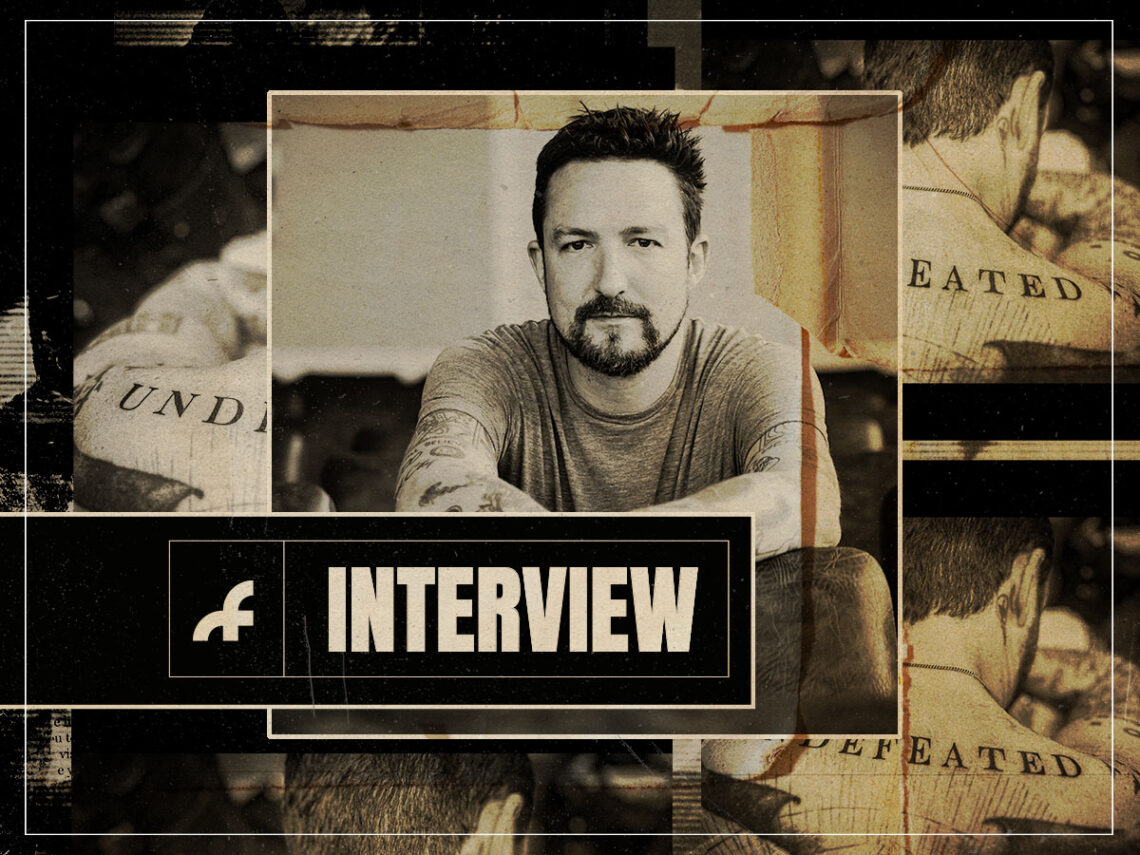
Frank Turner has finally made peace with his younger self: “I have always been a square peg in a round hole”

When Frank Turner was 15, he never intended to be a folk-rock troubadour. Instead, he fostered dreams of being the next Henry Rollins, ripped with spittle and punk energy, but it’s too late to turn back the clocks now. He’s on the verge of releasing his tenth solo album, Undefeated, which finds Turner coming to terms with a man that the younger version of himself wouldn’t recognise.
Since beginning his journey in post-hardcore band Million Dead in 2000, for the most part, the only constant in his life has been Turner keeping his feet glued to the road. In his 20s and 30s, there was always another show for him to play, another song to write, and any time away from touring was spent nefariously in North London pubs. There may have been a debauched decade or two when Turner thought this would be his existence forever, but life changes for everybody.
Turner now lives a quieter life in Essex with his wife, Jessica Guise, who works as a therapist and musician. Although he still puts most artists to shame with the number of shows in his calendar, which he says can be up to 150 in a “busy year”, by his standards, this is light work.
Undefeated, the first self-produced album in his oeuvre, was recorded in his home studio in Essex and finds Turner in a reflective mood. ‘Ceasefire’ embodies the spirit of the record, with Turner singing to the angsty teen that still occasionally taunts him, “There’s a million different people you’ll be before you’re me. I know I’m not everything that you hoped and imagined that I would be, I did my best, and I have seen things that you don’t even know that you’ve never seen.”
According to the singer-songwriter, speaking to Far Out over Zoom, the overarching theme of Undefeated is “mixed feelings over nostalgia as a concept”. Although it can be easy to look through the past through rose-tinted glasses, as Turner asserts, “The thing about nostalgia, broadly, it’s like a cheap high. I think it’s quite easy to imagine the summer when you were 16 was like Stand By Me.”
He continues: “But at the same time, personally, that idealisation of a certain period of my life, which was all about falling in love with punk rock, and indeed, falling in love for the first time, hasn’t been super helpful for me psychologically as I’ve got older. I do have arguments with my 16-year-old self behind closed eyes and get told off in this way that’s psychologically unhelpful.”
Having this as a reference point across the album was a valuable tool from a creative perspective for Turner, who concedes the “craft part of songwriting” has become easier with experience, but “finding interesting things to write about” is now a more challenging task. Nevertheless, it turned out to be a jumping-off point rather than an all-encompassing concept he evangelically tied to.

However, at this stage in his life, it seems an appropriate time to pause and ponder. When Turner began as a folk singer, those close to him thought he’d lost his mind. But rather than be discouraged, he carved out a successful niche for himself. He’s an artist who feels equally at home on the main stage at Download or Cambridge Folk Festival, making him a musical juxtaposition that somehow works.
“I have always been a square peg in a round hole or caught between various stalls as far as scenes go,” Turner admits. “In all honesty, there are moments when that’s been very frustrating to me. Million Dead were part of the punk scene or post-hardcore scene. I wanted to distance myself from that, and I was around people like Laura Marling and Mumford and Sons when they were starting; I was a footnote for that scene. Also, I was around The Holloways and The Libertines and that kind of crew, but I wasn’t really part of that either.”
While being an outsider of these various movements was deflating at times, Turner has remained authentic, which has paid off in the long run, even if it may have previously been detrimental. “I’d be lying if I said there weren’t days when I was envious of people that I know, getting very famous very quickly or becoming very successful very quickly because of genre and journalistic associations, and indeed, social associations,” he says before adding, “At the same time, those ties then tend to break and to take people down with them. And that hasn’t happened to me in quite the same way, which I’m grateful for.”
Reaching this position of contentment has taken two decades. While Turner is proud, he says he would “be at the front of the queue” to criticise his past work, but he’s comfortable in the knowledge that “my intentions were good and that my aspirations were in the right direction”.
His journey has taken him to London’s O2 Arena and headlining festivals, but Turner, a patron of the Music Venue Trust, remains fiercely loyal to his roots. This summer, he’ll be playing an intimate tour of these iconic rooms, which made him become the artist he is today, such as the Brudenell Social Club in Leeds and the Rescue Rooms in Nottingham.
Turner feels these venues are “socially important” and “politically important” because they have been vital to “human interaction” in “my corner of the world”. Sadly, he feels they are losing the fight to “large California-based corporations” in the entertainment sphere. He elaborates, “They are stealing adolescence, it’s not going to win me any friends among my nephews and nieces, but I want to smash their iPhones and make them fucking go to gigs.”

For Turner, the first moment he stepped into a sweaty sticky-floored venue as a teenager was a life-affirming moment, as he vividly recalls: “It can be pretty fucking mind-blowing, it was for me. I remember going to my first gig at The Joiners Arms (Southampton) in 1995 to see a pop-punk band called Snug; their guitarist was the producer Ed Harcourt who fucking hates me mentioning this. I thought they were absolutely fucking brilliant; I pogoed to all the bands and all the music between bands because I was 13, and it was blowing my mind.”
Furthermore, on the subject of grassroots being the lifeblood of the music scene, Undefeated is released exclusively through independent record label Xtra Mile, which has been Turner’s home since Million Dead. He’s had a licensing agreement with Universal for his last five solo albums and “expected to get dropped after one record”. Although the major label wanted to continue the partnership, Turner “politely” declined the offer and knew it was “time to come home to the independent world”.
Over the last decade, Turner has conquered achievements that seemed impossible, such as a number-one album in 2022 with FTHC. While he says there were never any “meaningful creative constraints”, Turner had to “expend firepower in making sure that I didn’t have creative restraints”.
Meanwhile, with the self-produced Undefeated, the singer-songwriter has been “completely in control of the ship, so it’s all my fault when it goes wrong.”
Turner’s voyage to Undefeated has led to a collation of battle scars, and now he’s in a position where his hero, Black Flag’s Henry Rollins, will be supporting him at his annual travelling Lost Evenings Festival later this year. Even 42-year-old Turner admits it’s “blowing my mind that Henry Rollins is aware of my existence as a musician”, a notion which would likely have made him combust at 15.
While Turner’s unique route is a previously untravelled path, his integrity has never been sold to the highest bidder, and his conscience is clean. His brand of music differs from the punk dreams he once glorified as a kid, but evolution is a necessity of life, and as the support of Rollins proves, 15-year-old Frank has every right to feel proud.
Undefeated is out through Xtra Mile Recordings on May 3rd.
