


Five classic tracks with secret famous backing vocalists

Present-day artist crossovers divide opinion. On the one hand, seeing two of your favourite artists couple up on a track is exciting, akin to a sports fan seeing their favourite player sign for their team. Where music is an industry mostly devoid of competition, there’s almost always no pushback on seeing our favourite artists join forces.
On the other hand, it can veer into the contrived. Labels putting mega stars on the same track is arguably a streaming cheat code. If the track has no real narrative, nor does it artistically benefit from a collaboration, it’s a crossover gone wrong.
Ultimately, the song should always be paramount and the serving of it supersedes the potential exposure of either artist. Trading vocal riffs and guitar solos tread dangerously into that territory. In contrast, a delicate injection of a backing vocal from an unknown yet familiar voice is a trope that satiates our artist cross-over desires while also delivering us with a song that’s in keeping with what we want from the main artist.
Modern tracks that have executed this brilliantly include Arctic Monkeys’ ‘Knee Socks’, featuring Joshua Tree legend Josh Homme delivering reverberated croons during the bridge, and Frank Ocean’s ‘Pink + White’, where Beyoncé provides uncredited backing vocals, subtly emerging only during the song’s reprise. These musical Easter eggs spark the imagination of devoted fans, who can only dream of the studio sessions where their favourite artists collaborate and exchange ideas.
While in the modern day, we may get a glimpse on social media, or worse, the audio file would have been emailed over, there would have been no real-life interaction. However, classic tracks from years ago leave us nothing but a backing vocal and our imagination to picture what that session would have really been like.
Five famous backing vocalists on classic songs:
David Bowie – ‘Fame‘ (John Lennon)
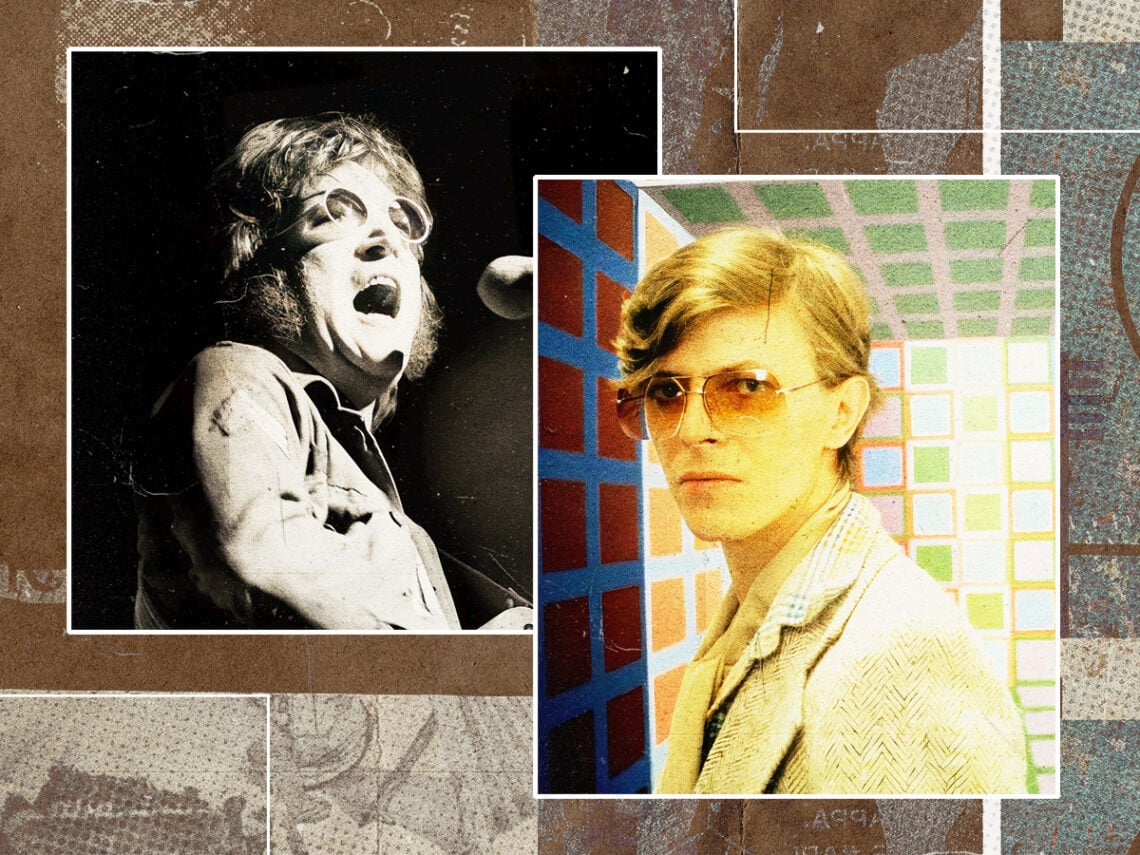
When it comes to the pantheon of musical greats, there are arguably no two bigger names than David Bowie and John Lennon. And on ‘Fame’, Bowie’s 1975 hit, from the Young Americans album – not only did Lennon feature as a backing vocalist, but he’s also credited as a co-writer. The partnering seemed to work as ‘Fame’ became Bowie’s fastest-selling US hit at that point, thrusting his star into global recognition.
Bowie told Bill DeMain in a 2003 interview: “When we were in the studio with John Lennon, I asked Carlos, ‘What was that riff you had?’ And it went from there.” When Lennon began to adlib the word ‘Aim’ over the top, the famous chorus line was born, and the rest was history. Lennon’s legacy on that song remains on the recording, with his only vocal contribution coming as a pitched ‘Fame’ backing Bowie’s croon of the song’s hook, which is only noticeable upon close listen.
Carly Simon – ‘You’re So Vain’ (Mick Jagger)
While the irony of John Lennon – one of the world’s most famous musicians – singing the word “fame” almost anonymously is impressive, then how would you describe Carly Simon having Mick Jagger doing backing vocals on ‘You’re So Vain’? The iconic Simon track, whose subject is still the instigation of intense rumour, is a fierce track of defiance in the face of an ex-lover.
Given that this chorus is one of the most iconic ever written, inspiring a raucous singalong from whoever is listening, it’s understandable that the harmonic nuance within it is missed. However, within the chorus’ harmonies is Mick Jagger, whose typically British delivery provides an edgy reflection of Simon’s performance.
Dire Straights – ‘Money For Nothing’ (Sting)
Dire Straights’ iconic, albeit controversial, track features one of music’s most instantly recognisable riffs and arguably Mark Knopfler’s most recognisable performance. But while the crunching blues line foregrounds most of the son, it gives way to one of the music’s catchier vocal hooks.
While Sting features as a backing vocal on the song’s main chorus, he also features again in the bridge harmonising ‘I Want My MTV’ in a strikingly similar melody to his own hit, ‘Don’t Stand So Close To Me’. What’s left is a thematic minefield for fans to navigate: a song critiquing the facile nature of growing pop stardom and its consumers, with backing vocal melodies performed by a man whose very song is being ripped off feels like almost too much of a wink at music fans that this entire collaboration feels like a joke on our behalf.
Steely Dan – ‘Peg’ (Michael McDonald)
Yacht rock legends Steely Dan released Aja in 1977, their sixth record in successive years. The album pushed them further into a compositional sound with the introduction of a wider set of session musicians. It ultimately allowed them to plunge their music into the heart of experimentation. The record’s title track is eight minutes long, with jazz chord progressions and a sprawling sax solo.
The collaborative nature of this record makes the fact that Michael McDonald featured on the backing vocals of ‘Peg’ somewhat less surprising than it may ordinarily be. Swimming in the same yacht rock circles, McDonald’s soulful voice was a signature of his band, The Doobie Brothers, and it was used to add texture to an already layered track.
Speaking in the Classic Albums documentary, McDonald said: “For those guys, phrasing could have such nuance. Singing a line like “half as much as”, you’d think how many ways can you say it?”
He continued: “It would come down to such fine points like pronunciation or exact rhythmic vibrato”. The detailed approach benefits the final master, where McDonald’s vocal take is somewhat of an added rhythm. Later, in the song’s outro, lead vocals and guitar lines take centre stage.
Neil Young – ‘Heart of Gold’ (James Taylor and Linda Ronstadt)
The sort of universal wisdom shown in Neil Young’s 1972 album Harvest is what has made him one of music’s most revered songwriters. One of his standout tracks strikes a chord on the fundamental human existence of love, longing and companionship. The song would go on and still continue to be a fan favourite for its quintessentially stirring Young vocal takes sat atop reliably emotive chord progressions.
It seems that the song’s search for companionship is successful in the outro, where backing vocals join Young in his delivery of the song’s chorus. It’s there that we hear James Taylor and Linda Ronstadt, who were in the studio with Young, adding delicate touches to not only ‘Heart of Gold’ but also ‘Old Man’.
Recounting the story, James Taylor said: “Neil and I had both done – and Linda Ronstadt – had done The Johnny Cash Show in Nashville at The Grand Ole Opry at the Ryman Auditorium, and just after we were finished, Neil said, ‘Well come to the studio with me, I got some studio time, I’m gonna put down a couple of songs’. So, I played along on that song, ‘Old Man’, and ‘Heart of Gold’ Linda and I sang on.”
While the track’s commercial appeal divides Young’s fans, the modest use of Taylor and Ronstadt as backing vocalists on this track is undoubtedly a fine example of super artists collaborating in service of the song rather than themselves.

Never Miss A Beat
The Far Out Beatles Newsletter
All the latest stories about The Beatles from the independent voice of culture.
Straight to your inbox.