


Five times Quentin Tarantino went too far

As one of the very few filmmakers in Hollywood who operates with the truest definition of creative freedom, Quentin Tarantino is in the position to do whatever he wants and depict it however he sees fit on-screen.
It hasn’t been without its controversies, though, with the filmmaker’s penchant for profanity-laden tirades, repeated use of potentially offensive terminology, and fondness for graphic violence finding him coming under fire on numerous occasions.
On the other hand, those have been accepted as hallmarks of his work and just as tied to his style as references to his favourite movies and needle-drops of his favourite songs. Like many creatives before him, Tarantino has overstepped and gone too far more than once, but not for the most obvious reasons.
Going too far doesn’t necessarily mean pushing the boundaries of cinematic acceptability to their limits, with a myriad of reasons responsible for Tarantino crossing the line.
Five controversial Quentin Tarantino moments:
5. His portrayal of Bruce Lee (Once Upon a Time in Hollywood, 2019)
Bruce Lee’s daughter Shannon was so offended by Tarantino’s portrayal of her father in Once Upon a Time in Hollywood that she effectively cancelled the movie’s release in China after lodging a complaint with the local film administration over the way he was depicted.
Several former friends and colleagues voiced their concerns, too, with his protégé Dan Inosanto saying “he worshipped the ground Muhammad Ali walked on”, while former co-star Kareem Abdul-Jabbar described Tarantino’s depiction as “sloppy and somewhat racist”. The filmmaker stuck to his guns, though, and defended his position in typically bullish fashion.
His defence amounted to saying he’d heard and read that Lee “was kind of an arrogant guy”, and even if Tarantino’s movies take place in a semi-heightened reality, it didn’t sit too well with a lot of people to paint an icon as such an arrogant and aloof presence.
4. Liberal use of racial slurs (Jackie Brown, 1997)
Profanity and racial slurs have been another repeated criticism of Tarantino’s filmography, and while he’s been defended on the latter front by regular collaborator Samuel L. Jackson, among others, Spike Lee has always been fiercely critical.
Years before he called Django Unchained “disrespectful to my ancestors”, Lee railed against Tarantino’s insistence on loading Jackie Brown up with derogatory remarks after one in particular was uttered 38 times. “I’m not against the word, and I use it, but not excessively,” he said. “And some people speak that way. But, Quentin is infatuated with that word. What does he want to be made – an honorary black man?”
Suggesting “he uses it in all his pictures”, Lee wanted Tarantino to know “that all African-Americans do not think that word is trendy or slick”, pointing that out to his contemporary “for future reference”. He wasn’t the only one with the same mindset, but it didn’t deter the word from reappearing in his work.
3. Seriously injuring Uma Thurman (Kill Bill, 2003)
Tarantino has since apologised for his role in the incident, but after Uma Thurman voiced her concerns to begin with, she should have never been put in the position of serious danger when shooting Kill Bill.
Persuading her to drive a car at 40 miles per hour so that her hair would blow in the wind exactly how he envisioned it, Thurman described the vehicle as “a deathbox” that ultimately veered off the road and hit a tree, where she ended up hospitalised, wearing a neck brace, and suffering knee damage.
The star did note that “he didn’t feel he had tried to kill me”, but the fact it took so much urging on his part and almost ended in even worse than it did proved her hesitance to be entirely correct. The director was adamant that he get his own way, with Thurman the one who paid the price.
2. An immersion-shattering cameo (Django Unchained, 2012)
Tarantino has always given off the impression that he’d chance his luck at becoming an actor had he failed to make it as a filmmaker, despite the vast amount of evidence suggesting he isn’t particularly great as an on-screen presence in any movie.
The worst offender by far is his excruciating extended cameo in Django Unchained, which slows the pacing to a crawl and shatters the suspension of disbelief for what appears to be the sole purpose of Tarantino proudly announcing to the world that his cameo appearances are back, and this time with accents.
Terrible and unconvincing accents at that, in what amounted to a self-indulgent showcase for a non-existent range that adds absolutely nothing to the film other than shoehorning its writer and director on-screen for no other reason than he wanted to be in it.
1. Gratuitous foot stuff (From Dusk Till Dawn, 1996)
Tarantino likes feet; this much everyone knows. Every single one of his movies features at least one lingering close-up of a female character from below the ankles, but he indulged his personal preferences to an uncomfortable scale in From Dusk Till Dawn.
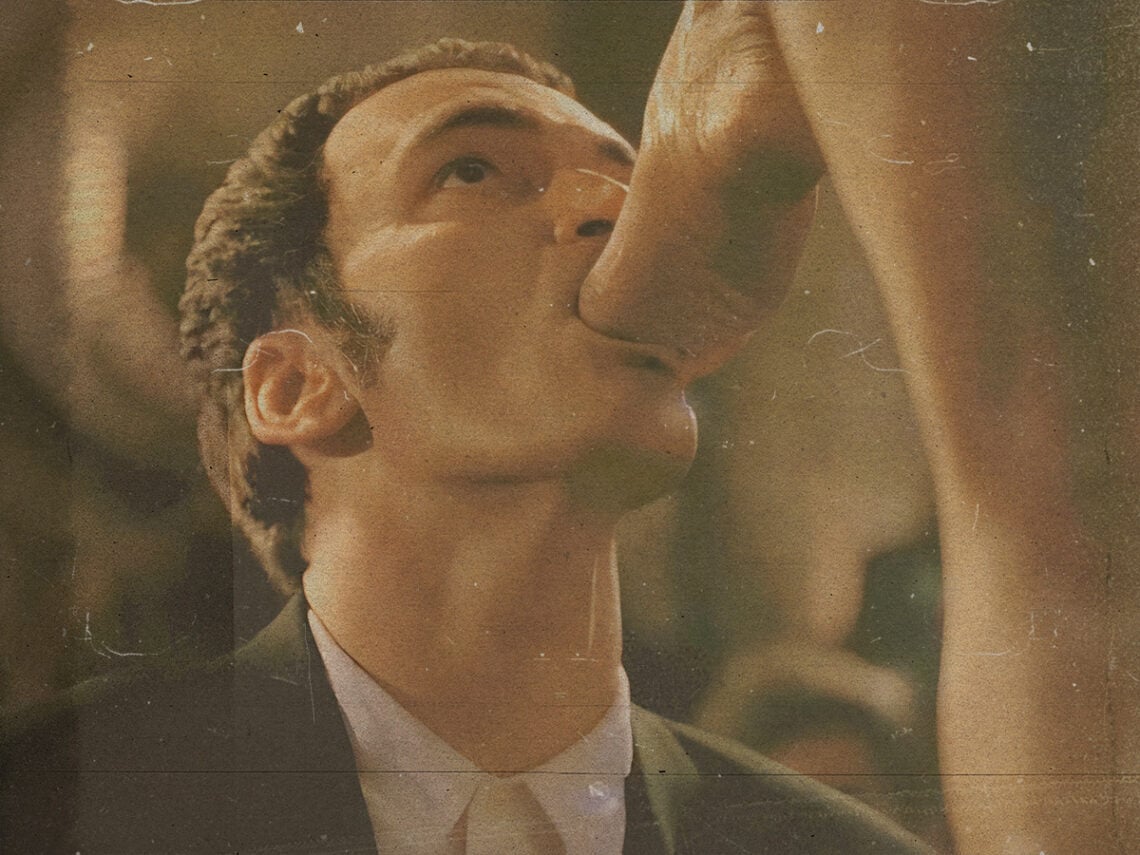
The script – which was written by Tarantino – finds two sibling thieves on the run from the law, where they seek refuge at the Titty Twister bar. Herein, Richie Gecko – played by Tarantino – ends up drinking tequila by sucking it right from the toes of Salma Hayek’s Santanico Pandemonium.
It was clear the man’s foot fetish was going to become a recurring motif beforehand, but scripting yourself to play a character who gets a mouthful of toes is about as needlessly self-serving as it gets, and the only real surprise is that it didn’t hold up production from Tarantino demanding as many takes as possible.

Never Miss A Take
The Far Out Quentin Tarantino Newsletter
All the latest Quentin Tarantino content from the independent voice of culture.
Straight to your inbox.