


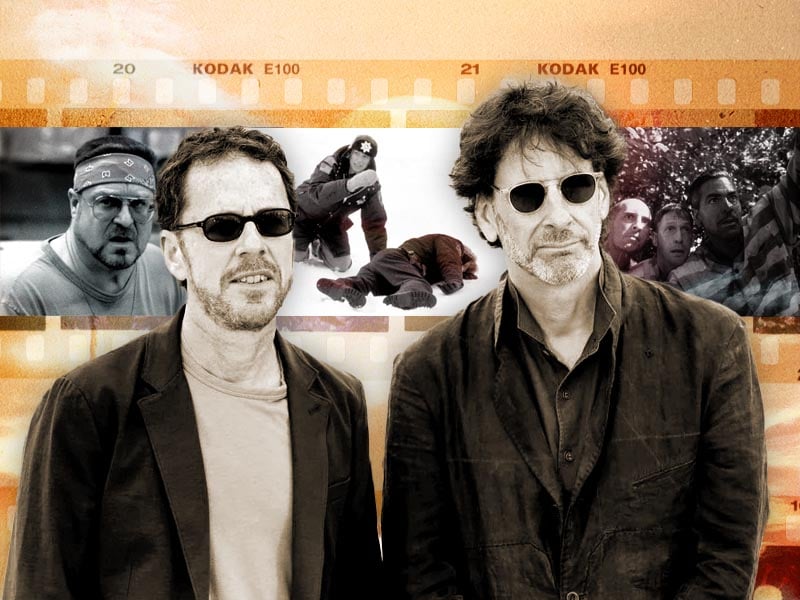
Five scenes to prove the Coen brothers are modern auteurs

It’s been half a decade since Joel and Ethan Coen collaborated on a feature film when The Ballad of Buster Scruggs hit Netflix, with their last theatrical release coming in 2016 when Hail, Caesar! was released, with their absence leaving a gaping hole at the forefront of modern cinema as a result.
While they’ve been active as individuals – with Joel carrying on their track record of acclaim with The Tragedy of Macbeth as Ethan puts the finishing touches on 2024’s road trip comedy Drive-Away Dolls – there’s an innumerable number of cinephiles out there counting down the days until they reunite and deliver a 19th movie as siblings.
It’s been confirmed that it’ll happen sooner rather than later, but absence hasn’t really been required to make the heart grow fonder, considering the legacy they’ve already carved out. When it comes to naming the foremost auteurs of the modern era, it would be foolish to not have the Coens residing somewhere near the top.
They’ve taken on many stories covering almost the entire genre spectrum, encapsulated by the following five scenes. Separated by decades and untethered by their narrative or thematic functions, each one nonetheless showcases the virtually unlimited strings to their creative bow, underlining why they’re among the true greats.
Five unforgettable Coen brothers scenes:
Miller’s Crossing (1990)
The Coens’ first three features all occupied the crime genre, but they couldn’t be more different from each other, with Miller’s Crossing an entirely different animal compared to Blood Simple and Raising Arizona. It’s that ability to navigate the same broad narrative and thematic ground while painting it in completely fresh strokes and brand new colours that had marked the pair out as two of cinema’s fastest-rising creative minds, with the film’s signature image also its defining scene.
Gabriel Byrne’s Tom Reagan has been tasked to take John Turturro’s Bernie Bernbaum into the woods and execute him, a straightforward assignment for a hardened gangster at first glance. And yet, the agonising begging that exists on a plane well beyond desperation is harrowing in microcosm, even more so when placed against the silent woodlands backdrop and the stony-faced expression Reagan maintains.
Remaining unmoved, the tension becomes excruciating because the audience can’t tell from his face alone whether he’ll ultimately pull the trigger before Bernie’s anguished “look in your heart” serves as the catalyst. Intense, unpredictable, and captivating, the two characters couldn’t be more different in terms of the power they hold within the context of the scene, but by the end, they’ve both been laid completely bare.
Raising Arizona (1987)
Pivoting from the neo-noir stylings of their debut Blood Simple into what’s essentially a live-action cartoon for their sophomore outing, Raising Arizona was the first of many indications to come that the Coens could pinball between genres at will and prove themselves as masters of every single one.
Bolstered by a breakthrough Nicolas Cage performance as H.R. McDunnough, the sight of the character sprinting down the street at full pelt with a pair of tights over his head and a box of Huggies under his arm was an early example of both the Coens’ penchant for comedy and the actor’s scene-stealing histrionics, both of which would go on to become key parts of their respective oeuvres.
Driven to the brink by a hare-brained scheme to become parents that necessitated the kidnapping of a quintuplet, the slapstick sightings of slobbering canines and bemused motorists are constantly underpinned by the all-too-relatable notion that McDunnough has been driven to desperation by the realisation of what he thought was his lifelong dream.
Back in the criminal saddle and fuelled by the chaotic nature of his own circumstances, Raising Arizona‘s robbery and getaway is framed and shot as a comedic interlude, but done so in a way that still displayed the Coens’ unmistakable sense of editing, pacing, and composition.
Barton Fink (1991)
The first time the Coens technically exited the crime genre in favour of something altogether different, a period-set psychological serial killer shot through with a subversive comedic streak was almost the very definition of swinging for the fences. For anyone who had been following their trajectory, though, it was no surprise they pulled it off with such aplomb.
Hotel Earle had already been established as a character in its own right, but the reveal of John Goodman’s Charlie Meadows really being decapitation-happy mass murderer Karl ‘Madman’ Mundt sets the stage for what’s quite literally an incendiary set piece steeped in unexpectedly fantastical trappings, all topped off with a heavy dose of symbolism for good measure.
Under arrest after being deemed an accessory to Mundt’s crimes, John Turturro’s title character can only watch as the crazed killer bursts down an endless hallway, letting out a guttural roar and wielding a shotgun as the walls erupt in flame around him. Gunning down the officers and then retreating to his room, the scene generated intense debate over the blurring between reality and fantasy, with countless scholars opining on the biblical connotations of the hotel potentially representing the fiery bowels of hell, with Charlie as the devil himself.
Of course, the question has never been answered definitively, which is just one of many reasons why the scene has been so heavily dissected over the years.
No Country for Old Men (2007)
There may not be a single more nail-biting and intense scene in 21st-century cinema than Anthon Chigurh’s stop at an isolated gas station, which in the context of No Country for Old Men barely even matters in the grand scheme of the narrative.
However, it’d be a much lesser – but still phenomenal – film if it wasn’t included. Something as banal as a coin toss suddenly becomes an exercise in cranking up tension frame-by-frame to a level so unimaginably chilling that Alfred Hitchcock himself would be proud, with the double-sided coin symbolic of much more than the fate of the unwitting clerk.
A complicated game of cat-and-mouse unfolds in very few words, with the clerk trying to escape from his impossible predicament, but Chigurh always has a means of stopping him. Ruminating on fate, destiny, choice, and their respective places in the world, the complete absence of any music only serves to make the scene more harrowing as it progresses.
Sighs of relief were breathed everywhere when the odds landed in the favour of the clerk, with Chigurh proving to be a man of his word after accepting that the universe had decided to spare him, but the unease permeated for days afterwards.
The Big Lebowski (1998)
Ludicrous in isolation but completely logical in regards to both the story and the mindset of its main character, The Big Lebowski‘s showstopping musical sequence is a distillation of everything that’s made the Coens powerhouses of modern cinema.
Stumbling from one mishap to the next as he’s wont to do, the Dude’s kidnapping investigation sees him fall victim to a spiked White Russian, with the fever dream acting as an extension of his drug-addled mindset and personality that’s sprinkled with tributes to some of the musical genre’s biggest names.
A psychedelic, otherworldly bowling alley is precisely where you’d expect the Dude’s mind to wander, with the unexpected sight of Saddam Hussein being the person renting out shoes tied to both the news footage of the Iraq War glimpsed earlier on and the man who works at the local alley.
The choreographed dance sequences themselves are odes to Busby Berkley and Powell and Pressburger, with the infinite staircase nodding towards A Matter of Life and Death, a not-so-subtle wink towards the stakes facing the Dude as he continues digging deeper into the plot’s overarching mystery.
Even the Kenny Rogers needle-drop makes complete sense amidst the outlandish visuals, with the song making obvious reference to tripping on hallucinogenic, something the Dude is all too familiar with. There’s so much going on, and yet it makes perfect sense for The Big Lebowski‘s narrative, characters, and setting, all wrapped up in a tribute to song-and-dance spectaculars that allowed the Coens to show off yet another new side to themselves.
