


From ‘The Shining’ to ‘Shawshank Redemption’: The five most infamous deleted scenes in cinema history

In the glory days of physical media, there was nothing a dedicated cinephile loved more than getting their hands on a DVD that boasted an array of special features. ‘Making Of’ documentaries? Awesome. Cast interviews? Cool. Special effects breakdowns? Yeah, why not? Perhaps the most exciting special feature of all for any movie, though, had to be the deleted scenes.
Now, people who aren’t obsessed with movies would probably turn their nose up at the idea of watching a deleted scene. After all, they’d argue, it’s not in the film, so it doesn’t count. Why would you want to watch something that wasn’t deemed good enough to be in the picture?
Well, that’s where you’re wrong, non-film buffs. Deleted scenes aren’t always removed from movies because they’re bad, per se. It may be because of a pacing issue, or maybe they don’t quite fit with the story, or the studio mandated they be removed. Sometimes, in fact, deleted scenes are so good, so memorable, or so shocking that they develop notorious reputations of their own.
Here are five of the most infamous deleted scenes in cinema history, including a gruesome moment that would have changed a franchise forever, a couple of unnecessarily depressing endings, and an extremely famous actor who was cut at the 11th hour from one of the most successful comedies of the last two decades.
The five most infamous deleted movie scenes:
The original ending – ‘The Shining’ (Stanley Kubrick, 1980)

This deleted scene actually got out into the wild and was included in many prints of The Shining that were shown in New York and Los Angeles. However, after realising that the scene muddied the waters of the movie’s denouement, meticulous director Stanley Kubrick sent an army of assistants to remove it from the dozens of prints in circulation. It is believed that all copies of the scene were destroyed. Indeed, the only evidence that it was ever shot are the costumes used, a few Polaroids, and two credits in the movie for actors who, once it was cut, don’t actually appear in the film: Burnell Tucker as ‘Policeman’ and Robin Pappas as ‘Nurse.’
So, what did this scene entail that was so offensive to Kubrick that it had to be razed from the face of the Earth? Well, it was a deceptively simple sequence. Between the classic shots of Jack Torrance frozen to death in the snow and the final tracking shot that ends on the July 4th photograph, there was a scene with Wendy and Danny Torrance in the hospital. She is recovering from her ordeal in bed, and when the Overlook Hotel manager, Stuart Ullman, visits her, he gives Danny the same tennis ball his father bounced while descending into murderous madness.
Diane Johnson, who co-wrote the script with the legendary director, said, “Kubrick felt that we should see them in the hospital so we would know that they were all right. He had a soft spot for Wendy and Danny and thought that, at the end of a horror film, the audience should be reassured that everything was back to normal.”
However, when he realised this directly conflicted with the ambiguous, unsettling idea that the family was somehow stuck at the Overlook forever, perhaps as ghosts, he knew it had to go.
Red struggles with life on the outside – ‘The Shawshank Redemption’ (Frank Darabont, 1994)

The ending of The Shawshank Redemption is a masterclass in bringing a story to an uplifting close. After the audience sees Tim Robbins’ Andy Dufresne make his tunnel-bound escape, they are told that Morgan Freeman’s Ellis ‘Red’ Redding was paroled the following year. The film then quickly goes through a montage of Red struggling to adjust to life on the outside, before he reunites with his best pal Dufresne on a sandy beach in Zihuatanejo. Boom. Not a dry eye in the house.
However, in the film’s original cut, the sequence of Red finding it hard to adjust to normal life after being in prison for 40 years is much longer and considerably more depressing. Red gets a job bagging groceries, much like Brooks Hatlen, the elderly inmate who is released earlier in the film, but commits suicide because life on the outside is too difficult. We then see him wandering the streets, lamenting how he feels like a “dirty old man” for looking at women wearing their ’60s flower power dresses, a world away from what he was used to when he first went to Shawshank in the ’20s.
In another scene, a little boy shoots a toy gun at Red, which prompts him to have a panic attack. He runs into a bathroom, hyperventilating and falling to the floor, before clutching the walls almost as if trying to replicate the comfort of a tiny cell. It’s all beautifully played by Freeman, but director Frank Darabont realised the melancholy tone would have made the audience so sad that they may have struggled to rally for Red’s reunion with Andy. So, he massively simplified the scene. It still communicates the same message, but does so in a much more elegant, subtle manner.
Dante dies – ‘Clerks’ (Kevin Smith, 1994)
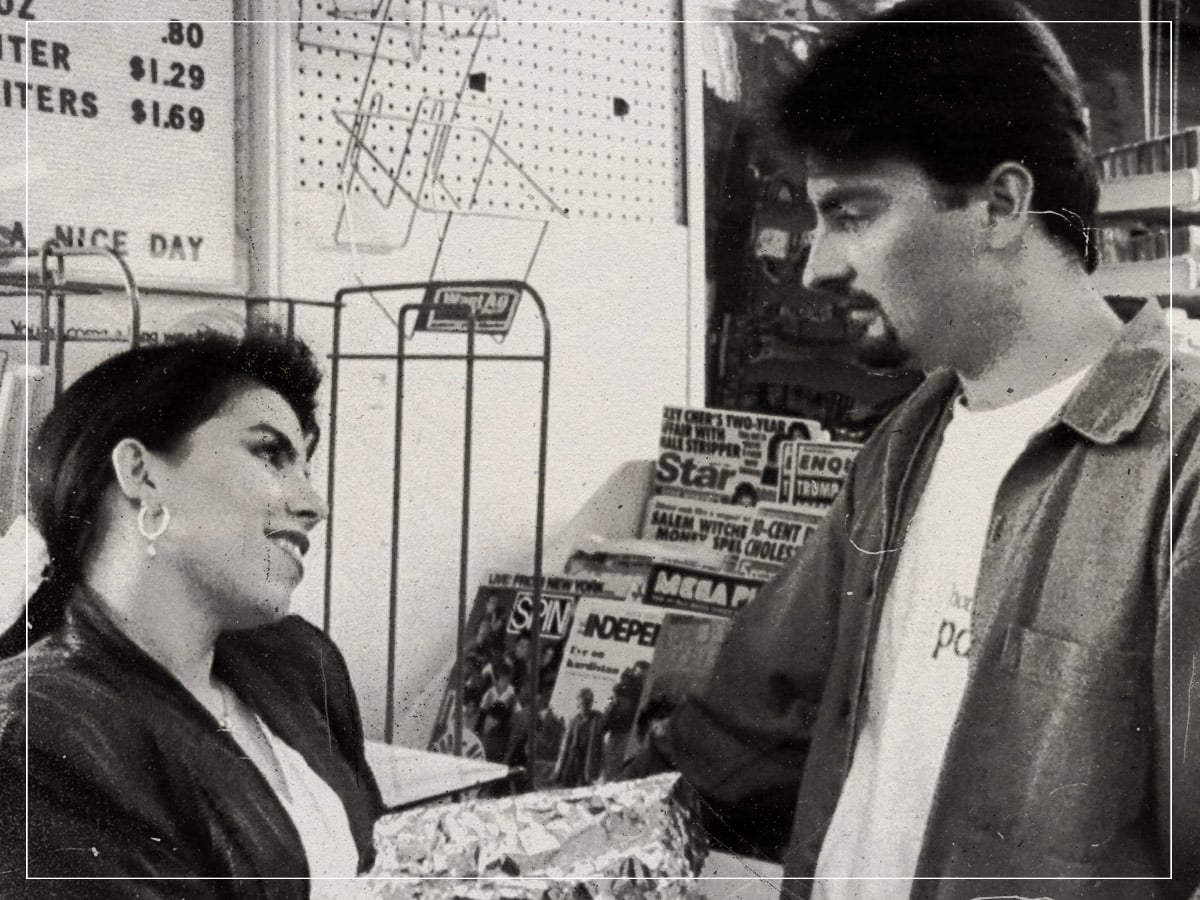
For some ungodly reason, Kevin Smith initially chose to end Clerks in a very, very different manner than what ended up in the final cut. In the alternate ending, Dante Hicks, the convenience store employee with whom the audience built a relationship throughout the low-budget movie, has seemingly finished his work day. Then, out of nowhere, an armed robber appears, shoots him in the chest, and steals a bunch of money from the cash register. The film ends with the camera looking at Dante’s lifeless body, bleeding out on the floor.
Disregarding the fact that, had Smith stuck to this ending, he’d have never been able to make two more Clerks movies and an animated series, the idea that he felt this was an appropriate ending to his amiable, quotable, dingy tale of 20-something ennui is bizarre. Even Brian O’Halloran, who played Dante, admitted, “I hated that ending. I just thought it was too quick of a twist.”
Smith’s defence has always been that he was young and inexperienced, and simply didn’t know how to end the movie. While racking his brains to figure out what to do, he theorised that a big twist might be the kind of thing that would develop buzz. Thankfully, though, cooler heads prevailed, and he was convinced that killing the guy who spends the whole movie saying, “I’m not even supposed to be here today!” might have been darkly hilarious in another film, but that film most certainly was not Clerks.
The cocoon scene – ‘Alien’ (Ridley Scott, 1979)

In Ridley Scott’s timeless classic Alien, Tom Skerritt’s ship captain Dallas isn’t seen again after having a seemingly fatal encounter with the Xenomorph in the Nostromo’s air ducts. However, one scene that didn’t make it into the final cut featured Sigourney Weaver’s Ripley finding Dallas trapped in a grotesque alien cocoon, begging to be killed. Beside him is Harry Dean Stanton’s Brett, who looks to be in a more advanced stage of cocooning, and is beyond saving. An emotionally horrified Ripley is forced to flamethrower her shipmates to death, to put them out of their misery.
To screenwriter Dan O’Bannon, the scene showed that the alien’s life cycle included transforming human hosts into the large eggs that become home to the terrifying facehuggers. Scott backed this up by saying, “They’re morphing, metamorphosing. They are changing into – being consumed, I guess – by whatever the alien’s organism is into an egg.” This is a truly frightening and disgusting fate for a human being, and another spectacular body horror aspect of Alien.
In the end, Scott decided to remove the scene because he didn’t feel the special effects looked real enough, and it also slowed down the breakneck pace of Ripley’s climactic escape from the ship. It turned out to be a blessing in disguise for the franchise, though, because if it had stayed in the movie and established how alien eggs were created, James Cameron wouldn’t have been able to introduce the iconic egg-laying Alien Queen in the sequel, Aliens.
Paul Rudd screams obscenities at a young ginger boy – ‘Bridesmaids’ (Paul Feig, 2011)

For some people, the heavily improvised nature of Judd Apatow comedies like Knocked Up and The 40-Year-Old Virgin is one of their biggest selling points. For others, seeing famous actors riffing and saying nonsensical things they make up on the spot is a unique form of torture. If you dig that style, though, then Paul Feig’s Bridesmaids – produced by Apatow – is a treasure trove of truly hilarious nonsense which features a doozy of an infamous deleted scene.
At one point in the original conception of the movie, Kristen Wiig’s hapless Annie goes on an ice-skating blind date with a man who seems too good to be true. This man is played by the ageless Paul Rudd, an actor so intensely likeable that it’s impossible not to smile when you see his face. However, Rudd’s niceness soon turns into malevolence when a ginger child runs over his finger, and he absolutely flips out on the poor lad, screaming F-bombs at him and demanding an apology. He is then punched right in the face by the boy’s dad, hitting the ice like a sack of potatoes.
According to Feig, the scene was “one of the funniest things I’ve ever been a witness to,” and he shot a huge number of takes, with Rudd saying increasingly foul-mouthed and outlandish things each time. However, when it came down to it, the movie was already running long even without Rudd’s extended cameo, so Feig decided it had to be cut completely. Apatow was forced to deliver the bad news to Rudd, who probably took it all in stride because he’s so darn nice – and, in real life, not at all prone to yelling at small children.
