


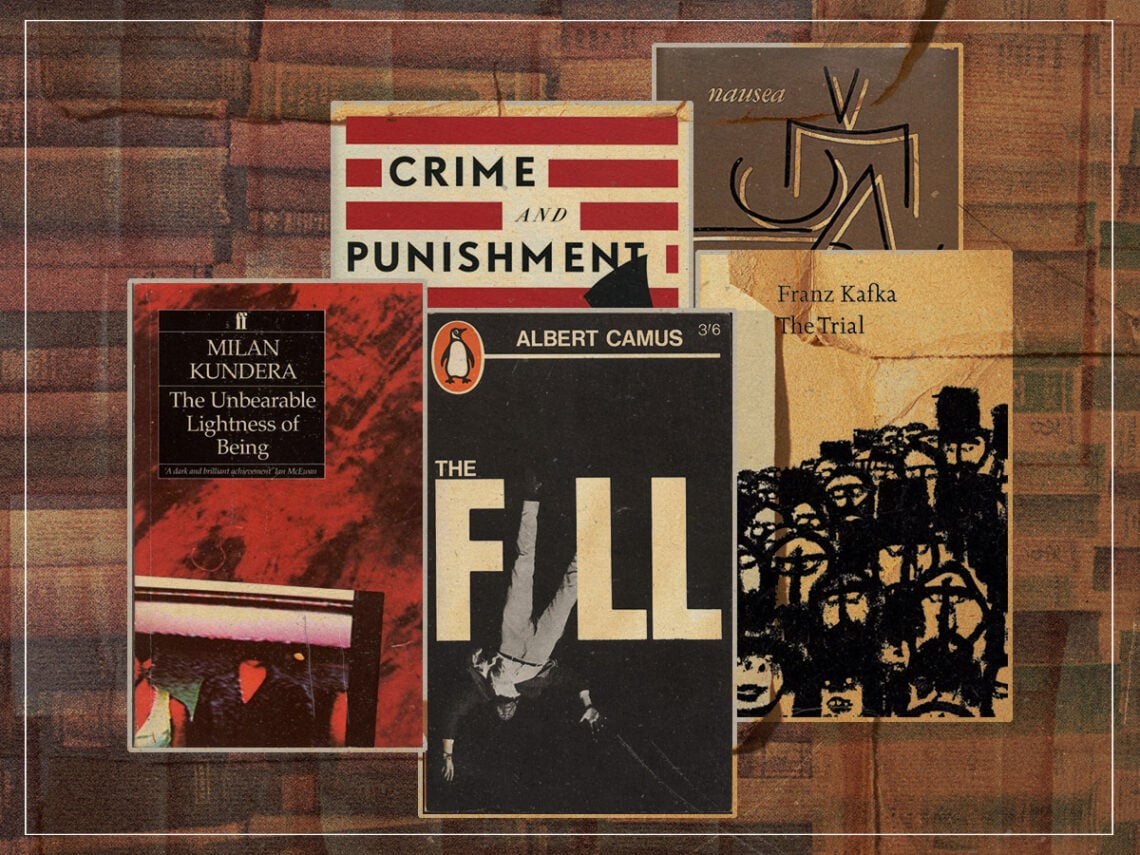
Five masterpieces of existentialist fiction you need to read before you die

In the ancient and endlessly diverse and convoluted world of literature, we encounter several core genres, many of which have proliferated impressively over the past two centuries. People read and write for different reasons: William Shakespeare pursued a passion for drama; theologians study religious texts for salvation and guidance; and philosophers seek answers to the fundamental questions of humankind, usually encompassing morality, knowledge, aesthetics and existentialism.
Today, we are diving into existentialist fiction. Authors of such tales usually place protagonists in unsavoury dilemmas to explore their philosophies regarding human existence and the meaning or, indeed, meaninglessness of life. Such ponderings date back to the cognitive revolution and permeate literature dating back to ancient times.
However, the intellectual movement reached a zenith in the mid-20th century, with Gabriel Marcel coining the term l’existentialisme, which was first applied to the work of French philosopher Jean-Paul Sartre. Albert Camus, with a sequence of philosophical novels throughout the 1940s and ’50s, helped to consolidate France’s status as the existentialist capital of the world.
Strictly speaking, Camus was a party to the absurdist arm of existentialism. This philosophy accounts for the “meaninglessness” I mentioned earlier, wherein Camus believed that we are here by chance and that life is a pointless symptom of universal chaos. “You will never be happy if you continue to search for what happiness consists of,” Camus famously wrote in one of his early texts, titled Intuitions. Adding, “You will never live if you are looking for the meaning of life.”
If Camus is correct, we have nothing to do but try to live in the moment and create our own moral codes. Why not live in the moment in the company of some of our finest existentialist philosophers? Below, we list five essential masterpieces of existentialist fiction.
Five essential masterpieces of existentialist fiction:
Crime and Punishment – Fyodor Dostoyevsky (1866)
The great Russian author Fyodor Dostoyevsky is not commonly bundled in with the existentialists. However, as a prime luminary for leading proponents of the category’s zenith in the mid-20th century, including Sartre and Camus, his literary canon certainly encompassed existentialist themes. Much of Dostoyevsky’s work was wantonly studious, delving deep into the human psyche, hence Sigmund Freud’s famous obsessions.
I could have chosen several entrants to Dostoyevsky’s oeuvre for this list, from the character development tour-de-force The Idiot to the confessional novella Notes from Underground. I finally landed on 1866’s Crime and Punishment for its consummate study of the imperfect human condition through Rodion Raskolnikov in an eternally engaging and ultimately satisfying narrative arc.
The Trial – Franz Kafka (1925)
It seems fitting that Franz Kafka’s enduring masterpiece, The Trial, should follow Crime and Punishment, given the monumental influence Dostoyevsky and that novel in particular had on the Austro-Hungarian author. Like Kafka’s other two novels, The Castle and Amerika, The Trial was never completed, but Kafka penned an abrupt yet satisfying conclusion to the story before his death, aged 40, in 1924.
Kafka’s friend Max Brod published The Trial a year later, and the book went on to become a crowning posthumous masterpiece. Like The Outsider and Crime and Punishment, The Trial uses a legal case to examine his existential philosophies under the sobering light of oppression, guilt and bureaucracy.
Nausea – Jean-Paul Sartre (1938)
Jean-Paul Sartre is perhaps best known for his non-fiction existentialist study Being and Nothingness, but the second port of call for most readers is Nausea. This brief, uncompromising masterpiece delves into the dark abyss latent in every human being, using the unstable vector Antoine Roquentin. In this melancholic tale, Sartre examines his existentialist ideas in a feverish paroxysm of anxiety and social isolation.
To exhibit his ideas, Sartre sets Roquentin in the fictional town of Bouville, where he falls into a spiral of manic rumination. His spiralling state of disillusionment with the outside world funnels him increasingly into a state of existential revulsion, or “nausea”. This intense feeling grips Roquentin whenever the line between living and inanimate blur objects beyond recognition. “A pale reflection of myself wavers in my consciousness…and suddenly the ‘I’ pales, pales, and fades out,” reads an extract from the book.
The Fall – Albert Camus (1956)
This list could have contained several novels by the great French philosopher Albert Camus. But in the name of variety, I have limited myself to just one. As an introduction to Camus’s portfolio, readers are usually directed to The Fall or The Outsider. It is undoubtedly a tough decision, and while I implore you to read both, the former was, for me, the more compelling work.
While The Outsider demolishes the human construct of morality, The Fall is a secular reflection of the fall of man from the Garden of Eden. The short, innovative novel consists of a series of monologues uttered by the self-proclaimed “judge-penitent” Jean-Baptiste Clamence as he unfurls his life story to a stranger in Amsterdam. Once, he was a reputable Parisian denounce lawyer, but a moment of crisis triggers a dramatic “fall” from grace.
In a famous passage, Clamence highlights the Dantean significance of the Netherlands’ capital: “Have you noticed that Amsterdam’s concentric canals resemble the circles of hell? The middle-class hell, of course, peopled with bad dreams. When one comes from the outside, as one gradually goes through those circles, life — and hence its crimes — becomes denser, darker. Here, we are in the last circle.”
The Unbearable Lightness of Being – Milan Kundera (1984)
This seminal and relatively modern work of existentialist fiction explores the complexities of human existence and the concept of eternal recurrence. Set against the backdrop of Czechoslovakia during the Prague Spring of 1968, the novel follows the interconnected lives of Tomas, Tereza, and Sabina as they navigate love, politics, and personal identity.
Through Milan Kundera’s incisive philosophical musings and compelling narrative, the novel delves into themes of freedom, responsibility, and the search for meaning in a world devoid of inherent purpose. The 1988 film adaptation starring Daniel Day-Lewis is worth a watch, but it’s best to enjoy the book first.
