


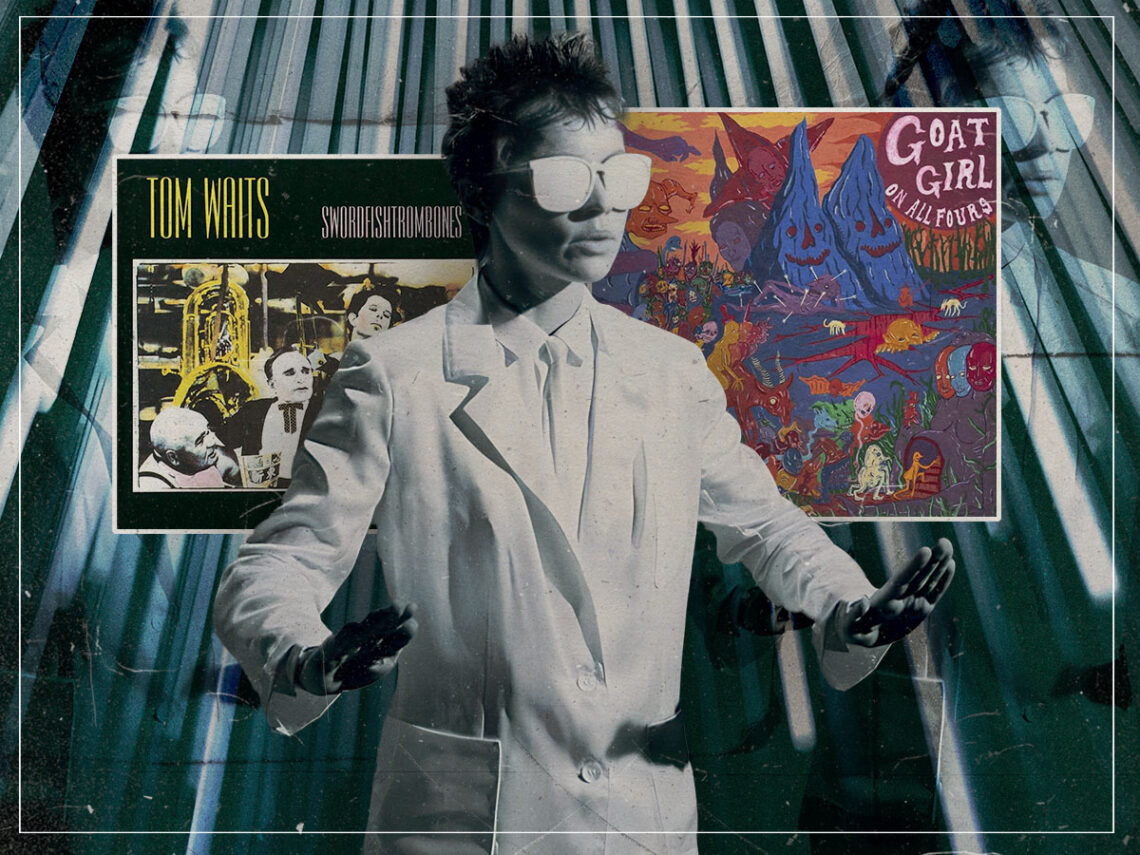
Five Easy Masterpieces: introductory albums to the weird world of the avant-garde

All the best things in life are an acquired taste. Beer, olives, The Office, jogging: all these things take a little bit of acclimatising. But they are also the most rewarding. The same can be said of music; the instant hit of pop can’t be denied as a pick me up, but when that gets stale, you want to shake some fresh action with the weirdos in the world of avant-garde.
In truth, it is a very loose term—more of a concept than a genre. However, the origins of the phrase itself help to delineate what music you might be in store for when confronted with this rack in a record store. So where does it come from?
In a military sense, the Vanguard was the leading part of an advancing group of soldiers. However, you didn’t just send the bulk of your army blindly into the unknown; you would send out a few foolhardy scouts in the dead of night to seek out new territories and spy on enemy positions. These brave souls advancing where nobody had gone before were known as the avant-garde.
This French term for a reconnaissance group who gambled into the as yet undetermined might fit the bill for defining the expression as it links to artists breaking the norms and pushing boundaries as a result, but in actual fact, the usage has an even more direct tie to art than that. Given the dangers of being a member of the avant-garde, only the soldiers most committed to social reform would volunteer, and often, these fellows had a bold, eccentric edge, too.
Thus, it only became natural that the trailblazers of social change on the battlefield would soon become linked to art. Often, avant-garde soldiers would return to civility and set up clubs—these clubs had social change at their heart, and the art and entertainment on display would follow suit. These clubs were open and incorporating, melding ideas—this is why avant-garde is less of a genre and more of a concept of free-form creativity with progression in mind.
As the phrase moved away from the art of war and more towards art itself, it was the idea of progressive, boundary-pushing, non-conformity that stood out. This is why bands like The Velvet Underground are truly worthy of the title. But also, because of the fact that it is often devoid of familiar standards, it can be hard to get into. This is why we’ve collated five masterpieces to start with that should help you get out of any musical rut.
Five essential avant-garde albums:
Laurie Anderson – Big Science (1982)
Narrative is a great way to keep people’s attention fixed. This is the tool that Laurie Anderson uses as she grabs you by the hand and leads you through the weird echoing wails of a Lynchian soundscape, stringing you along like a sultry-voiced Pied Piper of strange tales. By pairing the familiar with the frankly unheard, she creates a fascinating world.
Big Science is her debut album, and it is proof that her artistic ideals arrived fully formed. She posits big questions to the world and finds a catchiness and emotive depth as she floats them out into the ether, designed to be enjoyed and marvelled at rather than answered. It’s a record that provides a similar strange joy that playing SIMS once did.
Goat Girl – On All Fours (2021)
Great art endures, and some of the best of that great art changes over time, too. This is a sorry reality that has left many critics red-faced as they focus on immediacy and struggle to see the swell. With On All Fours, the London quartet Goat Girl produced a record that just keeps giving as you fall for it one hundred times over the more it reveals itself to you.
This is an opinion shared by Conor Curley of Fontaines D.C. Recently, when we were discussing our mutual love for the record, he told me: “I love that album On All Fours,” he said of Goat Girl’s 2021 swirling wave of genre-blending brilliance featuring anthemic tunes like ‘Sad Cowboy’. “I listened to it when it came out but since then I’ve got so much more into it. I feel like it’s made sense to me more, I feel like I’ve gotten to the place where I understand it more. It’s amazing, man.” This truth offers a glimpse of the amorphous sound of the record and the depth of sensibility behind it.
Marvin Pontiac – The Legend of Marvin Pontiac (2006)
Marvin Pontiac is not a real man. Although he has a biography, an album, and testimonies from the likes of David Bowie to his name, he is merely a figment of the fevered imagination of John Lurie. He created the outsider musician, filling him with the tropes that we all lap up, the serve as a vehicle for his first singer-songwriter style record.
Only it’s not a singer-songwriter style record at all. Sure, it had vocals, but those vocals tell strange tales about tiny tribes who drive tin cans, and they’re set to a smorgasbord of sounds summoned from all over the world. The result is a masterpiece that beguiles by virtue of just how much brimming creativity is contained within. You can read the story of Marvin himself here.
Tom Waits – Swordfishtrombones (1983)
Ever find yourself in one of those rare snaps when music suddenly seems slightly boring? Those painful few days where there is nothing new under the sun, and you’re strangely irritated by pop sentiments that you’ve loved for years. Tom Waits’ Swordfishtrombones is the antidote to that dull snap. It’s a terror attack on banality—a bewildering journey underground where you can shelter for a while with ‘the other’.
If the lyric “there’s a world going on underground” doesn’t hit you like an assegai of wonder, then the record might not be for you, and you’re not alone – I’m sure Waits would admit that himself – but that doesn’t mean the exploration of Swordfishtrombones is a selfish one from a place of creative boredom. Quite the opposite, it is an album that caringly extends a loving hand and says, ‘I have bravely waded into a world of weirdness, you can now safely join me’. If that come hither sounds like your cup of tea, then welcome to Wonderland.
Exuma – Exuma, The Obeah Man (1970)
Perhaps the best insight into the Bahamian musician known as Exuma comes from a quote of his given in an interview with Record World upon the release of this sing: Exuma said the “‘electrical part’ of his being ‘came from beyond Mars; down to Earth on a lightning bolt’”. He then described his songs as “all music that has ever been written and all music not yet written. It’s feeling, emotion, the sound of man, the sound of day creatures, night creatures and electrical forces.”
In truth, there is indeed something otherworldly and timeless about his output and that is far from limited to the berserk drum sound on tracks like the epic ‘Dambala’, which both harks back to the plains of West Africa and yet also conjures bud. In a nutshell, that is the avant-garde appeal of Exuma, The Obeah Man, it is a genre-less assortment of sounds by a man who isn’t trying to be different; he’s just trying to tap into exultation any way he can.
