


John Lurie: the competent composer who invented the outsider artist ‘Marvin Pontiac’

There is a current fetish afoot for artists saved from the ash heap of history by a fateful reissue. I’m a sucker for them myself. Something about the dogeared tones of a lowly home recording and the humble, often tragic and alluring backstories that go along with them hint at a sincerity, originality, and art-for-the-soul’s sake authenticity that ‘just another band’ can’t seem to muster. Outsider Music is even better for this.
This exposes an interesting paradigm of art in the age of pop culture. Recently, by means of an experiment, a friend pitched a song and their unembellished written profile to a music management company. Not much was made of the music itself bar a complimentary comment; the song had seemingly passed muster, however, there was a call to drum up the working-class element of their history a little more in order to satisfy what was termed as the need for a ‘USP’ (unique selling point).
The phrase that was cited was: “You need to add what somebody hasn’t already got to the pool”. In truth, when framed in a different context, there isn’t anything cynical about that. In fact, never have truer words been spoken. However, it does offer up the presentiment of a problem that millions of artists face from atypical backgrounds: if you’re just another great musician, then good luck to you, but you’ll often find yourself outstripped by an ‘angle’ any day of the week.
And nothing carries more of an interesting angle than Outsider Music, the realm of the folks swimming in an entirely different pool altogether, seemingly untouched by the malevolent mainstream, often bedevilled by the fetishised creative uniqueness of mental illness, and embalmed in a narrative that adds far more depth to the music that any amount of interesting thrift store trousers could imbue upon a simple fairly working-class indie band.
In 1999, John Lurie decided to spear this trend with a glorious parody. The musician, painter, actor, director, and producer’s talents are self-evident merely from the list of roles I have just rattled off. He is a modern renaissance man, but a relatively ordinary one at that—not in terms of talent, but in terms of the fact that he likes simple hoodies, grey slack, sensible haircuts, and he hails from a normal background.
As such, he never felt totally comfortable being the sort of artist who stepped out from the comforts of his Lounge Lizards jazz ensemble and into the spotlight himself. All the same, he had important, expressive things to say, so he created a voice piece that people would listen to. “For a long time, I was threatening to do a vocal record,” he told eMusic. “But the idea of me putting out a record where I sang seemed ostentatious or pretentious. Like the music of Telly Savalas . . . I don’t sing very well, I was shy about it. As a character, it made it easier.”
The character in question would be a constructed outsider artist who parodied our lust for a USP. When the term is laid out in this blunt business-speak, it seems ugly, but when you delve into how Lurie actualised the skew of our appetite for pop culture angles into an orchestrated lie consisting of all the things that fascinate us beyond the art itself, the crux of cultural history is revealed.
His creation was called Marvin Pontiac, and the liner notes revealed his story: “[He] was hit and killed by a bus in June 1977, ending the life of one of the most enigmatic geniuses of modern music. He was born in 1932, the son of an African father from Mali and a white Jewish mother from New Rochelle, New York. The father’s original last name was Toure, but he changed it to Pontiac when the family moved to Detroit, believing it to be a conventional American name.”

They cunningly continue: “Marvin’s father left the family when Marvin was two years old. When his mother was institutionalised in 1936, the father returned and brought the young boy to Bamako, Mali, where Marvin was raised until he was fifteen. The music that he heard there would influence him forever.”
So, now, with a touch of childhood and an exotic influence established, they begin to tap into the doom-laden blues revivalist origins of the whole ‘authentic’ craze. “At fifteen Marvin moved by himself to Chicago where he became versed in playing blues harmonica,” the notes continue. “At the age of seventeen, Marvin was accused by the great Little Walter of copying his harmonica style. This accusation led to a fistfight outside of a small club on Maxwell Street. Losing a fight to the much smaller Little Walter was so humiliating to the young Marvin that he left Chicago and moved to Lubbock, Texas, where he became a plumber’s assistant.”
With the holy grail of an artist giving up on art for a while – implying that the return was purely out of love – established, the lure of mystery enters the narrative. “Not much is known about him for the next three years,” they continue. “There are unsubstantiated rumors that Marvin may have been involved in a bank robbery in 1950. In 1952, he had a minor hit for Acorn Records with the then controversial song “I’m a Doggy.” Oddly enough, unbeknownst to Marvin and his label, he simultaneously had an enormous bootleg success in Nigeria with the beautiful song ‘Pancakes’.”
“His disdain and mistrust of the music business is well documented and he soon fell out with Acorn’s owner, Norman Hector. Although, approached by other labels, Marvin refused to record for anyone unless the owner of the label came to his home in Slidell, La and mowed his lawn,” they added in quirky fashion, showcasing the integrity of his unwavering artistry.
Then, to add some much-needed authority to the tale, the vital ingredient of another cool artist giving credence to Pontiac’s brilliance, to assure us we’re onto the right mentalist, enters the fore. “Reportedly Marvin’s music was the only music that Jackson Pollock would ever listen to while he painted, this respect was not reciprocated,” it comically progresses. “In 1970 Marvin believed that he was abducted by aliens. He felt his mother had had a similar unsettling experience, which had led to her breakdown. He stopped playing music and dedicated all of his time and energy to amicably contacting these creatures who had previously probed his body so brutally.”
Adding: “When he was arrested for riding a bicycle naked down the side streets of Slidell, La, it provided a sad but clear view of Marvin’s coming years. Marvin held the tribal belief that having a photograph taken of yourself could steal your soul, thus these candid shots are the only ones known to exist. In 1971 he moved back to Detroit where he drifted forever and permanently into insanity.”
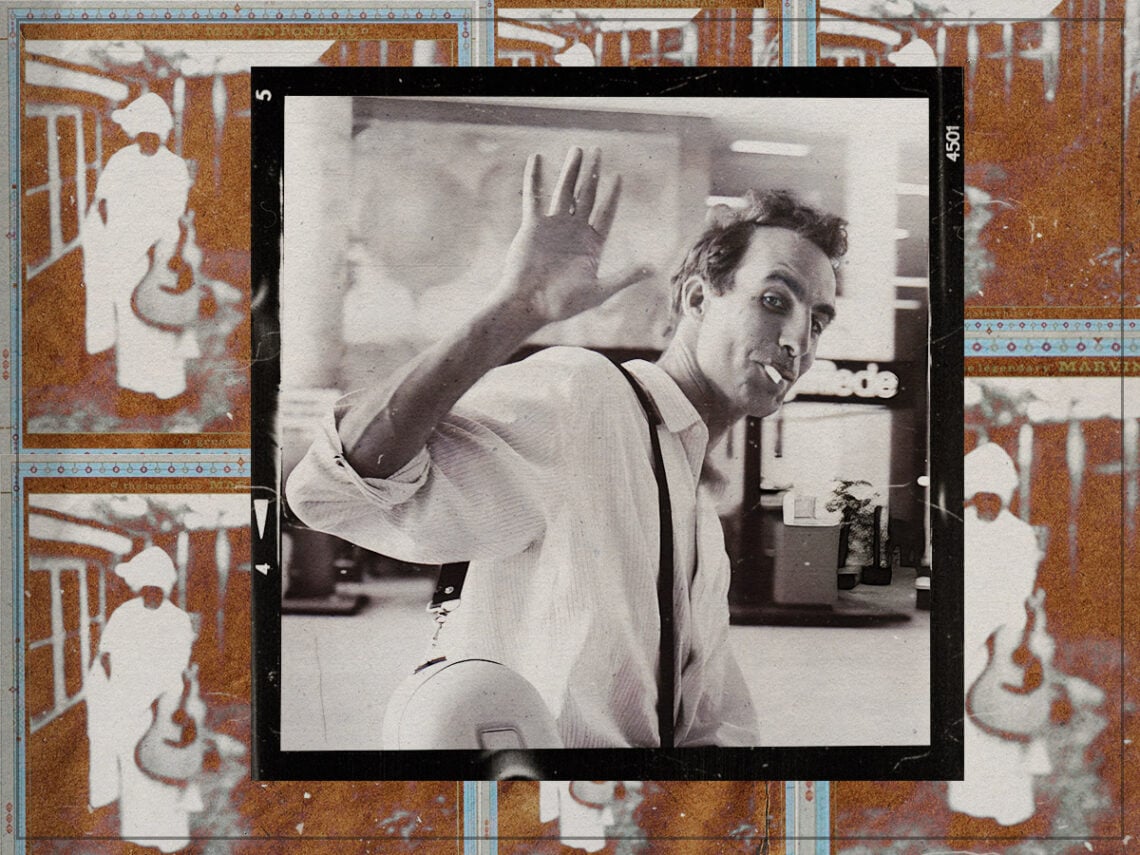
So, a blurry picture adorns the cover of the crazed artist’s surviving work. And Lurie even roped in the esteemed voices of the likes of Iggy Pop and David Bowie to offer the following respective testimonies: “Marvin would kick your ass for nothing. A true genius, Marvin was a pure original” and “A dazzling collection! It strikes me that Pontiac was so uncontainably prescient that one might think that these tracks had been assembled today.”
While the quality of the 2000 record, Greatest Hits, abounds with Lurie’s own considerable skill combined with the greats like Marc Ribot, the irony is that it is the USP of this album that elevates it. Thus, his masterpiece, like the advice afforded to my friend, should be viewed uncynically as interesting social commentary that reveals the hook of empathy or something exemplary rather than a skewering of our warped fetishes and the cons that critics fall for. Abnormality is inherently interesting, perhaps especially when it comes from a place of manufactured artifice.
