


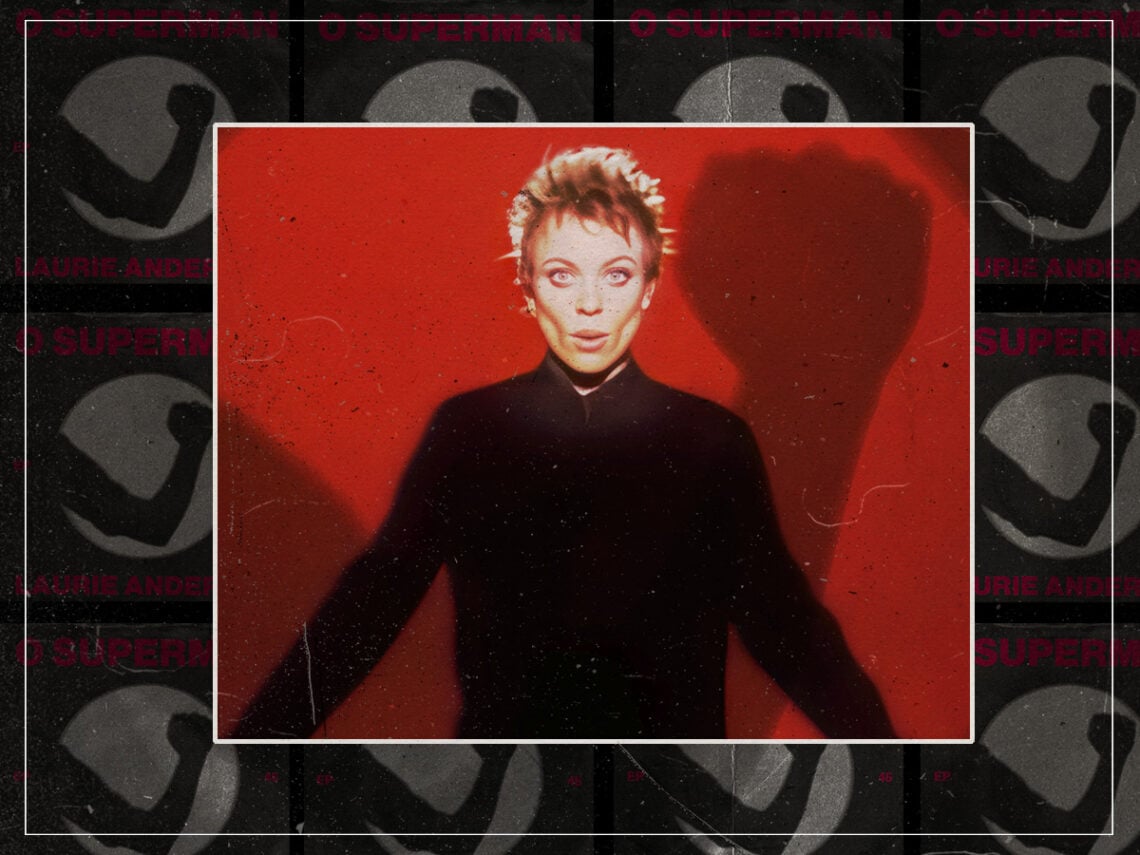
The birth of dissociative music and the death of America: Laurie Anderson’s ‘O Superman’

On September 11th, 2001, the course of American history changed forever when terrorist hijackers crashed two planes into the Twin Towers of the World Trade Center. Precisely 20 years earlier, Laurie Anderson released 1,000 copies of ‘O Superman’, an obscure, eerie song unlike any you’ve ever heard. These are two completely unrelated events, but the song had a scary prescience, containing unintentional but almost undeniable parallels to 9/11. The ‘O Superman’ story is nearly as strange as this coincidence, and just when you think you’ve found the weirdest thing about it, there’s more.
It starts with Anderson’s friend B. George convincing her to record the song in the first place. At this point, she was most well known for her performance art, taking the Duets on Ice piece worldwide – which involved freezing ice skates in a block of ice and playing the violin on top of them until they melted. The pair were both working at the Whitney Museum teaching art, and George soon became co-director of her show, putting one of her tracks on an album his indie label released.
He was desperate for Anderson to also release ‘O Superman’ on the label, which she did after they applied for a $500 National Endowment grant. Recorded in a quiet hallway, it came out in a limited release. Influenced by a four-act French opera and the hollow tone of automated voices, it was a total gem of a track but not destined for radio success in the slightest until John Peel got ahold of it.
George had been writing Volume: The International Discography of the New Wave, which Peel was so impressed with that he invited him on his show to expose British audiences to unheard-of New York tracks. ‘O Superman’ was played and promptly got significant UK airplay from other DJs. George later told The Guardian that before the practical overnight success of the song, he sent it to “major industry players” like Ahmet Ertegun and Richard Blackwell, who all said thanks, but you can keep your weird electronic bloops.
In 1981, it was number two on the UK singles chart. Its success was so pronounced that George got into a taxi in England and was instantly recognised for his voice alone. The song opens with a chorus of “ha, ha, ha’s” looped disorientingly through an Eventide Harmoniser, sounding nothing like a laugh and more like a forlorn robot malfunctioning. The taxi driver dutifully parroted it back to George.
Clashing with the flat, robotic tone is a chorus of birds tweeting. It’s incredible how odd a natural sound can seem removed from its context because, like the feeling you get in your gut when you’ve been up too long and can hear the birds in the morning, it instils an uncanny sense of liminal space. Anderson was so adept at creating that feeling the Body, Space & Technology Journal wrote research on it. They conclude that in the case of her music: “Mediated forms and modes are used to rearrange our sensory systems.”
Some have argued Anderson, specifically with ‘O Superman’, helped pioneer not only art-pop but dissociative music entirely. It’s a catch-all term not only for music that’s great to stare at a wall to but for songs that tackle the complex subject matter with a resigned flatness. ‘O Superman’, which draws from the drama of the 1885 opera Le Cid but delivers it in freakish monotone, delivers in spades on that front. As a complicated narrative unfurls, Anderson backs it only with sparse notes and robotic vocals, explaining she “juxtaposed sinister and mundane imagery”.
That narrative involves a phone call with an anonymous speaker and their mother. “Hello? This is your mother, are you there? / Are you coming home?” rings out. “And I’ve got a message to give to you / Here come the planes / So you better get ready, ready to go.” Where and why, we don’t know, but those are the lyrics some have linked to 9/11. Anderson’s monotone conversation continues: “This is the hand, the hand that takes / Here come the planes / They’re American planes, made in America / Smoking or non-smoking?”
It’s entirely plausible that because 9/11 is so burned into the public consciousness, listeners have made the link where it doesn’t exist. But the uneasy feeling the track is imbued with, combined with references to smoking American planes and the format of the song itself, is uncanny. The heartwrenching voicemails left by victims trapped in the Twin Towers may be clouding objective judgment here too, but there seems a powerful parallel in the panicked: “Are you coming home?”
Anderson herself has explained at length the song was written with the 1979 Iranian hostage crisis in mind. “We were left with dead bodies, a pile of burning debris, and the hostages nowhere to be seen,” she said. “So I thought I’d write a song about all that and the failure of technology.” That said, a week after the 9/11 attacks, she reinstated the song into her set after it had long been retired. The line about the planes had proved, if not prophetic, that her lyrics had persistent relevance.
That’s a trend that’s long continued. This year, some 42 years after the obscure record was released, it became a viral sound on TikTok. It’s being used in videos about, of all things, strange coincidences that verge on the impossible. While the storied journey of ‘O Superman’ and its enduring popularity and strangeness might not speak to the horrors of 9/11, it highlights Anderson’s almost unfathomable talent. She crafted a song practically guaranteed to vanish into the ether and instead made one that existed outside it. It is an unearthly masterpiece that has had an unexpected cultural sway twice now.
