


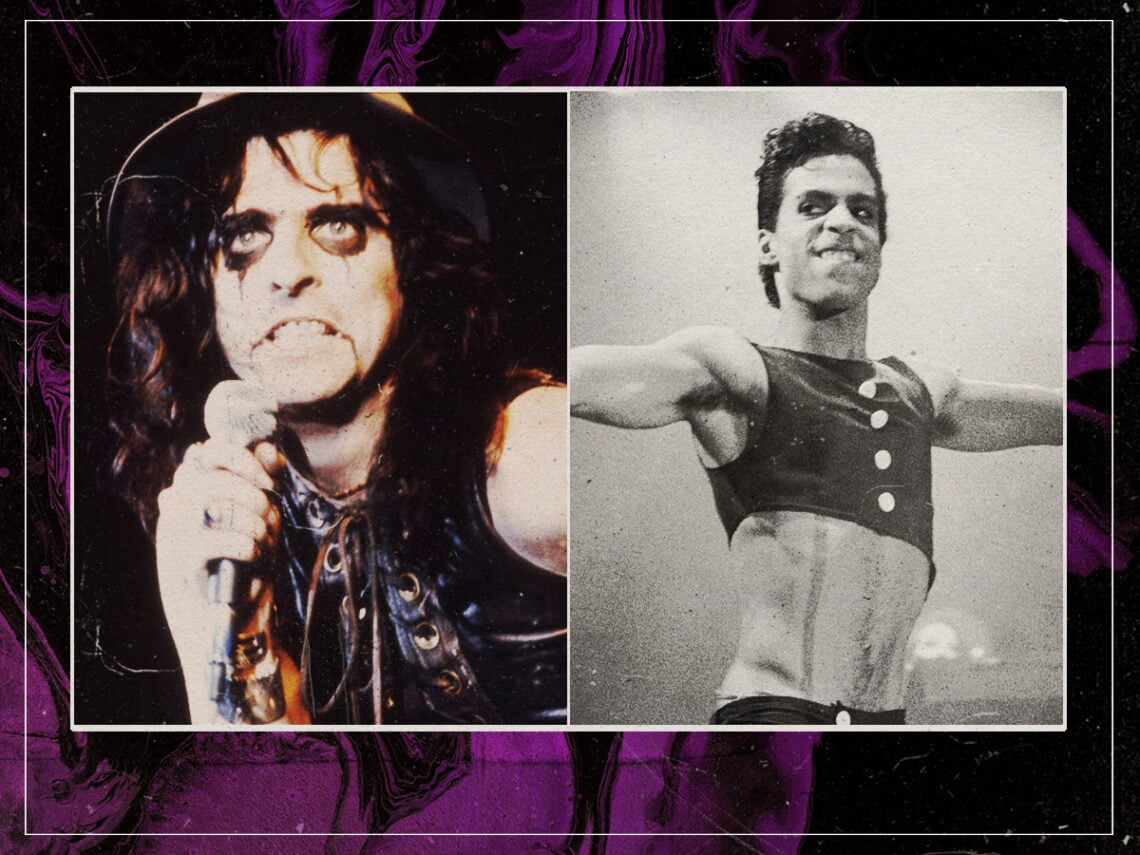
The first time that Alice Cooper witnessed Prince

Throughout his lifetime, Prince seemed almost otherworldly. His music, descending from a heavenly, often sensual realm, felt like a gift from a divine source, with The Purple One serving as the conduit for hits like ‘Purple Rain’ and ‘Kiss’. Yet, despite his singular presence, Prince’s talent still managed to astonish even a shock rocker like Alice Cooper.
Although Prince had his signature moves down to a science, Cooper already knew what the combination of theatrics and music could do as far back as the late 1960s. Being a fan of the harsh side of rock and roll, Cooper’s first shows were known to be surrealist exercises, hitting the hippies like a straight shot of bad acid.
While Cooper hadn’t yet made the guillotine a part of his touring equipment, his performance at The Toronto Peace Festival in 1969 showed him the power of terror in the genre. After accidentally killing a chicken by throwing it out into the audience, Cooper would become known as the ultimate villain of rock and roll, taking the outfit from a weird art-rock act to one of the biggest groups in the country.
By the time Cooper decided to drop his bandmates and go full Phantom of the Opera on the album Welcome to My Nightmare, Prince had already started carving out his place in music history. Playing the same R&B-focused music that he grew up with in Minneapolis, Prince was taking cues from a different kind of shock rocker: James Brown.
Much like Brown did every time he stepped onstage, Prince was known for practically “playing” the band when he performed, serving as the conductor as he tried to get the most out of everyone onstage. Then again, when you play every single note on most of the record, you tend to have more freedom in telling the group how it should go.
As Prince started to gain traction in Minneapolis, Cooper remembered seeing him in New York City and getting a taste of everything he was about. When discussing his stage show, Cooper was shell-shocked by him, saying, “There was no stage, and he was in his underwear. Just his underwear. He was the lead singer in this band. I don’t know where it was, but I remember seeing this little guy in his underwear, and he was kind of half James Brown, and he was kind of half this and that. He was great.”
While most people would pay attention to the sexual tension radiating off of Prince, Cooper appreciated his skills as a musician more. Outside of his amazing music, Prince could work in virtually any genre he pleased, with Cooper applauding him for his guitar hero skills, many of which would equal what his guitar virtuoso Orianti could do.
The eclectic side of Prince would eventually become his calling card in the years to come, making songs that felt like they should belong on three separate albums across one project on tracks like Sign O’ The Times. Whereas Cooper could get fans off their feet through the grotesque visuals he put into his art, Prince is the prime example of how to shock someone just by being jaw-droppingly good on his instrument.
