


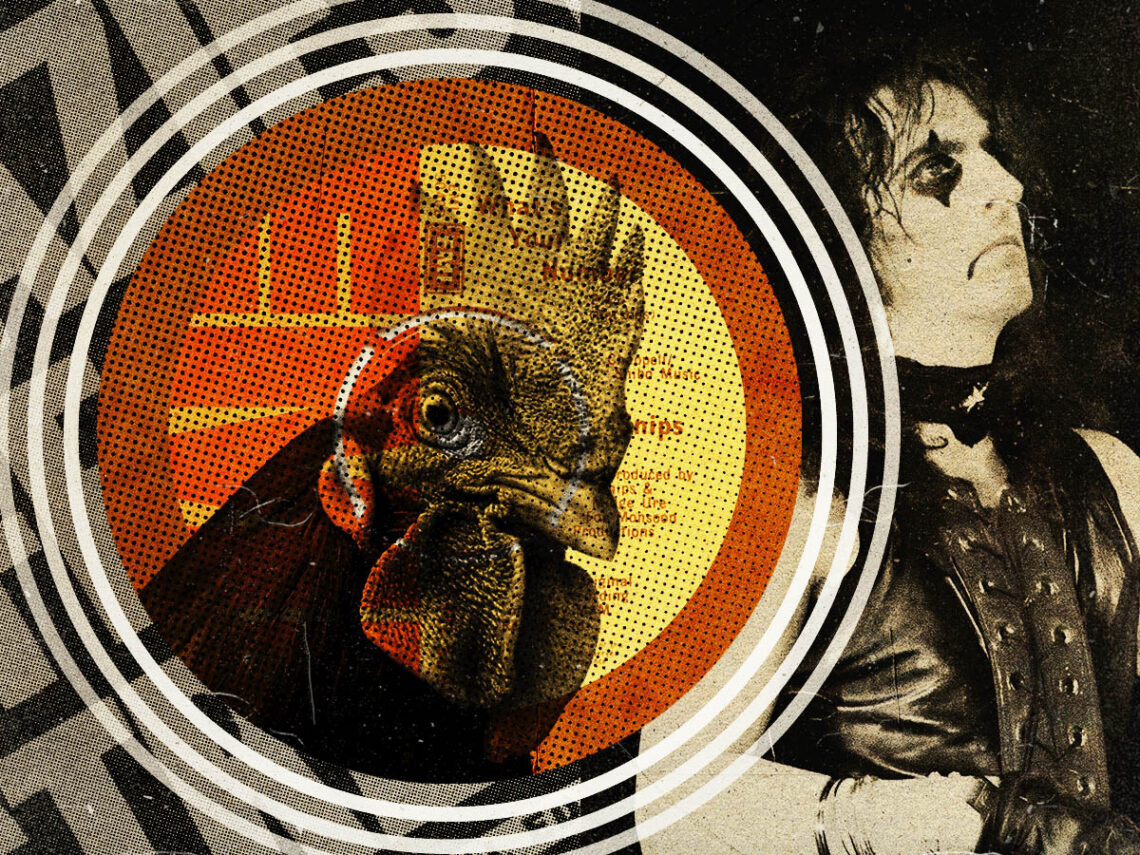
Clucking Madness: In loving memory of the chicken that changed music forever

The 1960s were drawing to a close. The children of the revolution’s children were looking forward to something fresh—something to revitalise the ideals of Woodstock, which were increasingly looking like a futile pipe-dream. On September 13th, 1969, their own chapter would begin, and the world would never be the same again, evolving into a beastly bonanza of wild hedonism and all the good fun that goes along with it. At least, that was the case for the humans of this mortal coil. But for a poor coop of chickens, that tragic day marked the loss of a friend, family member and beloved community presence.
On that fateful day, the fittingly named Toronto Rock and Roll Revival festival was taking place at the Varsity City Stadium. One of the acts taking to the stage that afternoon was Alice Cooper. Only a few months earlier, a gig at Los Angeles’ Venice Club saw them empty the room in ten minutes flat—the hippy crowd were too freaked out by their Salvador Dalí meets the rock ‘n’ roll circus style, with many of them leaving disgruntled, muttering about some search for ‘the real thing’. It was one of the best gigs Alice Cooper had ever played. They gained a single fan.
The lone clapping straggler happened to be Shep Gordon, a music manager who saw the future potential of this singular act. He sent them Frank Zappa’s way, after all, his label was the highest purveyor of weirdness around. Zappa signed them in an instant. It is important to note that what Zappa signed at this juncture was essentially a psychedelic band with an eccentric frontman. It took a flightless tragedy to bring the shock rock element to the fore.
Nevertheless, thanks to Zappa’s management, Alice Cooper were suddenly set to play in front of the 25,000-strong crowd gathered in sunny Toronto. Meanwhile, Mary Cluckers, a chicken, was heading home. Alas, the Varsity City Stadium was famously open in those days and as Mary ventured along, she spied within its hallowed arena a feathery friend by the stage. So, like many ill-fated chickens before her, Mary sadly crossed the road. She slipped through the gates, and she casually ambled across the delta of wires backstage towards her pal.
Sadly, as Mary had become accustomed in a world without Junglefowl Optometry, the white plumage she had spied was not, in fact, her friend but rather a feathery pillow-based prop that Alice Cooper used during their show. At this stage, all would have been well for the short-sighted Mary Cluckers if this was merely a case of mistaken identity, but in Hitchcockian fashion, it just so happened that Vincent Damon Furnier, the dastardly man behind the Alice Cooper make-up, was about to use that cluster of feathers in an act of neo-rock revelry.
As Furnier crossed the stage mid-performance to retrieve the pillow prop, he saw a chicken pecking at it. From Mary’s perspective, she had travelled all this way only to be met with a faux-plumed imposter, so she may as well engage in a quick harmless cock joust to make it worth the journey. However, the pumped-up Furnier saw nothing other than an act of free-range sabotage as the efficacy of his vital prop was pecked away at one quill at a time. Thinking on his feet, he quickly swept down towards Mary like a line-back, plucked her up in one fell-swoop and held the modest Mary aloft, much to her eternal shame. But worse was yet to come.
Frightened by this sudden heavy-handed abduction and startled by the spotlight and screaming mass of featherless sapiens, she clucked with the sort of force that one might muster if they were auditioning to replace the Kellogg’s rooster. This, in turn, startled Furnier—a man famous for his lack of animal husbandry knowledge. This farmyard ignorance resulted in an error that christened him the shock rocker of his age: he presumed chickens could fly. The panicked Mary could sense this from the ungodly height that he had lifted her to, but there was little she could do about it now; her fate was as sealed as Col. Sanders’ flock.
As is reported by several witnesses in the crowd that day, an odd sense of acceptance is said to have washed over her in this moment—a consigned peace usually only observed by air traffic controllers as doomed pilots relay their final message. As Mary expected, in the blink of a chick’s eye, she was careening towards the crowd. Furnier hurled the winged beast into the audience expecting it to soar to safety, only to see it tumble headfirst towards a group of wheelchair users stationed in a designated area by the front.
Mary tried her best to steer away from this immobile section but her feeble wings only succeeded in displacing the same volume of air as an asthmatic mouse’s shallow sigh. Try as they might – which is actually very rarely – chickens simply cannot fly. The fans that Mary collided with were incensed. Enraged by this farmyard intruder, in what can only be diagnosed as a rock-induced hysteria, they literally tore the poor bastard apart—ripping into her flanks like a drunk returning home on a Sunday evening to devour what was left of the roast’s carcass. Furnier and his band looked on appalled, gobsmacked by both the shocking reality that chickens can’t fly and the primordial behaviour of their differently-abled fans.
The next day, a headline claimed that Furnier, a firm friend of the avians, had, in fact, bitten the chicken’s head clean off himself. Zappa gave him one piece of advice on the matter: “Whatever you do, don’t tell anyone you didn’t do it.” Now, two things happened that day: once again in the inadvertent life of poor old altar boy Vincent Damon Furnier, he found himself thrust towards an ill-begotten musical fate that he had not fully intended upon when he set out to become a friendly, fun rockstar; and Mary was in the headlines for the second time in her life – or now lack thereof – for all the wrong reasons.
So, as the auspicious Toronto Rock and Roll Revival festival decreed, Furnier was now the proverbial shock rocker. The band relished the publicity that came with this clucking carnage and audiences flocked to their shows as a result, heralding a new age of performative pop culture which the world is still very much in the midst of.
But as Alice Cooper celebrated, and a selection of fans considered their actions as they washed entrails from their forearms in festival toilets while the world around them revolved onto a new page, Bob Cluckers, a cock, mourned the loss of his daughter. He had prepared a fine trough of grain for her that evening that went uneaten. A search party was organised within the coop, but the worst was confirmed when they saw Mary’s remains smeared across the back pages of the Toronto Star under a salacious headline that gave little mind to Mary’s plight and only the most fleeting reference to her charity work.
The next morning, Bob sidled away from the fellow mourners and made his way over to an area of the chicken wire fence where a fox sometimes sticks its muzzle through, and he clucked and clucked as loud as he could until his wattle swelled up.
So, next time you think about what the world gained that day through the pantomime of modern pop culture, spare a thought for the cost at which this thrilling pageantry came. Because without Mary, it seems to me that we wouldn’t now be witnessing former politicians chow down raw kangaroo spam javelins on a family television show in order to remain captive in some permanently surveilled jungle as a form of PR repentance, and for better or for worse, that is now a reality that we cannot fly away from.
