


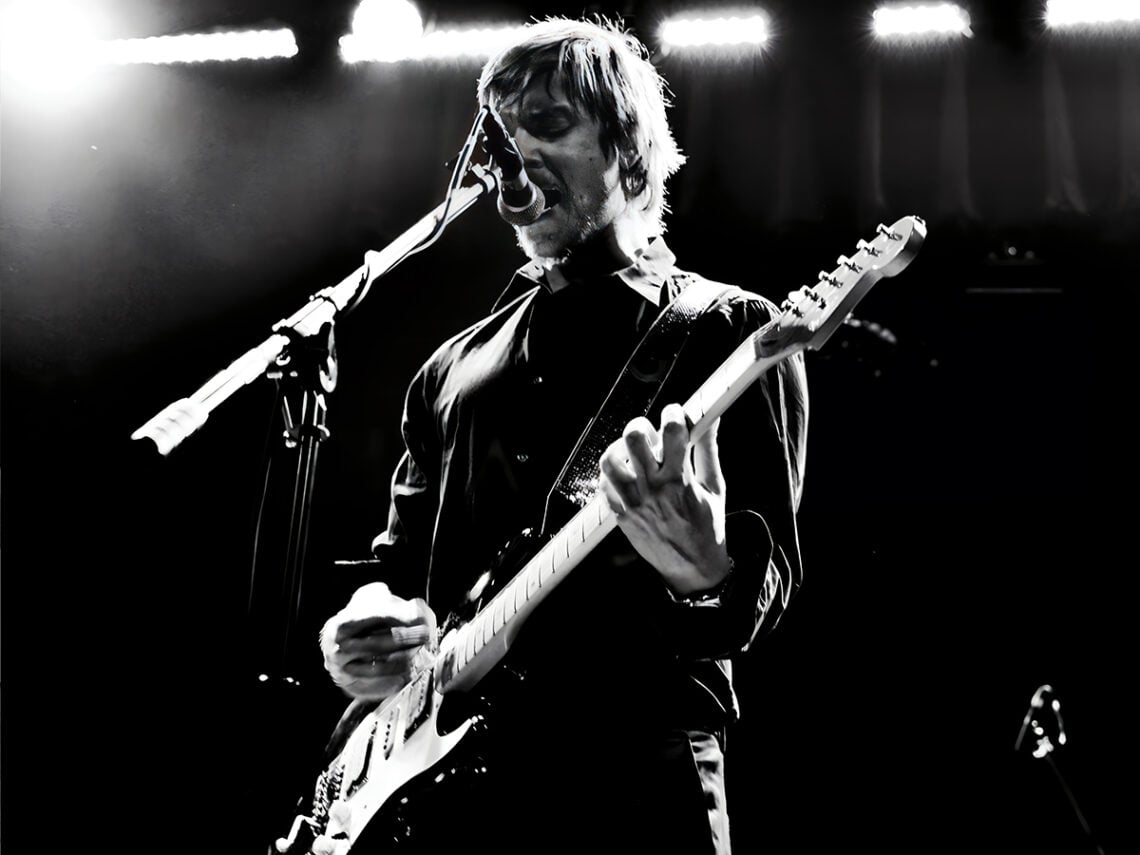
Interpol’s Paul Banks on the first CD he ever bought: “I had to have it”

Nirvana is usually credited with drawing the figurative line in the sand between the introspective alt-rock of the 1990s and the pointless debauchery and self-indulgence of 1980s hair metal. It’s a narrative that looks pretty accurate from an overhead satellite image, but zooming down to street level, the evolution is, of course, much more nuanced. Even setting aside what was going on in punk and indie rock, the late ‘80s had already seen some new attitudes emerging within the so-called “hair” genre itself, as an audience of CD-buying, middle-class white kids were being challenged to think about things beyond glitz and girls.
One of those kids, back in 1988, was a ten-year-old Paul Banks, future frontman of the New York post-post-punk outfit Interpol. Living at the time in the upscale Detroit suburb of Bloomfield Hills, Michigan, Paul was drawn to the flashier excesses of late ‘80s American pop culture: ”My brother and I were really into the WWF (World Wrestling Federation),” he recalled to Pitchfork in 2018. In that same discussion, Banks remembers the first CD he ever purchased, which featured a hit song that matched the contemporary riffage of a Van Halen or Mötley Crüe but with a very different message and visual presentation.
“[It was] Living Colour’s Vivid,” Banks said, referring to the debut 1988 album from the New York quartet led by guitarist Vernon Reid and singer Corey Glover. “I had to have it. I’ll listen to that record today and get into that shit.”
Living Colour was unique on sight alone in the late ‘80s. Yes, they were a hard rock band dressed in bright spandex—nothing new there—but all four members of the band were African-American at a time when white artists almost entirely dominated the rock charts. Living Colour was also among the first acts to bridge the rock and hip hop divide, welcoming guests like Public Enemy’s Chuck D and Flavor Flav on Vivid, a record that eventually went double platinum in the US.
Glover’s lyrics, importantly, were inspired by rap’s street-wise social commentary, as well, rather than glam metal’s snotty posturing. The best example of this was the opening track of Vivid and Living Colour’s first and biggest hit, ‘Cult of Personality’. While the song is, first and foremost, a showcase for Reid’s incredible guitar work (half Hendrix, half proto-Tom Morello), the subject matter has only become increasingly relevant in the three decades since the single’s release.
“I sell the things you need to be
I’m the smiling face on your TV
Oh, I’m the cult of personality
I exploit you, still you love me
I tell you one and one makes three
Oh, I’m the cult of personality“.
Of course, at just ten years of age, Paul Banks wasn’t necessarily picking up on the warnings about two-faced political demagogues. He was just vibing on the sensory overload.
“‘Cult of Personality’ had a great video,” Banks recalled. “I can picture the Spandex, and the bass player had pretty cool dreads, too”. Of course, bassist Muzz Skillings didn’t have dreads at all; Banks is probably just thinking of Corey Glover’s hair in the video’s headbanging moments.
“The riffs were sick, and the vocal harmonies are dope as fuck. And when the song ends with that JFK sample, I felt like it elevated things and gave it this weird dimension of grandeur,” he added. “Reappropriating things in a new context is interesting to me—like in Lost Highway, when David Lynch cut back and forth between VHS. There’s something about watching a degraded format within a format that becomes this meta thing that resonates with me. If Interpol ever goes edgy, I’ll be the guy cheering on that sound.”
Coincidentally, ‘Cult of Personality’ would later become associated with another of Paul Banks’ childhood passions. Since 2011, it’s been the entrance music for one of pro wrestling’s biggest stars, CM Punk.
