


Who were the first band to perform after the fall of the Berlin Wall?

The fall of the Berlin Wall signified, in many ways, the beginning of modern society as we know it. As the resounding crash of those bricks hit the ground on November 9th, 1989, a new era of civilisation had dawned, in which archaic hatreds became a thing of the past and Germany, as well as the world, could look forward to the future in unity. For a rare moment, there was hope – and, of course, music.
Of course, the symbolism of the wall itself had become its own artistic muse over the years, from David Bowie’s ‘Heroes’ to ‘Holidays in the Sun’ by the Sex Pistols. But naturally, the crumbling of the monument came with its own significance, and though many famous bands get recognised for taking part in the celebrations with their own prescient sonic efforts, there was one lesser-known group that gained far more of an important crown in the context of this event.
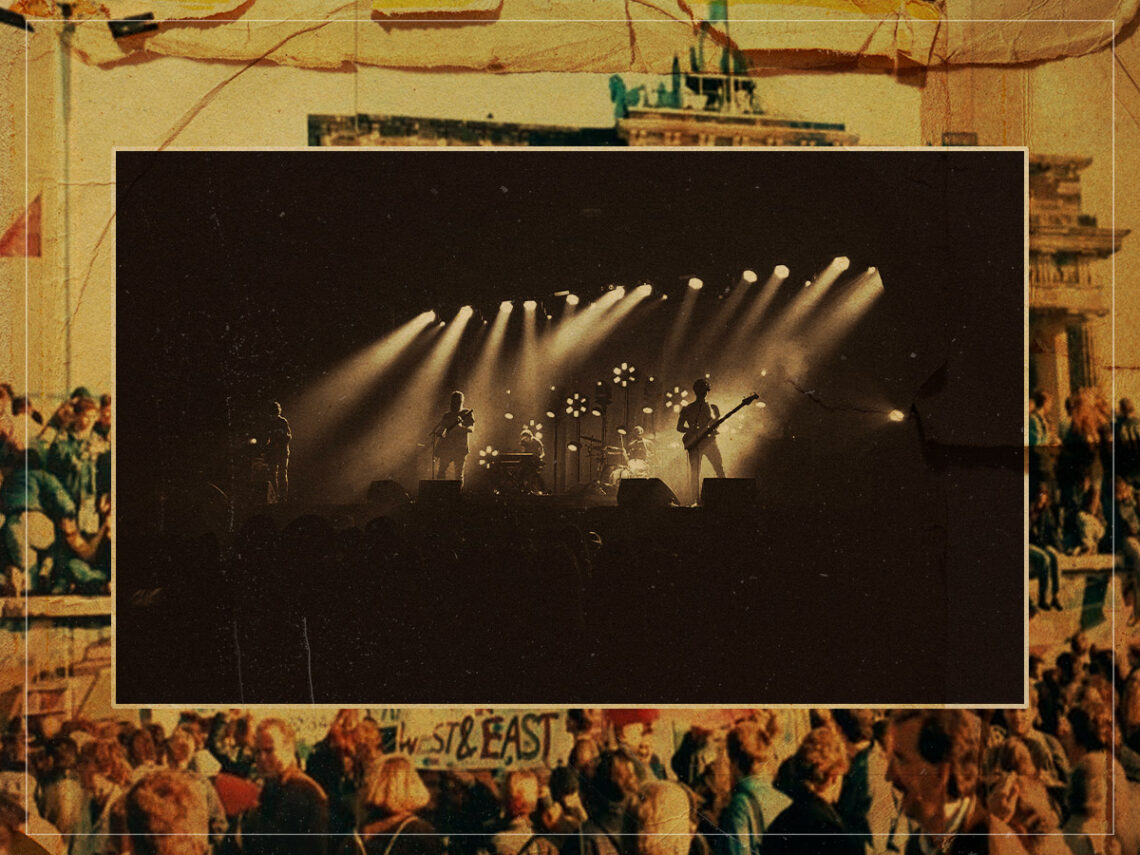
It was a post-punk outfit from Teeside by the name of Shrug who basked in the honour of being the first band to play in Germany after the fall of the Berlin Wall – indeed, somehow only hours after it came down. There’s not much known about the outfit today; they were just another in the slew of ‘80s rock groups who managed some moderate success in Europe, but in their midst, they wrangled their way into the history books.
Becoming the first Western band to pass freely through Checkpoint Charlie and into the then-East Germany from the West, the gig Shrug went on to stage that night, in some long-forgotten bar in East Berlin, holds its own huge place in the canon of rock music, even though the band members themselves may have faded into relative sonic obscurity.
How did Shrug come to perform first after the Berlin Wall fell?
Indeed, in 2014, a local outlet called Teeside Tunes managed to track down Shrug in order to hear the story from the horse’s mouth and find out exactly what they were doing in Berlin in the first place. As it turns out, making history as the musical counterpart to the political event of the decade was never the intention – just a sliding doors moment, and the realisation that they had to seize the golden opportunity in front of them.
Shrug’s singer Robert Nichols explained: “We went to the checkpoint and we trying to get through without a visa. People were going through already but you had to be back before a certain curfew. But no one had gone through, as far as we were aware, to play a gig. We went, showed our passports and actually got through and we went and played the gig in East Berlin.”
But what did they actually make of their performance when they got there? “We played the gig for near enough two hours, because in Germany you’re expected to play for hours,” said Nichols. “So by the time we were done it was past midnight we had just missed the curfew but they let us out.”
And with that, history was set – even though Shrug perhaps didn’t quite grasp the gravitas at the time. Many acts performed around Berlin and Germany in the weeks that followed, from Crosby, Stills, and Nash to David Hasselhoff and Leonard Bernstein. But none of them were Shrug, the small Teeside punk band who unknowingly marked a piece of musical history.
