


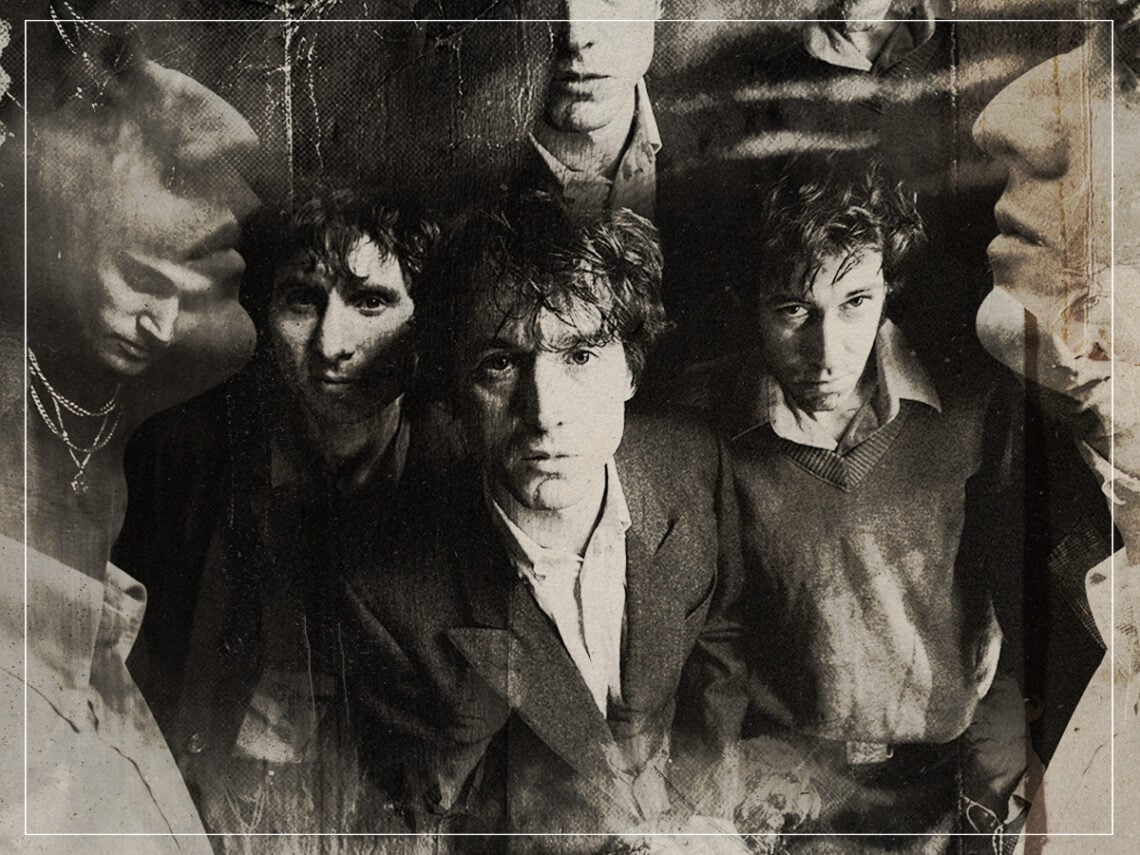
Fat White Family: Drug-fuelled encounters, uncertain futures, and new music with Lias Saoudi

If you scrape the clotted remnants of gear from a troubled fingernail and flick it, grinningly, into an apocalyptic dystopia, it shouldn’t land too far from the territory Fat White Family chartered with their 2013 debut album, Champagne Holocaust. In a 21st-century echo of The Velvet Underground’s dark psychedelia, band leader Lias Saoudi established an anarchic playground of salacious meddling and medicine-mixing apt for a menagerie of south London hedonists navigating their 20s.
Fast forward just over a decade, and Saoudi sits opposite me, cheeky grin intact. We are hip-deep in the digital age, so, naturally, we face one another through a pair of screens, his in Brixton and mine in Brighton, with one sun glaring off two rain-spotted windows. The focus of our conversation is, of course, the imminent album Forgiveness Is Yours. The long-awaited release continues on the trajectory of refinement configured deftly in 2019’s Serfs Up! but retains the gritty nuances crucial to the Family’s DNA.
Like his spiritual progenitor, Iggy Pop, Saoudi is a deceptively erudite and well-mannered individual. The last of a dying breed of mould-breaking, fearless frontmen, the 38-year-old’s maturity is mirrored by the band’s sonic stability in recent years. The sultry synths in ‘Bullet of Dignity’ will have the feet stomping at Glastonbury, but Saoudi keeps it real in the lyrics. Clearly, maturity travels on a different plane in “cannibal years”.
Forgiveness Is Yours is Fat White Family’s fourth studio album and first in five long years. The band remained mostly dormant during this period, spectating ominous viruses and overseas bloodshed, but reared heads to leave a lasting impression on Liam Gallagher fans at Knebworth and appear on John Cale’s immaculate 2023 album, Mercy.
As we squared off the small talk, I reminded Saoudi of his band’s contributions to the Velvet Underground co-founder’s song ‘The Legal Status of Ice’. “I love that record, but it took a year for me to fully appreciate it,” Saoudi reflected before remembering the tumultuous session from which it spawned. While recording, Saoudi’s brother, Nathan, “stormed out” in a cocaine-addled “tantrum” because “he thought John’s guitarist was starting on him”.
Saoudi, in the control room with Cale, looked on anxiously as his brother squared up to Cale’s guitarist, leaving the room after a bloodshot, expletive-laden exchange. “I’m sitting there next to John Cale thinking, ‘Man, this is fucking bad!’” he recalled. Thankfully, Cale, who has seen it all at his age, diffused the situation. “Too much sugar,” Saoudi quoted Cale, laughing through a deep Welsh drawl.

Drugs, for better or worse, are an integral component of rock ‘n’ roll’s chequered history. Intensely aware that I wasn’t speaking to Chris Martin, I expected Fat White Family’s well-documented hijinks and addiction struggles to form the core of our conversation, and I wasn’t disappointed.
After highlighting ‘Today You Become Man’, the unflinching tale of his older brother Tamlan’s traumatic circumcision, as one of my personal favourites from the new album, I probed at another highlight: ‘John Lennon’. The song patently regards one of Saoudi’s musical heroes as a pop-cultural touchstone but also references a seismic celebrity encounter.
Saoudi noted that the Beatles had “always been prominent in his mind”, making it a mind-blowing moment when he found himself “hanging out with Sean and Yoko” across the Atlantic. “The Fat Whites were over in New York in the middle of the last decade, and that’s where the song comes from, just when I met Yoko, spangled on K,” Saoudi explained. “She told me that I reminded her of her husband.”
For some reason, I misconstrued this story without that all-important comma. “Yoko Ono on ketamine in her late 80s?!” I quizzed. After a raw of laughter on both screens, Saoudi clarified that it was himself and his bandmates who had the dissociative mindsets at the time. “Yeah, don’t print that,” he giggled apprehensively.
Saoudi concurred with my favourites but offered the comically-titled ‘Polygamy Is Only For The Chief’ as his current album highlight. “Adam Harmer of Warmduscher fame, he’s the main man with the music on that one,” he praised. “That was the first one that was finished on the record. We were swimming around in shadows and cast-offs for ages and then we got that through. I have a real love for that one and it’s the most Fat Whites-ish thing on there.”
Even in cannibal years, a 38-year-old man, I’m afraid to say, is in touching distance of a middle-aged man. Integral as the hard-knock life of south London squats, all-night binges, and heroin flings seem to Fat White Family’s sordid content, we all want the band to complete its trajectory unscathed. Thus, Forgiveness Is Yours has been a mission of moderation for Saoudi.
In the Champagne Holocaust days, the frontman bought beers by the pint, even on a “school night”. These days, he limits himself to a couple of halves on casual pub visits. “I’m a bit of a loner, really,” Saoudi revealed. “The thing is, I went out so much and got so into booze and drugs, but now I’ve kind of stumped myself a little bit, where if I go out and I’m around people on that level, two pints and I start to think about drugs.”

Like most things in life, and, indeed, life itself, drugs wield a double-edged sword. This particular sword is also barbed, causing long-lasting afflictions difficult to shake off. “I’m too imbalanced psychologically to do drugs as often as I used to,” Saoudi reflected on a sombre note. “I just end up getting really, really depressed. I’ve beaten myself around the head with that particular brush so many times now, I’m like, ‘Man, I shouldn’t go out.’”
So, while the Tuesday all-nighters are a thing of the past, Saoudi is not averse to a bender on special occasions. “If it’s a party and you’re kind of celebrating something, it’s kind of OK,” he said. Otherwise, he lets his creativity simmer in relative sobriety, reading Martin Amis books, listening to the Weird Studies podcast and bobbing his head to Pregoblin’s latest album, Pregoblin II. “I think even if I wasn’t a dear friend of Alex Sebley’s, I’d still love that album,” Saoudi lauded. “I think it’s great.”
Fat White Family is undoubtedly one of the most interesting rock ‘n’ roll bands of the post-2010 era. The band’s edgy, post-apocalyptic sound is at once progressive and nostalgic, celebrating social malaise in an off-beat harmony bitterly relevant to these unsteady shores. Accordingly, Saoudi and his pals enjoy a good ol’ masochistic wallow in the filth. After all, there’s more artistic value in a grain of dirt than a fistful of glitter.
Saoudi’s lyrical concepts are predominantly macabre, embracing the brutal realities of human existence with a wry smile. Juxtaposed periodically by danceable rhythms, these musings hold an uncompromising eyeglass to the writer’s psyche. “I think I’m a happy-go-lucky nihilist,” Saoudi admitted, elucidating his ‘Religion for One’ outlook, “but that’s the best you can hope for in this day and age.”
Early on in his career, confronting the abyss and loading up to “oblivion” may have helped Saoudi attain a mindset from which some great ideas manifested, but this isn’t a sustainable exercise. “I still use ketamine to write, I still love magic mushrooms,” he explained, “but all the rest of it – the gak and all the booze and all the shagging around, that doesn’t lead anywhere but oblivion.”
A “glimpse of oblivion” is all Saoudi needs to understand the importance of suffering. “There is some aesthetic value in that, but at some point, you either have to go all the way and just fucking cut your own head off or begin the humiliating retreat back towards civilisation.”
As far as Saoudi is concerned, utopia is an eternal trip to Southeast Asia, but with a little less of the psytrance music. “That’s the reason everybody doesn’t move there,” he laughed. On the popular backpacking region, he mused, “It is basically heaven: the food, the people, how peaceful it is, and the emerald green… everything just glowing.”

Try as one might to find utopia and the perfection it promises, it is unattainable at length. This is a depressing prospect, but the Fat Whites’ music wouldn’t exist in a world of such peace. It would be a never-ending reel of ‘Mr. Blue Sky’ and ‘Here Comes the Sun’. “Pain is what makes you move forward,” Saoudi pointed out on the value of suffering in art. “The human animal is just an accumulation of hundreds and thousands of years of pain and agony. That’s the key civilisational force: pain, violence and torture.”
“You remember an embarrassing comment you made seven years ago, but you don’t remember that witty remark you made a week ago,” he pursued. “Pain is behind every good thing. Behind every bit of calm and harmony in the world are oceans of suffering, pain, darkness, and melancholy. I think happiness writes wipe. I mean, who wants to read books about how chuffed you are with your beautiful wife and kids and money?”
Saoudi conceded that Martin Amis’ Inside Story is an exception to the rule as a “wantonly smug” portrayal of life posed to highlight how writers tend to focus on and compete for abject misery. “I thought it was actually quite refreshing, you know, it’s brilliant,” Saoudi said, “but I don’t really have enough to be smug about. Martin Amis, at the end of his life, I’m sure he did feel pretty smug.”
“Perhaps you’ll have your smug period in the future,” I chimed in.
“Who knows?” he wondered in reply. “It’d be great to get to the smug period… sounds great.”
On the topic of the future, Saoudi and I gritted our teeth to delve into the hot potato that is artificial intelligence. Everywhere you scroll these days, the initialism looms large, but is AI really worth worrying about?
“Everybody’s got a bit het up about it, but I think we already arrived in a cyborg state of play maybe ten, 12 or 20 years ago,” Saoudi pondered. “I think our capacity for original thought, creativity and that kind of stuff is already and noticeably in decline.” He deems the pernicious impacts many of us fear “a complete inevitability,” adding, “We’re basically kind of machines ourselves now. We’ve become so infected with the technique and nature of our technology systems that we reflect the devices we use and make art with an according level of banality.”
Referencing James Lovelock’s classic non-fictional book Gaia: A New Look at Life on Earth, Saoudi appeased our anxieties by noting the biosphere’s incredible ability to evolve and overcome hardship. “In the machine future that is coming, they’ll look back on biological life – or human life – in the same way human life looks back on plant life,” he explained. “I found that vaguely reassuring. It’s going to be completely inconceivable where it goes, but I think within our lifetime the real artists will kind of curate these completely immersive world experiences that we slip into. Not too dissimilar to The Matrix.”
As our conversation wound to a close, I sought a parting nugget of advice for young, aspiring musicians. Avoiding the hackneyed “don’t do drugs” platitude, Saoudi said, “I would advise all young people thinking about taking to the stage to ingest mushrooms before they do so.” It is a delicate chemistry the frontman has perfected over several years. “Mushrooms are great for performance, as long as you don’t do loads – it’s a bit of a white knuckle ride if you do loads.”
In a more serious, conclusive tone, Saoudi offered a parting message to his fans: “Don’t ever allow yourself to take anything too seriously…don’t ever take yourself too seriously.”
Fat White Family’s fourth studio album, Forgiveness Is Yours, will arrive on April 26th. You can pre-order the LP and see all upcoming tour dates on the band’s website here.

Never Miss A Beat
The Far Out New Music Newsletter
All the latest New Music from the independent voice of culture.
Straight to your inbox.