


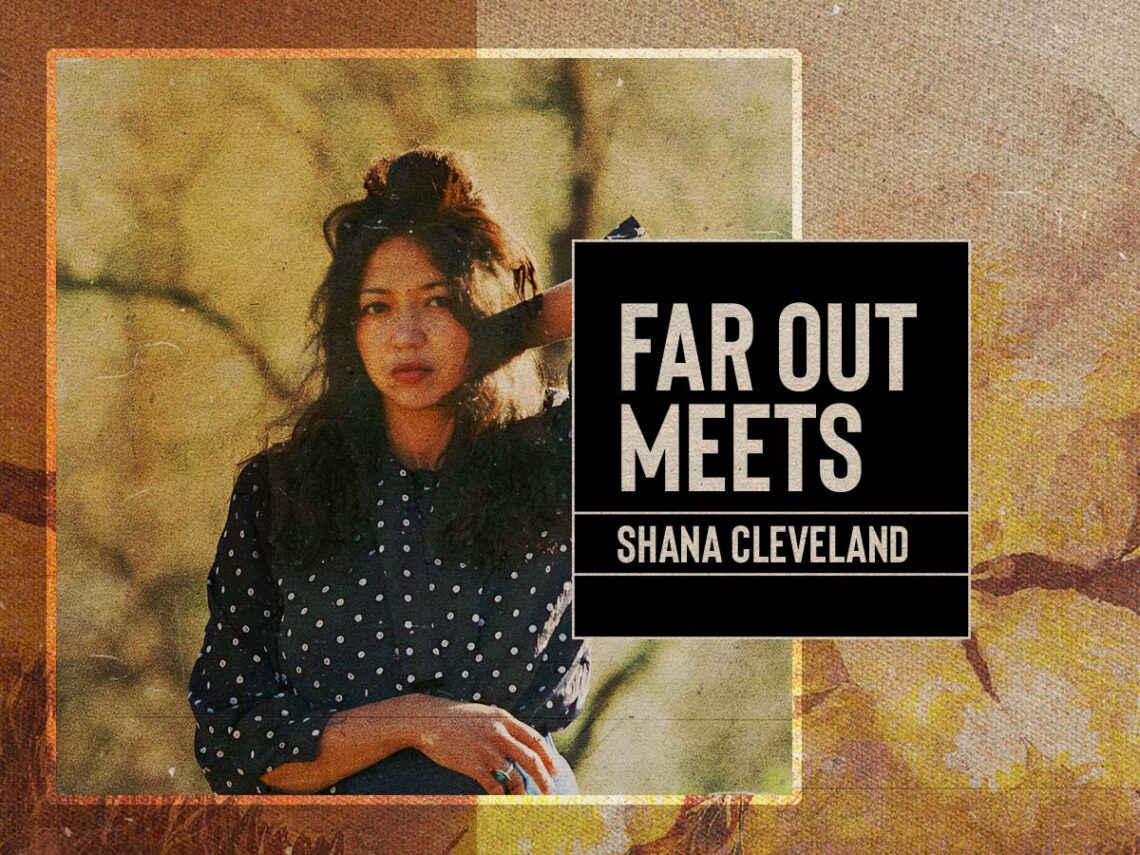
Far Out Meets: Shana Cleveland analyses the power of motherhood and the magic of California

It was the first Friday of February, more commonly known as a complete nothingness to most. Whilst the days were getting ever so slightly longer, we were still in the dark abyss of winter, and as it was 5pm, any faint hope elicited by the day’s brief glimpse of sunlight had been parried back into the distance. Luckily though, I had an interview with La Luz frontwoman and solo artist Shana Cleveland. For 40 minutes, the Californian sun was to cast off the winter blues.
When Shana first popped up on the screen with a “hey”, she disclosed that whilst she was good, she was feeling a “little under the weather”. She said: “Hopefully, I’m not too fuzzy-brained. I feel, like, a little out there.” It was immediately suggested that we reschedule, no problem. Ever the warrior, as exemplified by her battle with breast cancer, Shana elected to plough on. Despite the illness, she emitted a warm presence throughout the next 40 minutes or so. However, that storied Californian sun was nowhere to be seen on what was her morning of February 3rd. Shana was unphased by the downbeat atmosphere, though, as promise was on the horizon: “It’s a rainy day here. But it’s almost springtime. So excited about that”.
As we settled into our Zoom surroundings, Shana asked me if it was summertime where I am, thinking it was Australia. After happily establishing that it was still very much winter and that I was not down under but on the cold floating pebble that is the UK, we moved on to the actual topic of the day, her new solo album, Manzanita. An intensely hypnotic ode to the primal love of motherhood (she recently gave birth to her first child, a son), and the natural beauty of her adopted home, California, the record is a psychedelic reading of Americana capable of whisking you away from any setting. Such is the power of Cleveland’s musical prowess; her vocals, guitar work, and songwriting do wonders on a project that clearly comes from the heart.
It makes sense, then, that the title of the record, Manzanita, is taken from the name of a small tree endemic to California – noted for its medicinal uses. Whilst using it in the title of her new opus might initially have conveyed some great interest in gardening, it wasn’t necessarily the case. Shana explained that she likes the sound of the word, as she “really likes” those with Z’s in them: “I feel like we don’t have enough of those,” she suggests.
“It’s a tree that’s in my yard,” Shana continues before clarifying that they have an abundance of them in the area. “I’ve always found them interesting because they’re just strange-looking trees; they’re really crooked and small,” she said. “They often look like they’re half alive. They have these branches that will be grey and dead looking. And I think that serves a purpose”.
In one of the marvels of the day, we very nearly had a brief horticultural lesson: “You know, I think that they kill off…actually, I don’t want to get too deep into the science of Manzanitas because I probably don’t know what I’m talking about,” she said with a comfortable ease. “But they’re just interesting-looking trees”. Fair enough, I thought, as our conversation began to flow on through. Outlining the natural theme of the new album, and the one that would course throughout the discussion, Shana sketched a tranquil pastoral scene: “We have this little pathway, this little trail that the deers have made in our yard, and we walked down it a lot, and it’s through a corridor if manzanitas”. We would later come on to the fantastical literature of California, with this vivid description plucked straight from it.
Utterly exquisite were my first thoughts. Wanting to drill deeper into Shana’s connection to her Californian surroundings, from the people to the general spirit, Shana outlined how the state impacted her as a songwriter, as from La Luz to Manzanita, the heady sounds of the state colour her work.
“I think I’ve been influenced by California since I was a teenager – long before I lived here,” she said. “I grew up in Michigan. I went to school in Chicago. I feel like Chicago… If any place in the US is the opposite of California, it might be Chicago”. Enchanted by the promise of California even at a young age, the music and literature of the state helped her fall in love with it even before she had seen it with her own eyes. She might have taken a “roundabout way” of getting there, but it now “feels like home”.
She voices: “It feels weird to make a generalisation about a whole state of people, but people are friendlier on the west coast than in the Midwest or east coast of the US. There’s just sort of a baseline friendliness that I really appreciate and which makes it feel easier to just be alive.” Noting that her friends from the east coast have a natural edge, she concedes, “What I look for in life is just a sort of ease, and I think I’ve found that here. Also, the weather is just unbelievable. It can’t be beat.” Demonstrating the balance that instantly engaged me in the conversation, Shana corrected herself. The weather takes a tumble a couple of months a year, but more often than not, it’s pretty damn good.
What attracted her to the specific sounds of California? “I feel like it just fit my brain chemistry,” Shana supposes, before admitting that the first time she heard seminal psychedelic rock outfit Love, she found it to be “sort of cheesy”. However, over time, that feeling changed. She delivered a lucid account of the state and the art it produces.
“Over the years, I’ve just grown to love it so much. I don’t know if I’m just getting cheesier, but I love that type of idealism. I think that’s the state I always want to be in. And I feel like there’s so much idealism just baked into the myth of California. A lot of that is based in some reality; it’s obviously not a perfect place. There are all the same problems that exist everywhere else”. Registering the “ridiculous” side of California that has attracted an inordinate number of wannabe stars over the years, Shana says, “Even if it doesn’t come true, I want to always feel like these big flowery realities are possible”.
That was the perfect launchpad from which to analyse whether Manzanita is an idealistic album itself, as, from my point of view, it is. With that, Shana concurred. “It is inherently idealistic. I think that there are a lot of things about my life out here in the country that are ideal, but I think it’s also a really dark album. So it has that duality. I think that it’s creepy; I can’t seem to write anything that’s not a little bit creepy. So, you’ve got a song like ‘A Ghost’, which is essentially a love song. But, it’s also about feeling creeped out by this great mystery of….”
Peeling back the otherworldy magic of her album, Shana revealed: “That song is specifically about the mystery of pregnancy and birth”. In a conversation full of fascinating takes on life, her candid discussion of the impact of having her first child was another highlight: “I feel lucky to have this window into a totally different life. I’ve just this extreme closeness with another human who will grow up in a totally different time than I did”. Pretty profound stuff it might be, but Shana maintained that she does not expect to write another entire album about being a mother – or her son. Nevertheless, the experience was “so intense” she could not let it pass her by without exploring it in her art.
Naturally, Shana’s experience of motherhood for the first time was a learning curve, and she found that it was “much weirder and darker” than she’d been led to believe by the standard portrayal of motherhood and pregnancy that permeates society. Hence, she sought to unpick it in a personal way. Delving into the primal nature of the experience, something which comes to the fore at many points on Manzanita, she shared an anecdote she had recently read about. “When you have a kid, you feel this huge expansion of love right away,” Shana starts. “I was reading this story just last week about a mountain lion attacking a five-year-old kid on a trail in California, and the mom ran at the mountain lion, and it ended up running away. Immediately, I knew. I was like, ‘Oh yeah, I would have done that.’ There’s no question. I would if I saw a mountain lion come near my son. I would run toward a mountain lion.”
Continuing, Shana explained: “There’s just this weird, primal feeling about being a mother. You have this huge expansion of love, but there’s also this huge expansion of terror”. This aforementioned duality – another prominent theme in our chat – was captured adroitly on Manzanita, from ‘A Ghost’ to ‘Faces in the Firelight’, with simple beauty balanced by essentially indefinable forces. Characterising the depths of terror that come with motherhood, Shana noted that this is primarily due to the constant possibility that something terrible could happen and the necessity “to keep this creature alive”. Even before her son was born, Shana became aware of the shocking things she’s capable of that she cannot control. It’s just one of those great mysteries of life, she asserts.
“Honestly,” Shana says, in the most sobering moment of the conversation, “cancer was another thing that we try to understand, but we can’t. It’s just going to do whatever it’s going to do. It makes you feel like a tiny speck in the universe”. Before her pregnancy, she had expected it to be all pastel colours and cute, but it couldn’t have been further from the truth. “Your body is changing, and your brain’s out of control. It’s just so much wilder”.
Moving on from the factual to the fictional, eminent author, Richard Brautigan, referenced in the song ‘Mayonnaise’, crops up. Admittedly, I’d never heard of him before (I know), so Shana provided insight before examining the other literary influences of Manzanita. After only seconds, it was clear that the record’s supernatural angle largely emerged from her penchant for heady Californian literature. His 1965 novel, A Confederate General from Big Sur, which grapples with the struggles of the mind’s perceptions and beliefs versus reality, was noted as an influence, with Shana describing it as a “California fantasy”. The story feels like it’s going to be realistic, but then it’s not. One of the characters has “two or three” teeth, but they change position every time you meet them. Elsewhere, Big Sur is overrun by alligators. Offering another definition, it’s a total “hippie fantasy”, she says.
Another writer who significantly impacted Shana and her new album is Gary Snyder, the ‘poet laureate of Deep Ecology’, famed for his poem and essay collection, Turtle Island. A Beat Generation affiliate like Brautigan he’s still alive and resides in the same area as Shana. For a long time, the La Luz frontwoman did not understand nature poetry, and even though she was a poetry major in school, the form always seemed “so boring” to her. However, after moving to the area fiveish years ago, she picked poetry back up, with her interest in Synder piqued by his nearby presence. He eventually left a tremendous mark on her. “I’ve been reading his books a lot,” she comments.
Although Shana’s locale remained anonymous for the entirety of our talk, her reflections on leaving Los Angeles for it were also compelling. The city is one of the most expensive places in the country, with the state being the most expensive of the 50, so she and her partner – fellow musician Will Sprott – were almost forced to look at the affordable small towns. Somewhere down the line, they stumbled across their current residence, nestled in an area of natural beauty. Over time, they fell in love with it and decided to plunge into the unknown. In addition to the rising prices, the couple felt they weren’t making the most of what the city had to offer, primarily due to them both being touring artists. So when the news arrived that they were pregnant, the message was clear. It was time to move on. “When I found out I was pregnant, we were like, ‘Oh, it seems like a good idea to have a kid here’,” she said sarcastically, followed by a laugh.
This conversation had a natural arc, flowing unimpeded. Following the rising cost of living and being a touring musician cropping up, we segued into a discussion on the economics of Shana touring Manzanita. Presenting her with a much different scenario than the established act of La Luz does, she explained that she was presently debating whether to tour the record on her own or with a band, with the costs an ever-present fixture in her mind. You can find her speaking about it in more depth in our recent piece for The Price of Music. Despite eye-watering costs, Shana maintained that she will always make sacrifices to continue as a musician. Don’t be fooled by her laidback nature; she’s a “diehard frugal”, after all.
Elsewhere, the actual merits of festivals such as SXSW were debated, as were the differences between US and European crowds. It’s a toss-up for her favourite European city, with the vibrance of Lisbon noted. Aside from these familiar cities, the opportunity to visit places off the beaten track is “a huge privilege” for Cleveland and, more important. So is getting to know people who share “little bits of their lives” with her. This compels her to push on into the future with the music. No wonder she ended up in such a utopian corner of California.
Shana has drawn to these unaffected places removed from a big city’s dictated experience, and it could not be more transparent on Manzanita. The forays into the primal essence of motherhood, the glorious vistas of California, and the concentrated dose of the weird that’s poured in; all derive from authenticity. This is Shana Cleveland.
