


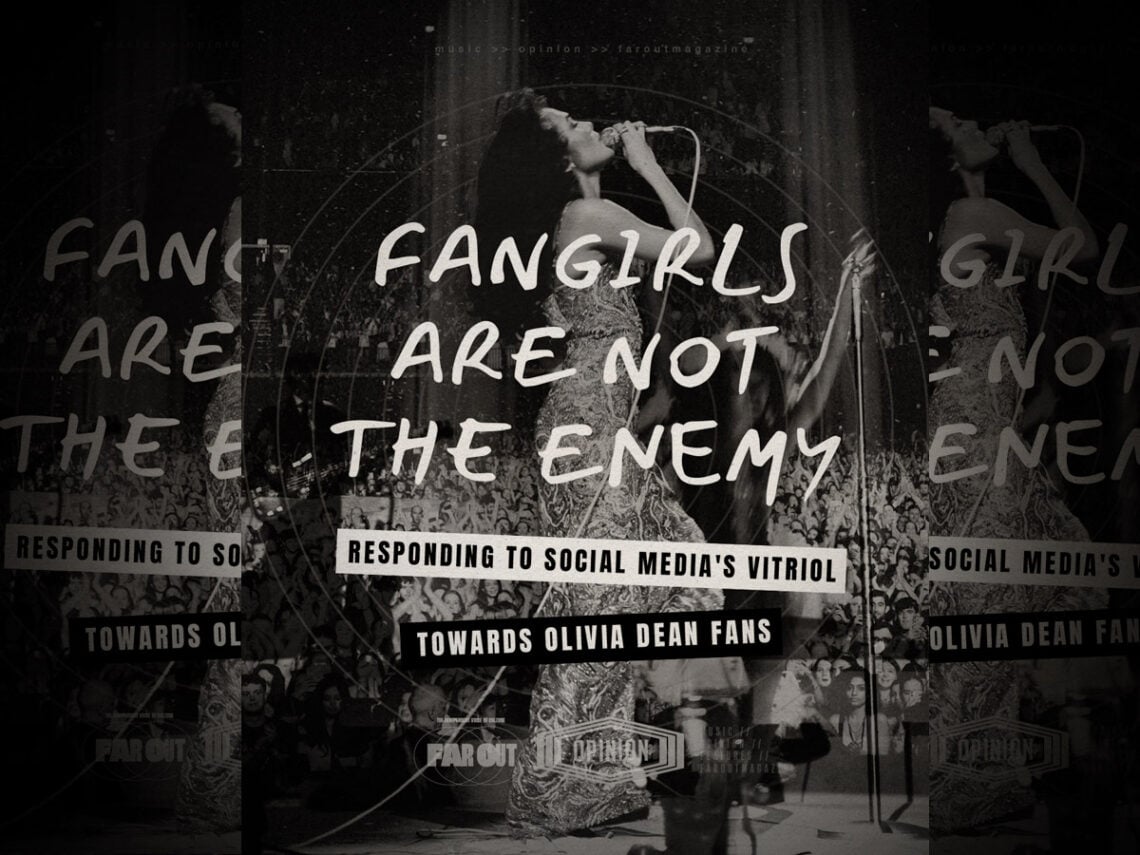
Fangirls are not the enemy: responding to social media’s vitriol towards Olivia Dean fans

They say that nothing brings people together more than a common enemy trying to tear them apart. That may be true, but the last place I expected to see it manifested was at an Olivia Dean concert.
Summer arrived early in Glasgow over the past few weeks, and as the pop darling graced the city for the first two nights of her The Art of Loving tour in late April, the sunshine in the sky was certainly putting the hordes of fans heading to the OVO Hydro in a good mood, me being prime among them. The energy was one of unremitting positivity.
Two nights at the arena means that roughly 28,000 people had bought tickets to see Dean play, and although inevitably each one of those individuals had come from their own distinct walk of life, many shared one predominant characteristic: they were young women. Without wanting to make too blunt a point, you might have guessed that I fall into this category as well.
Age and gender may seem a banal thing to make mention of in what is supposedly the unifying utopia of the live music scene, but these two traits have remained stubbornly persistent and annoyingly relevant throughout the entire course of my culture-consuming life. They have painted me as a type of fan I shouldn’t want to be, or one that I’m somehow meant to be ashamed of.
My specific experience is that my music tastes have been viewed in polarising extremes. Growing up, family and friends would laugh with derision at the fact that I was a fan of David Bowie at the same time as One Direction, as if one invalidated the other or that each of their typical respective crowds would outlaw anyone who fell outside their restrictive self-made boundaries.

But the usual sticking point always came with artists like the latter, with the idea of fandom and idolisation in large female quantities invariably being met with a look of disgust and pompousness from anyone who didn’t understand the hype. As such, it was from these experiences of loving One Direction, or Justin Bieber, or anyone in between, that the untamable concept of the fangirl was introduced into my life, and has never subsequently left.
The cultures created by fangirls and the impact they leave in the music industry is an entirely separate discussion to be had, but the point in all of this is that whenever an artist begins to gain traction within a demographic of young women, the wider perception of them, and reception towards the fans, automatically begins to sour.
I’ve seen it happen time and time again, both in the pop music that I enjoy as well as fandoms that I witness from the outside. Fangirls have the stereotype pitted against them that they are hyperbolic, hysterical, and ultimately airheaded when it comes to ‘real’ music. But would the same be said towards dominantly male crowds, showing the same type of passion towards their favourite football team?
I don’t think I need to spell out the answer. Yet even despite the fact that I am well-accustomed to the vitriol, the speed and voracity with which this hatred attempted to derail the otherwise joyful experience of Dean’s gigs in my home city was something that caught me off guard nonetheless, and sparked a sense of anger I have rarely felt about the situation before.
Almost as soon as the first of the two concerts kicked off, my social media feeds were flooded with not only normal, celebratory clips, but also unnecessary comments from strangers behind a keyboard about the people in them. On a video of a group of young women leaving the arena, joining together in singing Dean’s number one hit with Sam Fender, ‘Rein Me In’, the top-liked comment said that it looked like a “matcha-fuelled nightmare”.
A bizarre amount of other videos and photos that emerged from the gigs also mocked the large number of fans in the crowd wearing outfits with polka dots on, for no more complicated a reason than because the pattern is on trend at the moment. But suddenly, everyone who wore it was “basic”, “boring”, or the dreaded “performative fangirl”.
The demonisation of young women in a space that was largely designed to be safe and appeal to their interests is nothing new, but it is also frankly saddening to see friends on a fun night out being dragged through the mud for no other reason than existing and finding entertainment in the things that they do.

It’s a classic example of a social media consensus swinging so far in one particular direction that the masses feel conditioned into following suit, hence the sudden outburst of contempt towards Dean’s fans that didn’t seem to exist prior to the immediate boundaries of the past few weeks. But it also says something far more damning about the state of society as a whole, and how we use the veil of pop music to tell harmless audiences what we really think about them.
Frankly, it is also not helped by men in musical positions of power, like AC/DC’s Angus Young, entrenching those toxic norms by painting his own fanbase as a place only truly welcoming to men.
“There’s usually more guys than girls who come to our shows,” he once said, before sneering that “girls are more into the pretty side of things” and the “Duran Durans of the world”. It may be a somewhat dated example, but in doing so, it also proves that this conditionality in music has been around from when our mothers were teenagers, and even far beyond.
A timely blast of ‘Man I Need’ is not the root of this issue, nor will it ever be the end of it. Until population-wide problems towards the treatment of women, and particularly those at the more youthful end of the scale, are properly addressed, then this kind of vitriol is always going to exist in the music sphere.
But for every young woman who is told they are a stereotype, they are basic, or that they’re a sheep following a crowd, it increasingly risks alienating a group who, for a long time, have unscrupulously served as a backbone to the live music sector without ever receiving a second’s credit for it. Once they are gone, you’ll realise just what you are missing.
So, girls, keep drinking your matchas, wearing your polka dots, and being a staunch music fan with pride. In this world, you’re actually creating an act of resistance.
