


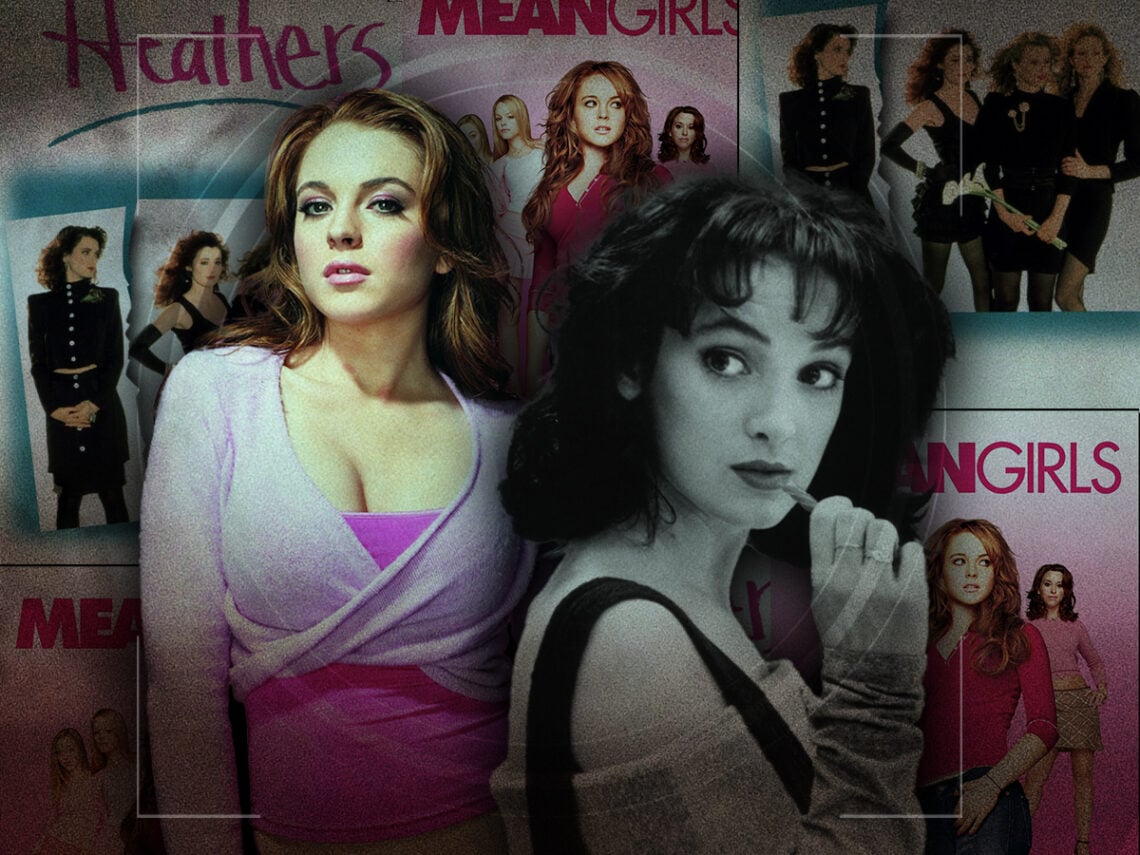
The family connection that links ‘Mean Girls’ and ‘Heathers’

If we’re to consider the greatest teen comedies ever made, then Heathers and Mean Girls would definitely rank high on the list. While a John Hughes number or perhaps something a little more recent, like Superbad, might be your pick for the best, I think what makes the aforementioned two stand out is their darkly satirical take on high school hierarchy.
It makes sense, then, that there’s actually a family connection between Heathers and Mean Girls. You can certainly see some ties between the two, and I’d argue that Mean Girls perhaps wouldn’t have had the nerve to have such bite at times, if not for the pre-existing popularity of Heathers.
Released in 1989, Heathers was penned by Daniel Waters, and while it underperformed at the box office (grossing $1.1million against its $3m budget), it soon became a certified teen classic, loved by many for its rather morbid vision of adolescence. In the coming years, you could see its lineage spread across movies like Gregg Araki’s Nowhere, Darren Stein’s Jawbreaker, and Jamie Babbit’s But I’m a Cheerleader.
These films had this campy essence that reared its head in Heathers, with outrageous plotlines, often involving death (although the latter, instead of death, deals with conversion therapy), and pretty strong visuals. The darker themes of these teen movies, combined with their comic tone, were so much more interesting than the Brat Pack movies of the previous decade.
These movies weren’t afraid to be a little cheekier, more deadpan, and more absurd, because isn’t being a teenager an innately absurd, surreal, and confusing time?
In 2004 came Mean Girls, with a screenplay by Tina Fey and direction from Mark Waters, Daniel’s younger brother. While there were no plots to blow up the school in this one, that Heathers-esque sense of humour is blindingly apparent. Regina George is a mean girl just like Heather Chandler, and there’s even a parallel between two scenes in which both characters compliment another student, clearly not meaning it.
Of course, then there’s the cliques in each respective film, made up of three mean girls (one being the queen bee) and then an outsider – Veronica in Heathers, Cady in Mean Girls. They both fall apart as the school hierarchy crumbles, although Heathers just takes a rather murderous approach. In the latter film, it’s calorie-dense snack bars, burn books, and violating arbitrary clique dress codes that lead to the demise of ‘The Plastics’.



Besides their thematic connections, both Mean Girls and Heathers stand as two of the most popular teen movie-to-musical adaptations. The two movies have been made into such popular (although, in my opinion, awful) musicals that you can even watch film versions of the musicals. I’d just stick to the originals, personally.
Clearly, there’s an innate theatricality to both stories that has resulted in such popular musicals. I think you can identify each film’s success within the relatability of the high school narratives – at least in terms of hierarchy and the struggle to fit in – paired with both films’ endlessly quotable witty dialogue that isn’t afraid to be a little subversive.
