


How ‘Fallout’ thrives where so many video game adaptations have repeatedly failed

For over 30 years, the video game genre has struggled to maintain consistency. While there has admittedly been an increase in ones that aren’t abjectly awful in recent years, the misses continue to dramatically outweigh the hits. On paper, Fallout would be one of the most difficult to adapt faithfully, but Prime Video’s new series has made it look effortless.
There are two major issues that console-to-screen titles have always struggled to reconcile with. The first is successfully navigating the struggle of turning the immersive and hands-on experience of playing a game into a passive one, where those with an affinity for the source material have to sit back and watch instead of actively taking part. Remove that element, and there needs to be a story that stands on its own as engaging enough to justify investment.
That seeps directly into the second, striking the right balance. It’s all well and good loading up on nods, winks, and references to appeal to the built-in audience ready to see one of their favourites realised on-screen but lean too heavily into fan service, and it runs the risk of alienating the newcomers. It’s a hurdle that’s tripped up countless adaptations before, but Fallout navigates the dangers with aplomb.
What works in its favour is that the latest show from Westworld co-creators Jonathan Nolan and Lisa Joy is based on a sprawling role-playing adventure. That means no two players have the exact same experience playing Fallout, which creates more scope for a standalone narrative that isn’t tethered to a certain set of events and actions that are expected to unfold in a specific order.
That being said, as a retro-futuristic and post-apocalyptic sci-fi inspired by everything from 1950s societies and body horror by way of action, thriller, romance, and comedy, trying to spin so many tonal plates at once makes it easier for at least one of them to fall and shatter. By embracing the absurdity of its concept, toeing the line between slavishness and wide-ranging appeal, and focusing on three archetypal narrative arcs set in a very distinct world, Fallout positively thrives.
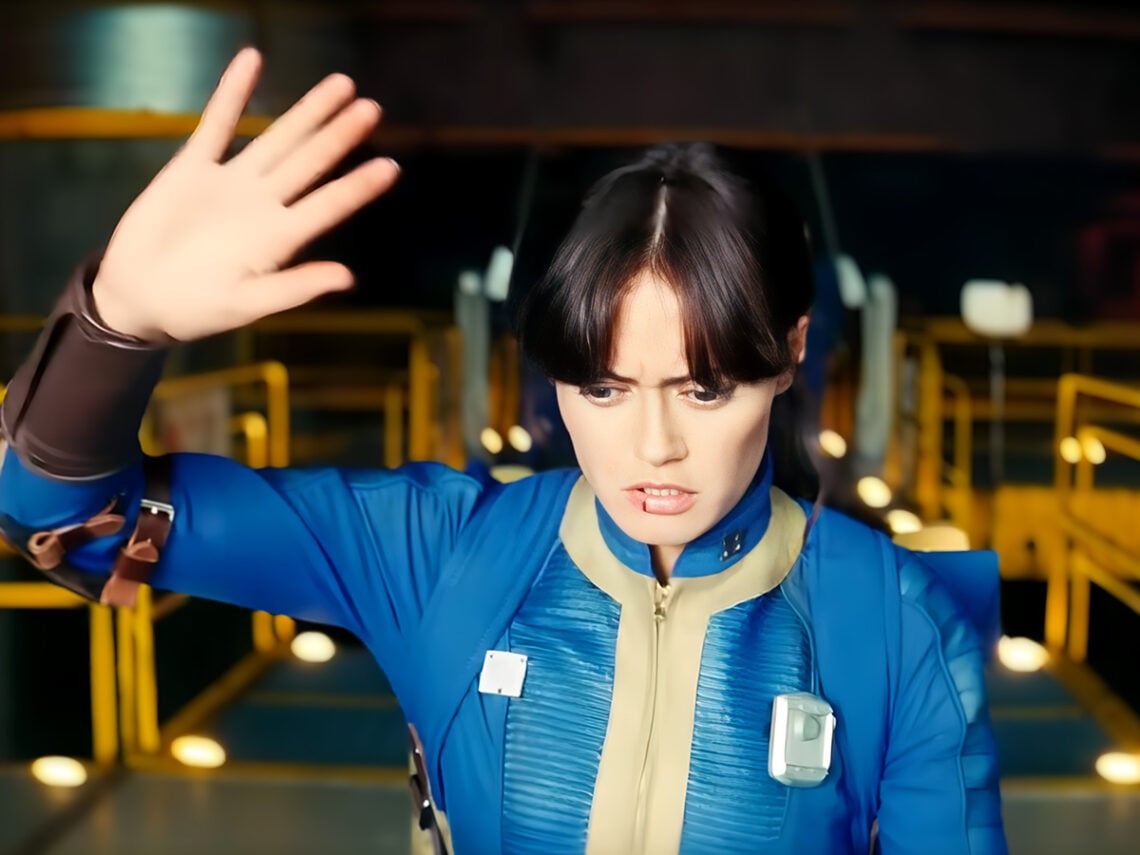
Ella Purnell’s Lucy has grown up in a sheltered existence that leaves her ill-equipped for the outside world, but she sets off to rescue her father anyway because it’s the right thing to do. Walton Goggins’ Ghoul is a world-weary mutated gunslinger, but at the end of the day, he wants both revenge and answers to what happened to his family. Aaron Moten’s Maximus is part of an uber-macho military unit that dreams of becoming equal parts respected or feared, seizing the opportunity to become just that when the opportunity presents itself.
In microcosm, those individual journeys have been seen and done a thousand times over, but there’s a very good reason why they’re so well-worn. Taking simple, straightforward journeys, placing the characters in the hands of talented actors, and then parachuting them into a lawless wasteland ripe with world-building, explosive action sequences, jet-black humour, and an overarching conspiracy that ties past, present, and future together is a formula genre fare has been using to great effect forever, but very rarely has it been successfully applied to video game adaptations.
It sounds counterintuitive, but Fallout has more in common with comic books than consoles. Marvel mastered the art of taking familiar places, stories, and situations with a devoted fandom behind them and then repurposing them into an easily digestible effects-heavy epic that never directly adapts its inspirations beat-for-beat but nonetheless makes them equally palatable to veterans and newcomers alike.
It’s debatable if Fallout is any more or less enjoyable for those who’ve never played a single second of the game series in their lives, which is about the biggest compliment any video game-derived project can ask for, and one that can’t exactly be levelled at a lot of them.
