


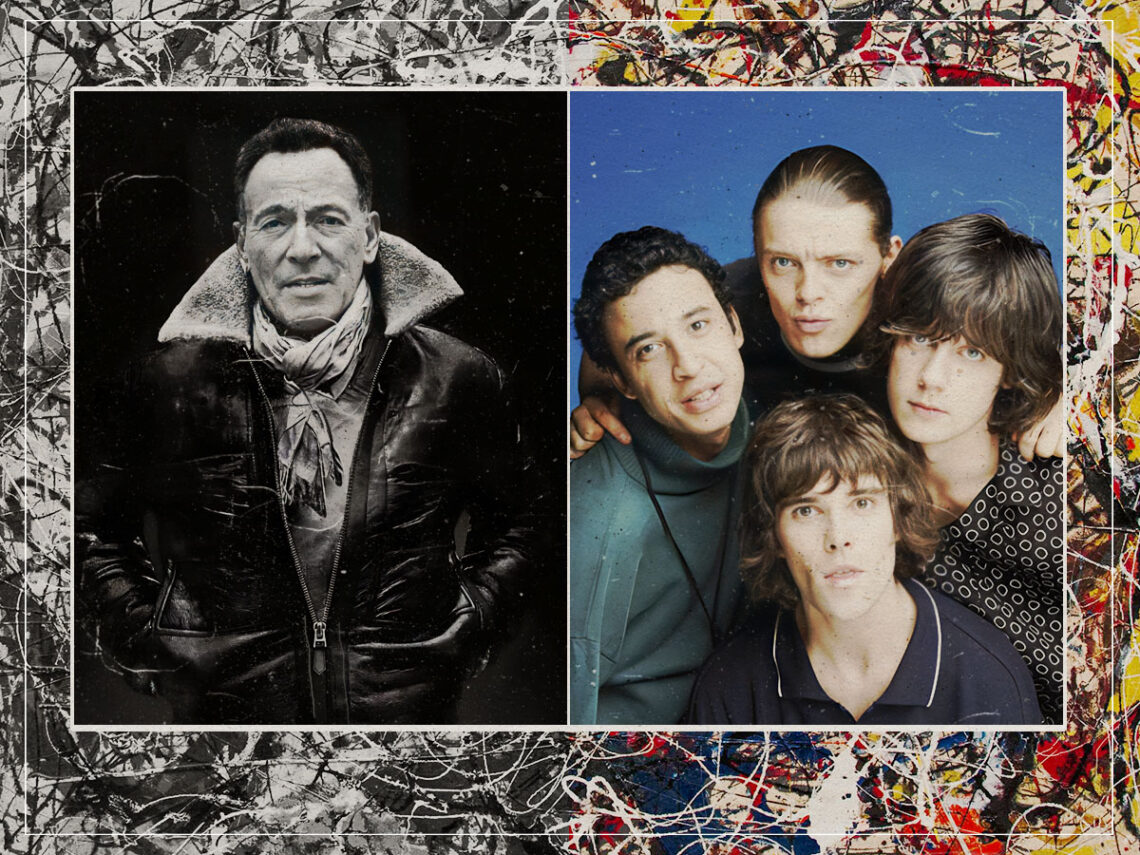
Exploring the strangeness of Bruce Springsteen love for The Stones Roses

A few years back, Bruce Springsteen was enjoying a holiday in Ibiza when he found himself in the crosshairs of a conversation with Noel Gallagher. He lived to tell the tale, and Noel has subsequently been calling it one of the best nights of his life. The topic of conversation that got the ball rolling between the unlikely pair was their mutual love of The Stone Roses.
It’s not hard to understand why: the legendary Madchester band’s two albums are masterpieces. Why, then, do I find it so damn strange to picture Springsteen grooving along to the swaggering indie of the lads in their baggies? After some thought on this matter, I can’t help but think that it highlights the cultural chasm between America and the UK and, indeed, the muses of artists on either side of the pond.
Americans make better driving music. Simply put, this is because their roads and cars are cooler. A trip in an old Mustang through the winding heartland of the States towards a brighter horizon still carries a pioneer-like glory to it. However, in the UK, there’s no daring sexiness to trundling along the lifeless M6 in a hatchback with only one previous owner until you get to the perfectly pleasant town of Telford for a work conference.
In fact, few artists act out the differing scope of music on either side of the Atlantic quite as perfectly as Springsteen and The Stone Roses. The dreams that reside in the blue-collar world of the Roses pertain to a glim hope that a stuffy ride on public transport is transfigured by the presence of someone pretty, and the bleakness of society is indicated in the creeping mould on the walls of a council flat.
In Springsteen’s world, the hopes and desires are the grand eponymous American dream, and the erosion of society’s virtues are tangled up in murder and destruction. Springsteen’s desire is to burn rubber as he chases down a happy ever after, putting the world to rights as he does so; Ian Brown is resigned to just trying to find contentedness and weekend reverie amid rainy Manchester—these creative dispositions are apples and oranges tied to the relative age of our respective nations.
Both the Boss and Brown hail from working-class backgrounds; however, Americans are still motivated to escape this fate by the dangling carrot of the American dream, whereas, in the UK, the carrot has long since been disregarded as a fallacy and a sense of glib acceptance has set in within the working classes.
“Sometimes I fantasise, when the streets are cold and lonely,” Brown sings, drifting away from deep-seated grimness for a moment that he accepts is a mere pipedream, even as he sets up the premise. However, the same subject in a Springsteen song would pertain to him actually taking action to escape a far more visceral sense of grimness in the form of the murderous Charles Starkweather or mobsters being bombed to death on their own crooked suburban doorstep. In a way, the ideas are much the same; it’s just that centuries of history have framed them differently.
Thus, with all that in mind, it is perhaps understandable to see why the Boss would love the Roses, but equally notable why it is such a strange proposition to imagine. It simply comes down to the wildly differing cultures that both artists hail from, glaring disparities that we often ignore because of the bulk of crossover art that we both enjoy. “[England] resembles a family, a rather stuffy Victorian family, with not many black sheep but with all its cupboards bursting with skeletons,” George Orwell once wrote. “A family with the wrong members in control – that, perhaps is as near as one can come to describing England in a phrase.”
Well, Brown is one of those rare black sheep desiring to be adored; Springsteen is too; it’s just America doesn’t have black sheep; it has lone wolves with hopes ostensibly more tangible than irascible adoration, and therein lies the gaping chasm between the two artists, even though their music sees eye-to-eye and conjures mutual admiration.
