


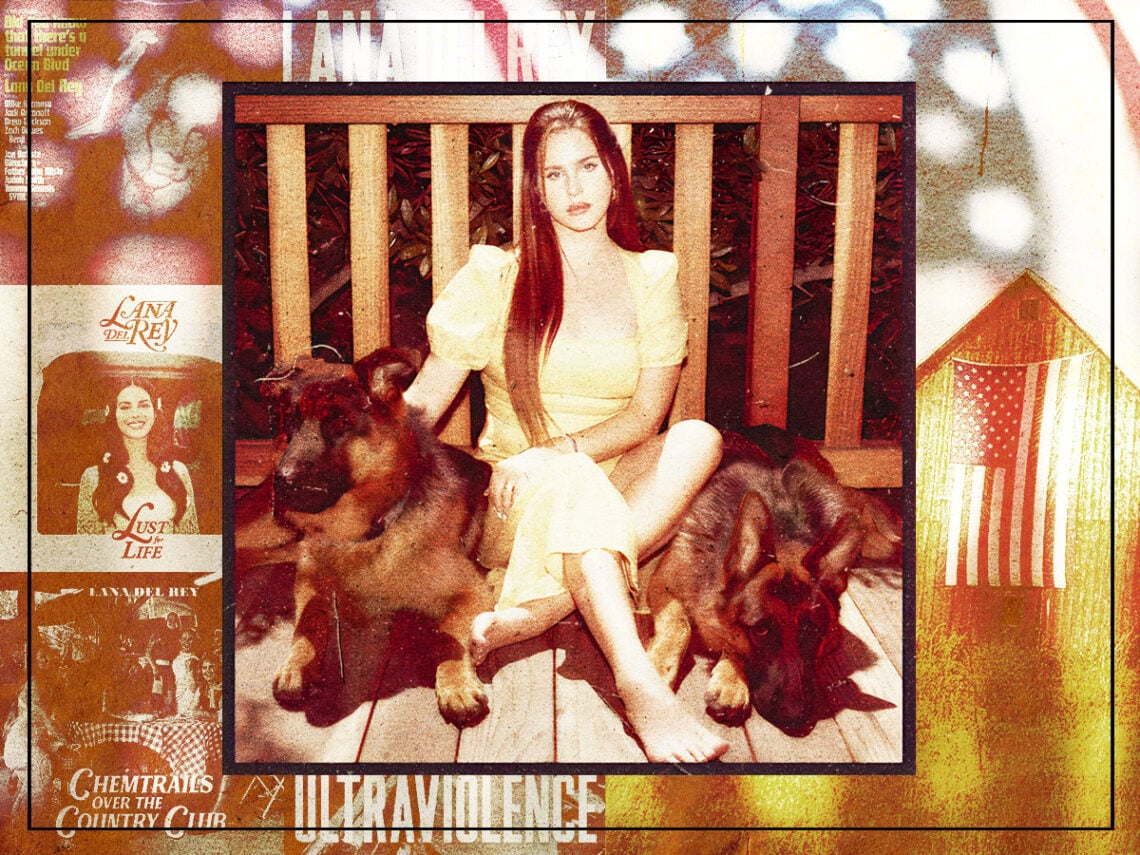
Vintage Aesthetics: Exploring the album covers of Lana Del Rey

When Lana Del Rey released her debut album, Born to Die, in 2012, it didn’t take long before flower crowns and heart-shaped sunglasses became popular. The singer either sported these items in music videos or referenced them in her lyrics, creating a distinctive visual aesthetic to go alongside her music.
The album’s reference to trashy Americana aesthetics, vintage glamour – calling back to the ‘50s and ‘60s – and melancholia was reflected in Del Rey’s music videos. With her major label debut single ‘Video Games’, the singer placed webcam clips of her mouthing the song between old, grainy footage of teenagers skateboarding against the setting sun, a drunken actor stumbling through Hollywood, and American flags. She encapsulated the bittersweetness of the song through these visuals, as well as evoking a penchant for nostalgia and the past.
Her music videos for ‘Born to Die’, ‘Blue Jeans’ and ‘National Anthem’ reflect Del Rey’s preoccupation with America, in all of its simultaneous greatness and destruction of dreams, tragic romance, death, and all things grandiose. You couldn’t escape screenshots of these videos on Tumblr during this time, with Del Rey’s use of visuals becoming just as vital to her persona as her music.
Naturally then, her album covers have followed suit, accurately evoking the essence of the songs found inside through simple yet evocative images, always featuring Del Rey herself. Typically, Del Rey works with either Neil Krug or her sister, Chuck Grant, when creating album artwork, and her close relationships with both photographers have allowed her to collaborate with them and ensure that their photos accurately reflect her music.
Born to Die, Paradise and the merging of old and new
Del Rey’s 2012 album Born to Die changed the pop landscape, and who can forget the simple yet confronting artwork? The singer looks directly at us with a moody gaze, a vintage green car just visible in the background and pops of pink coming from Del Rey’s lipstick, her bra beneath her almost-sheer white shirt, and the colour of the bold typeface reading ‘BORN TO DIE’.
Despite the photo being taken in Watford, the bright blue sky evokes the American summertime, with Del Rey’s perfect hair and big hoop earrings hinting at her love of Hollywood glamour. There’s a sense of ambiguity at play, with the vintage-inspired hair contrasting with a more modern and down-to-earth, simple shirt, alluding to the album’s blend of old and new sounds and aesthetics.
With Paradise, the follow-up EP, Del Rey uses a similar template, changing the font to shiny gold and replacing the background with a swimming pool and palm trees. We’re instantly transported to a world of luxury and opulence, reflected in songs like ‘Gods and Monsters’ and ‘Body Electric’.

Ultraviolence, Honeymoon, Lust for Life and Del Rey’s continued obsession with cars
Cars are intrinsically linked to the American Dream, a symbol of technological advancement and freedom. One of Del Rey’s biggest recurring lyrical themes is the meaning of freedom, as reflected most prominently in her song ‘Ride’. Thus, it seems like no coincidence that so many of Del Rey’s album covers feature her standing by a car.
On Ultraviolence, she is shot in black-and-white, wearing a simple white t-shirt. The sun creates a gentle shadow on the car bonnet – despite the lack of colour, we can still tell that it’s summertime. The album’s rock influence and preoccupation with slightly darker themes, such as alcoholism and domestic abuse, are reflected by this shadowy imagery, while Del Rey’s soft gaze, neat wavy hair, and the gorgeous old car highlight the album’s more romantic aspects.
It is hard to separate the summer months from Honeymoon, with songs such as ‘High By The Beach’, ‘Freak’ and ‘Salvatore’ painting a picture of lounging on the sand and eating ice cream. On the cover, Del Rey sits inside a car while wearing a sunhat and sunglasses, yet again using a sense of ambiguity by using a rather emotionless facial expression.
However, this ambiguity is disregarded on Lust for Life, which sees Del Rey smiling in front of an old green truck. For the first time, the singer proved to the masses that she was not merely obsessed with death and being a “sad girl” who wishes she was “dead already.” With a newfound sense of optimism, she beams in a ‘60s-style dress with flowers in her hair, looking as though she’s stepped out of Woodstock-era America and into the present day.
Norman Fucking Rockwell!, Chemtrails Over the Country Club, Blue Banisters and the importance of community
For the first time, Del Rey appeared next to someone else on an album cover with Norman Fucking Rockwell!. Holding onto Jack Nicholson’s grandson, Duke Nicholson, she reaches out at us while standing on top of a boat. Behind her is the American flag, and in the distance, L.A. is on fire, a reference to the lines “L.A. is in flames, it’s getting hot” from ‘The greatest’.
The logo for NFR! is also emulated in the style of pop artist Roy Lichtenstein. The pop art movement sought to blur the lines between high and low art, feeling perpetually modern despite booming during the ‘50s and ‘60s – making it the perfect fit for Del Rey, who has so often subverted and modernised vintage aesthetics.
With Chemtrails Over The Country Club and Blue Banisters, both released in 2021, Del Rey opted for more casual and communal photos, with the first featuring her hanging out with friends and the other featuring her with her dogs, Tex and Mex. As Del Rey’s music began to progress, not strictly relying on tragic yet glamorous aesthetics anymore, she emphasised the importance of her friends and family through her lyrics and album covers.
Did you know that there’s a tunnel under Ocean Boulevard?, intimacy and simplicity
With her most recent album, Did you know that there’s a tunnel under Ocean Boulevard?, Del Rey reunited with Krug for a series of intimate photographs which reflect the album’s confessional and honest nature. Posing on a bed in underwear, Del Rey lets us into her private sphere – in one alternative cover, she even exposes her bare breast.
She harks back to her earlier albums by appearing on her own, and the obvious fact that these images were taken on film rather than digital gives the images a vintage quality. It seems that no matter the album, Del Rey will always find a way to evoke years past, merging old and new both visually and musically.

