


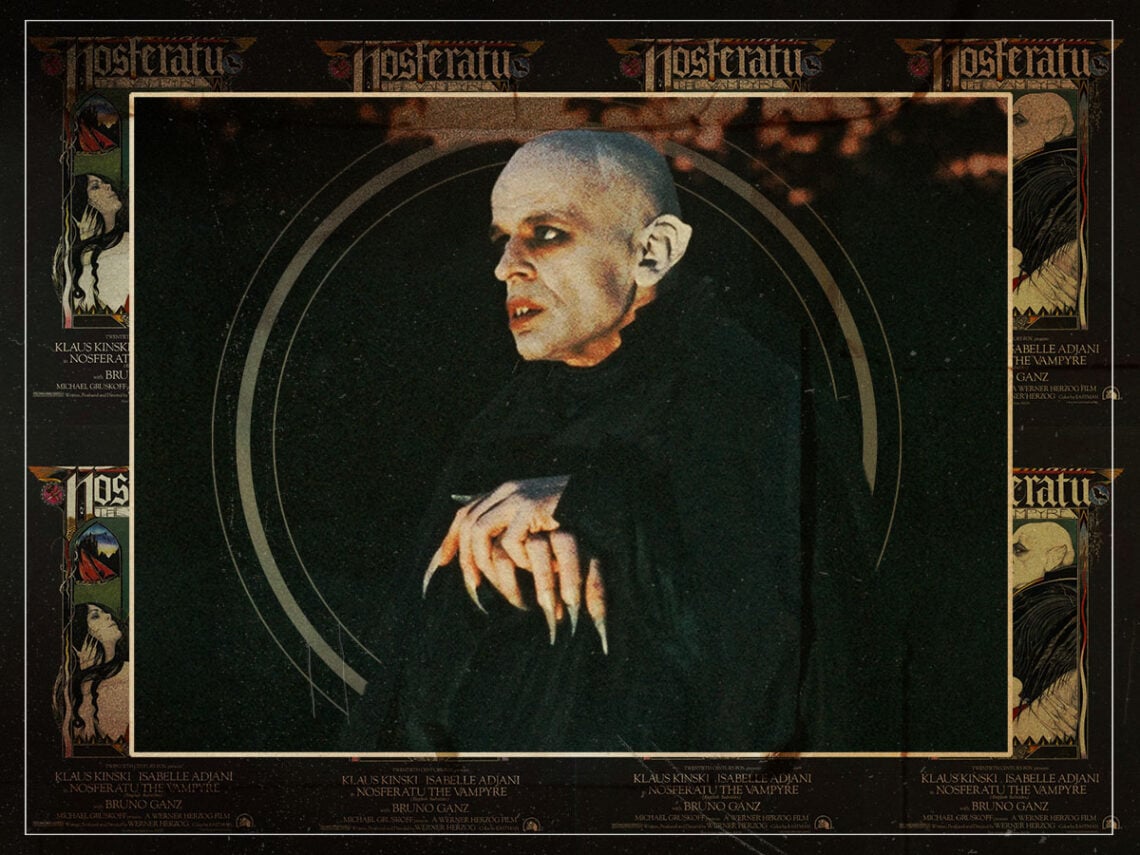
The ethereal poetry of Werner Herzog’s ‘Nosferatu the Vampyre’

There have been over a hundred movies based on Bram Stoker’s famous vampire, but Werner Herzog’s 1979 adaptation, Nosferatu the Vampyre, is in a league of its own. Taking its title from F W Murnau’s 1922 classic, Nosferatu: A Symphony of Horror, and drawing on both Stoker’s novel and Murnau’s German Expressionist style, it is still unmistakably a Herzog film, even though its premise is a far cry from the director’s usual work.
The story is a familiar one. Bruno Ganz stars as Jonathan Harker, an estate agent in the town of Wismar, Germany, in the mid-19th century who is happily married to Isabelle Adjani’s Lucy. When Jonathan is called away to Transylvania to sell a property to the famous Count Dracula (Klaus Kinski), Lucy is concerned for his safety. When he arrives at the Count’s remote castle, he is bitten and turned into a vampire.
Dracula successfully smuggles himself and a hoard of rats into Wismar in wooden boxes, spreading the plague throughout the town and supplying the vampire with fresh bodies. Suspicious that the rapid spread of death may have something to do with the count and her newly returned husband, Lucy discovers that she can defeat Dracula if the sunlight touches his skin. When he visits her bedroom at night and bites her, she distracts him long enough for the sunrise to kill him.
The story has been told countless times, but Herzog breathes new life into it by downplaying the horror and creating a dreamlike tone through lingering shots, extended silences, and artfully crafted mise-en-scene. Every frame of Nosferatu the Vampyre looks like a painting, from the misty waterfall that Jonathan passes as he journeys to Dracula’s castle to the gauzy bedroom where Lucy sleeps. The gothic nature of the story comes to the fore in these images, a mood that blankets the story with a misty, faraway quality that feels more magical than horrifying.
Considering that the substance of the novel is so well-known, Herzog’s decision to minimise the plot is inspired. The director is known for bringing nature into his films, whether it’s the teeming majesty of the jungle in Aguirre, the Wrath of God, or in his many documentaries that take place in the wilderness. While Nosferatu the Vampyre is a deviation from his usual man-against-nature storylines, it nevertheless features a similar fixation on the natural environment.
When Jonathan travels to Transylvania, he quickly discovers that no one will take him to the forbidding peak where Dracula’s castle is. Deciding to go on foot, he sets out through high-mountain meadows, grey peaks shrouded in fog, and ravines rushing with water. In a movie that is barely 80 minutes long, Herzog spends more than six minutes on this wordless sequence, resting on each image for so long, you almost expect his famous voice to break through the reverie with a cryptic rumination on the human search for meaning.
Later in the movie, when the plague has taken the lives of countless villagers in Wismar, Lucy emerges from her quarantined home to find that, contrary to the day before, the streets are full of people. As the sea of rats squirms through the streets, men and women sit at dining room tables in the sun. Dressed in their finest garb, they feast on wine, meat, cheese, and fruit. “Join us,” a woman with a flower crown says to Lucy. “It’s our last supper.”
It is in these moments that the film shines. Stepping outside the usual Dracula narrative, it transcends horror and gore and instead becomes paradoxically beautiful. There is a case to be made that Francis Ford Coppola’s 1992 adaptation, Bram Stoker’s Dracula, is more faithful to the novel in its maximalist, stylised gore, but Herzog’s take on the timeless tale is a mesmerising, almost trance-like ode to fothic horror. The jump-scares are few and far between, but its mood lingers long after the credits roll.
