


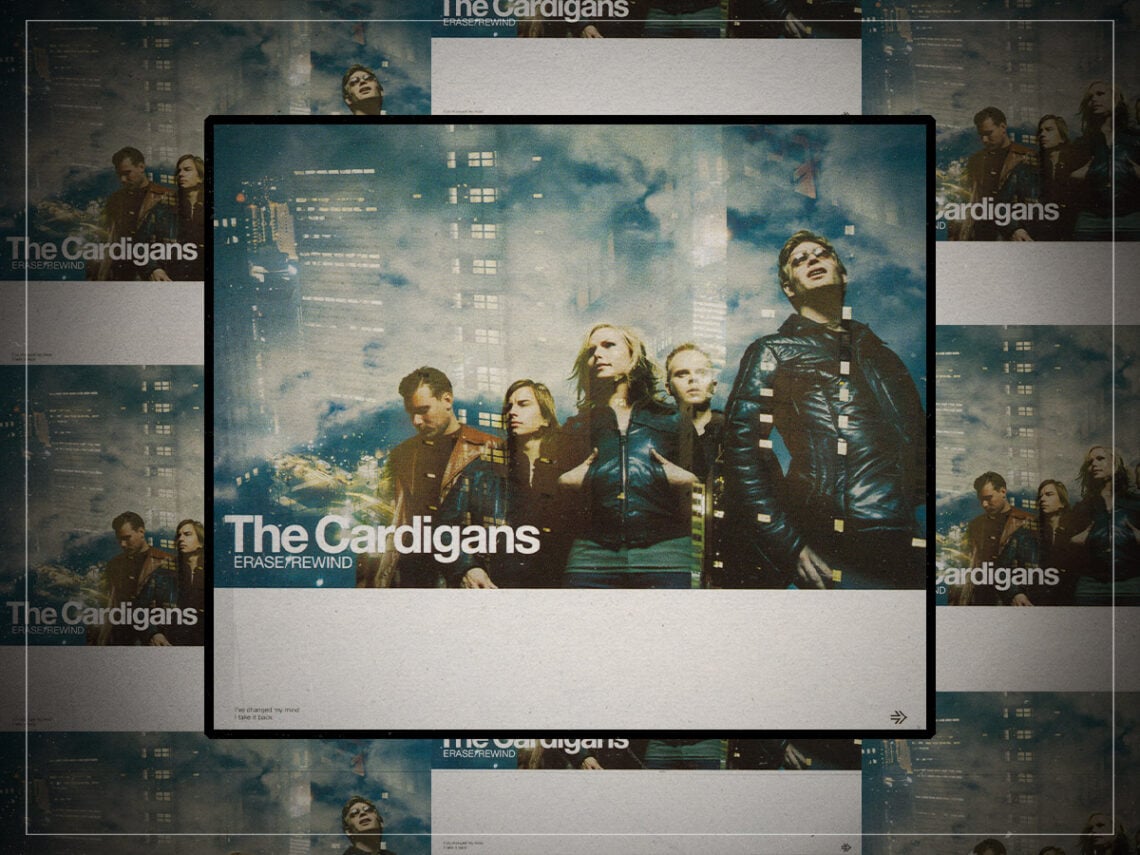
‘Erase/Rewind’: The Cardigans’ sonic gem of 1990s cool

With 1997’s Gran Turismo, The Cardigans went ‘dark’.
Initially, the Swedish band had situated themselves within a vintage-inspired niche of pop-rock; for instance, with their hit single, 1996’s ‘Lovefool’, they put out a song that blends the alternative rock stylings of the decade with ‘50s and ‘60s bubblegum pop. Soon, The Cardigans were perceived in the same vein: sweet, bubbly, upbeat. It was an image that they were not accustomed to, and certainly did not identify with it well.
In the burnt-out aftermath of their first few years of mainstream attention, which involved having their music featured in cult favourite films, like Romeo + Juliet and Cruel Intentions, to being approached to submit for the next James Bond theme (which they declined), The Cardigans were battling disillusionment. They entered the studio with an urge to not just radicalise their sound, but reclaim it, entirely. They began experimenting with computers for the first time, with the electronic and new wave stylings of the likes of Depeche Mode lingering in the back of their minds.
“The title can be interpreted in many ways,” vocalist Nina Persson explained ahead of Gran Turismo’s release, “I can think of music sometimes as tourism and travelling. So to me, Gran Turismo is sort of the way to describe music sometimes, or spending time with music… I think sometimes you can always compare living to being a tourist in the world.” Guitarist Peter Svensson agreed with the sentiment, concluding that “the album is pretty much about trying to find your place in the world”.
If Gran Turismo presented an eclectic display of The Cardigans’ attempt to find where they fit, travelling within the unfamiliar, then its second single, ‘Erase/Rewind’, may be the band finding their niche. The song is a stellar example of trip-hop and rock existing under an electronic umbrella, and nearly three decades later, it stands as one of those songs that courses through your bones and jolts you awake.
But, rather than wielding an emphasis on brash noise, ‘Erase/Rewind’ echoes with a cool remove. The lyrics trace a push-and-pull in Persson’s mind between staying and leaving, loving and longing, and like a tape that reverses and begins again, we wind in and out of a love gone wrong. The guitars are dream-like, joined yet dominated by the bass as they coast along Persson’s thoughts, while in the distance, the drums echo like a heartbeat. Each Cardigan sounds as though they are playing from a speaker in the next room, fuzzed-out yet just as vibrant as ever. Like puzzle pieces coming together, they form a sound that amplifies the mystery of ‘Erase/Rewind’s’ story.
In the lyrics, we get fragments that suggest an argument: “Hey, what did you hear me say?” Persson repeats from the beginning, met with a shrug of, “Yes, I said it’s fine before / But I don’t think so no more”. Persson then changes her mind, resolving to take back any ounce of forgiveness in the process. The so-called darkness of Gran Turismo seeps through every verse, as there’s a sense of exhaustion with every higher note that Persson’s voice reaches, and the circling of the verses, sonically, that oscillate from quiet hums to bursts of emotion. We’re easily caught in the tangled spiral of Persson’s voice: will she, won’t she? Are we easing the memory, or are we rewinding what’s occurred?


‘Erase/Rewind’ captures that perfect duality of being caught in limbo, between a relationship’s demise and reconciliation: a true bittersweet sentiment, if there ever was one. As Persson described while speaking on Sad Song Queens, the song’s story actually came as a response to the media attention The Cardigans had endured over the preceding years, namely the weight of expectation, “the right to change your mind, basically. It could be political in a way, too. You can be hell-bent on something, but you still have the right to retract. And it’s also a generous way to look at people. Like, yes, everybody can get a second chance…we’re humans.”
‘Erase/Rewind’ then becomes a song that hears not only the reclamation of The Cardigans’ sound, but their personal voices, too. For Persson, particularly, it meant acknowledging duality and allowing herself to define her voice on her own terms, rather than contorting her image to fit what outsiders believed of her: “Don’t think that you got me,” she concluded, “Don’t think that you know me”.
