


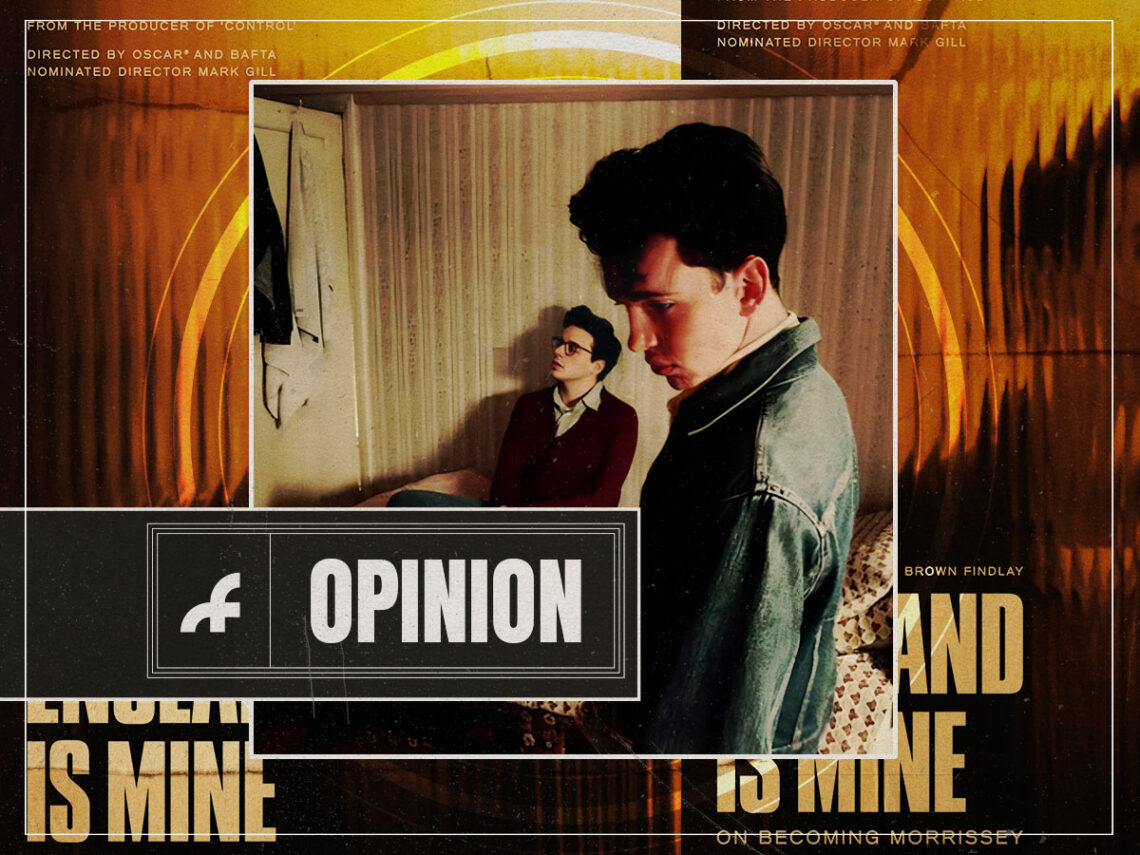
Hear Me Out: ‘England Is Mine’ is hands-down the worst music biopic of all time

Biographies are a tricky thing to master, particularly when rendered on film. Can a writer, filmmaker, or anybody else truly summarise the complexities of a person’s story without reverting to clichés and inaccuracies? Particularly with regard to the music biopic, filmmakers have resigned themselves largely to giving overly broad, one-dimensional views of specific artists and groups. Although there are a few notable exceptions, the genre of music biopics, on the whole, can be summed up in the cinematic monstrosity that was 2017’s England Is Mine.
For the uninitiated, England Is Mine aimed to tell the tale of Smiths songwriter Steven Patrick Morrissey. Specifically, the film focused on the early years of the songwriter as he traversed Manchester’s blossoming punk rock movement and attempted to find a place for himself in the local music scene. While that might be a reasonably cookie-cutter plotline for a music biopic, England Is Mine had the potential to reflect the vibrancy and importance of Manchester’s punk rock scene through the lens of the inspiration it provided to one of Britain’s defining songwriters.
Needless to say, that is not the film that fans were greeted with. Mark Gill’s movie presents an almost impressively one-dimensional view of Morrissey, who is reduced to little more than Jack Lowden, playing the role of an awkward teenage boy in a generic coming-of-age film. It seems confused about its own existence, often placing more importance on fictionalised relationship struggles than the true story of Morrissey’s musical development. Even the interesting parts of Morrissey’s story, such as meeting Billy Duffy and joining the Nosebleeds, are overshadowed by his overly romanticised relationship with Linder Sterling.
The benefit of making a biopic about somebody who is still alive is that they are available to provide reference points to the film. Yet, in the run-up to the release, Morrissey claimed that he had not been consulted about the movie in the process. Upon its release, I remember the promotional material boasting that England Is Mine came from “the producers of Control”, another music biopic, this time pertaining to Joy Division frontman Ian Curtis. However, Control was based upon the memoirs of Curits’ wife, Deborah, whereas England Is Mine – so far as I can make out – is based on Mark Gill’s half-hearted fantasies about The Smiths frontman.
Speaking of The Smiths, England is Mine might be the only music biopic to feature no music from its subject. Despite the film’s title, the notes of ‘Still Ill’ do not ring out during the 94-minute runtime. Whether or not this was done to avoid paying royalties to Morrissey and The Smiths is unknown, but it certainly detracts from the essence of the movie. For an hour-and-a-half, we are subjected to a horrendously banal account of how Morrissey arrived at The Smiths, and yet we never get to hear the product of that journey. It makes the film, as a whole, feel like a pointless exercise.
Aside from the title, the inclusion of Johnny Marr is the only thing in the movie that points towards The Smiths. While Laurie Kynaston gives a decent enough performance as the future Smiths guitarist, there is a distinct lack of chemistry between his character and Lowden’s performance as Morrissey. Perhaps as a way to combat this, the pivotal scene during which Marr visits Morrissey for the first time, the film is imbued with a bizarre sense of sexual tension that feels very out-of-place within the story of The Smiths.
This confused, misinformed, and, at points, comical take on the story of Morrissey’s early years culminates in the overarching feeling that nobody involved in the making of England Is Mine cared all that much about The Smiths. Lowden, by his own admission, was not particularly familiar with the work of the man he was meant to be portraying, and much of the dialogue sounds as if it was lifted from a fill-in-the-blank biopic guide – see, “Why can’t you be like everybody else?” and “You have to choose: work, or music”.
Even if everybody involved in the film were Smiths obsessives, England Is Mine seemed like an odd movie to make anyway. After all, by 2017, Morrissey had gone from being a champion of Britain’s unheard youth to embracing the persona of a dad at Christmas dinner, drunk on Bailey’s, muttering to himself about “the woke mind virus”. So far as I can make out, nobody asked for this film, and yet the final product still managed to be disappointing.
Some truly terrible music biopics have hit the silver screen over the years, and it seems as though there are plenty more coming down the pipeline. However, I do not think any other film has been as disingenuous, ignorant, or bland as 2017’s England Is Mine.
There is a line in the movie in which Morrissey laments the music scene of Manchester, claiming that its “regard for subtlety and variation is comparable to a pig’s passion for the slaughterhouse,” which is, in itself, a fantastic summation of the film.
