


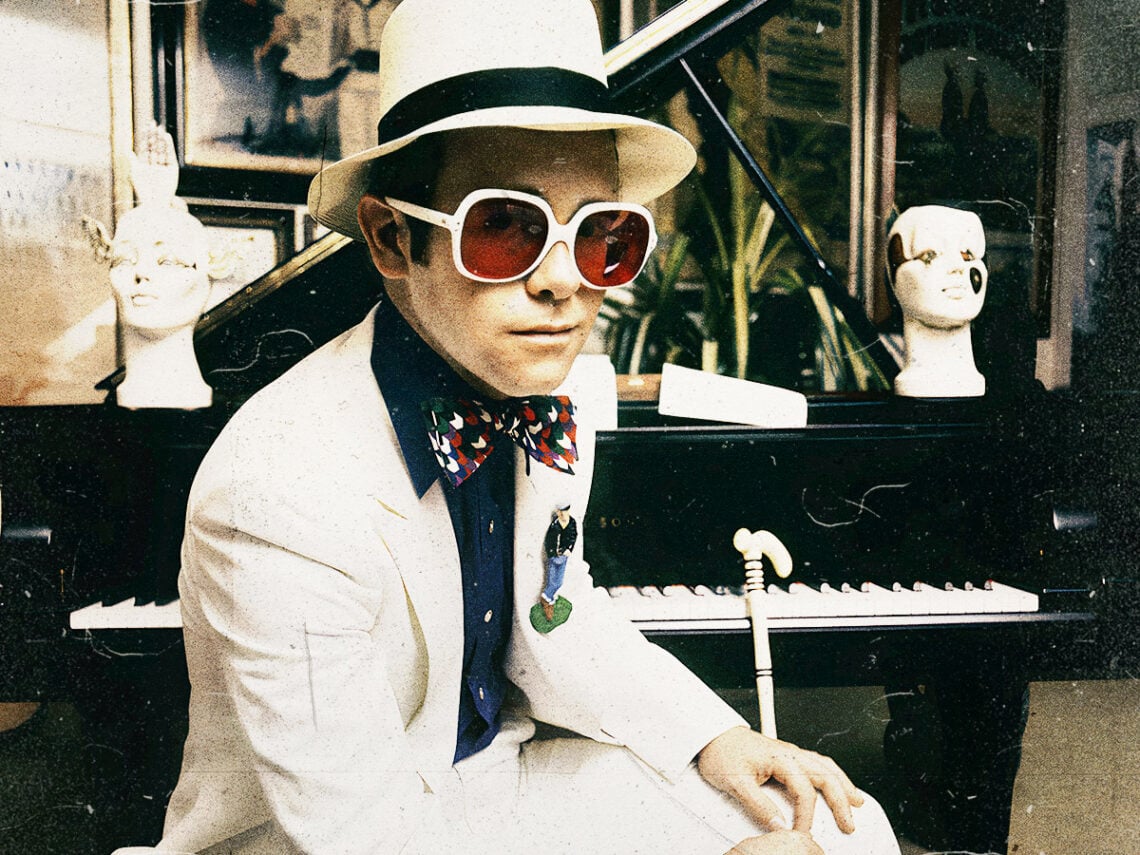
How did Elton John finally get sober?

In a chain of bars across the UK—which shall remain nameless—you’ll find a mural that turns my stomach. The so-called 27 Club, depicted sitting at a bar, having a drink together. Amy, Robert, Kurt, Jim—you get the picture. Maybe I’m being a snowflake, but these were real people who died five years younger than I am now, and here they are on the walls, engaging in the very act that killed them—all to sell us five-pound pints. It’s something of a miracle that Elton John isn’t part of that mural.
Put it this way. When the man born Reggie Dwight signed a mega-bucks record deal with RCA at the peak of his commercial powers, the year after releasing his masterpiece Goodbye Yellow Brick Road, the label reportedly took out a $25million life insurance policy on him, too. In a way, they were absolutely right to.
His biopic Rocketman gives us a few telling glimpses into just how lost to cocaine and alcohol addiction John was, and it’s probably not by chance that when he signed that contract and agreed to that policy, John was 27 years old. This isn’t just rock and roll excess, either. Elton has been brutally honest about how these experiences leave scars that still show today.
During an interview with professional irritant and failed journalist Piers Morgan, he talked about how close he came to dying on multiple occasions, saying, “I would have an epileptic seizure and turn blue, and people would find me on the floor and put me to bed, and then 40 minutes later I’d be snorting another line”.
Heartbreakingly, he told NPR in 2012 that he “still dream(s), twice a week at least, that I’ve taken cocaine and I have it up my nose.”
So, how did Elton John get clean?
The process began, as it always does, with identifying the reason that he was doing it in the first place. In the interview with NPR, he mentions how cocaine brought the chronically shy John “open up. I could talk to people”. It’s quite astonishing how Elton John, of all people, who regularly played concerts in costumes that Liberace himself would say “needs less glitter”, needed chemical assistance to be comfortable in the centre of attention, but it’s true.
However, just knowing that isn’t enough. Sometimes, you need outside assistance, and John found his from the most unlikely source. By the 1980s, his addiction had become so intertwined with his personality that not even the shadow of the aids epidemic could change his ways. That was until he met Ryan White, an American teenager who contracted HIV through a contaminated blood transfusion.
The vicious response Ryan White faced from his community following his diagnosis was appalling. His school, in a gross act of ignorance, barred him from attending despite him posing no risk to anyone. White became a lightning rod for the growing conversation around the humanity of those living with AIDS. Elton John was among the many public figures who befriended White, publicly showing his support, assisting White’s family where possible, and performing his song ‘Skyline Pigeon’ at Ryan’s funeral in 1990.
However, if you ask John about this today, he’ll say what he said at a talk at Harvard University in 2017. John said, “I wanted to help them, but they ended up helping me much more. Ryan was the spark that helped me to recover from my addictions and start the AIDS foundation. Within six months [of White’s death] I became sober, and clean, and have been for 27 years.”
It is a fitting tribute to how the best way of helping oneself is to help others in any way you can.
