


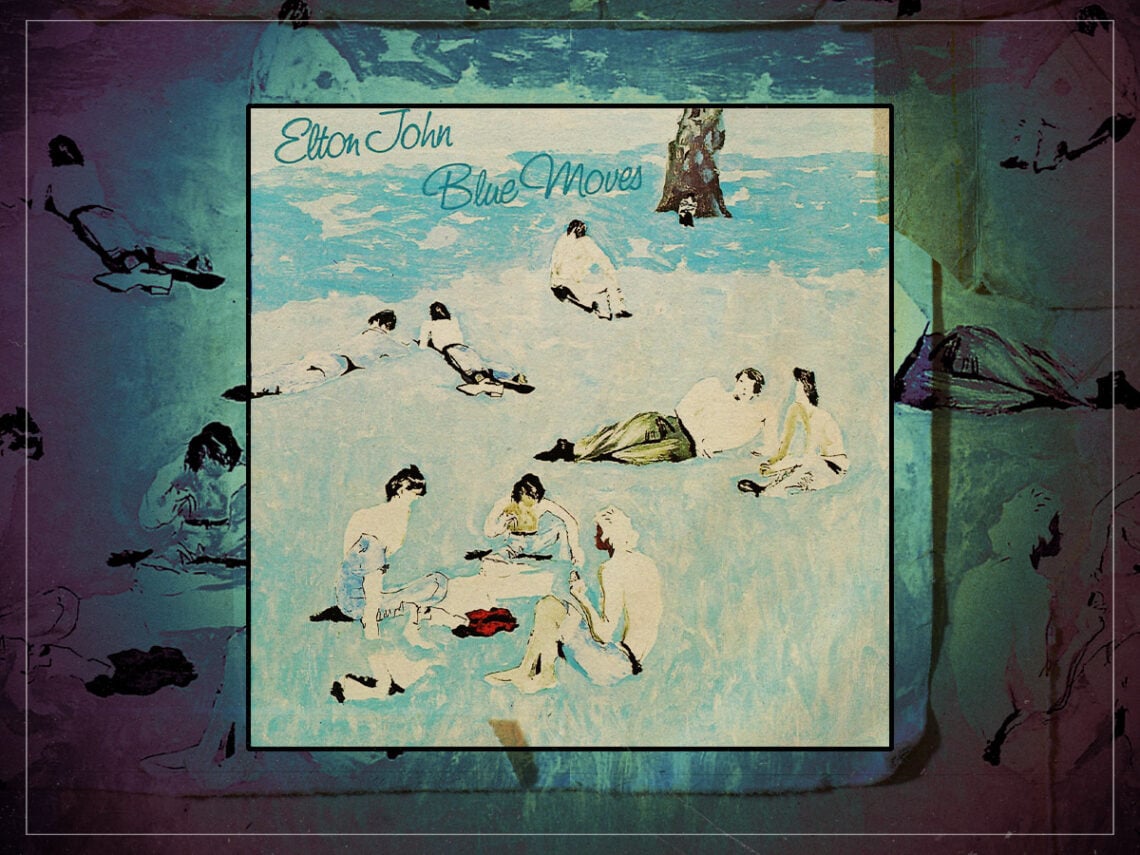
Elton John on why ‘Blue Moves’ was too “complex” and honest for commercial success

Whenever Elton John deviates from what he’s known for, people don’t really know what to make of it, at least for a while.
Find him taking a temporary detour from his usual formulas and catchy melodies and it’s like people view it as some sort of betrayal. And nothing proved this more than when he created his 1976 record, Blue Moves.
Things were a little strange for John in the mid-1970s. For starters, he’d fired two of his long-term collaborators and vowed to take a break from touring after two tours across 1975 and 1976 left him feeling exhausted. He’d also reached a new level of exposure, particularly with one part of his fame that had garnered significant mixed interest: his sexuality.
All the while, he’d been enjoying pinnacle after pinnacle, with the previous two albums, Rock of the Westies and Captain Fantastic and the Brown Dirt Cowboy, topping the charts. He’d also had a string of hits that placed him as one of the leading forces in music. All of these facts somehow support and contradict the notion that he’d suddenly wanted to venture into something different, as his art was clearly working on a commercial level. But it was also the straw that broke the camel’s back when it came to creative satisfaction.
John, along with Bernie Taupin, didn’t want to simply churn out the same thing over and over. Everything they’d done had worked up until that point, but Blue Moves was a culmination of their desire to break the mould they’d created for themselves. It wasn’t about constantly moving along with their own formulas; it was about moving away from them and exploring spaces they had never had before.
Most of the songs on the album were seen as experimental purely because they included different styles, like jazz. But what they were really doing was just showing how John actually felt at the time. It’s also why songs like ‘Sorry Seems to Be the Hardest Word’ were ignored at first, because they came as a surprise, a little too maudlin and not at all the upbeat and lively John that people were used to. Which, to some, was a sign of a lost artist scrambling for a new direction.
Because of all this, people didn’t really know what to make of it. Some people called it far too ambitious to be good. Others said it was too long, or not good enough to hold any kind of authority over titles like “experimental”. To their credit, although some of the songs don’t necessarily hold up against the classics we all know and love, they showed a side to John we’ve never seen, then or since. It gave a glimpse into his mindset and emotions at an intensely strange time, when he was both on top of the world and a victim of his own success.
According to John, who reflected on the record and his experience in his autobiography, Me, Blue Moves means a lot to him because it’s his most authentic work. But he also understands that it was too “complex” to be a chart-topper. “I’m very proud of it, but the music was complex and hard to play, quite experimental and jazz-influenced,” he said.
Perhaps being overly sophisticated with his own emotions ostracised loyalists, but in the end, it’s art that is the most honest that people end up coming back to.
