


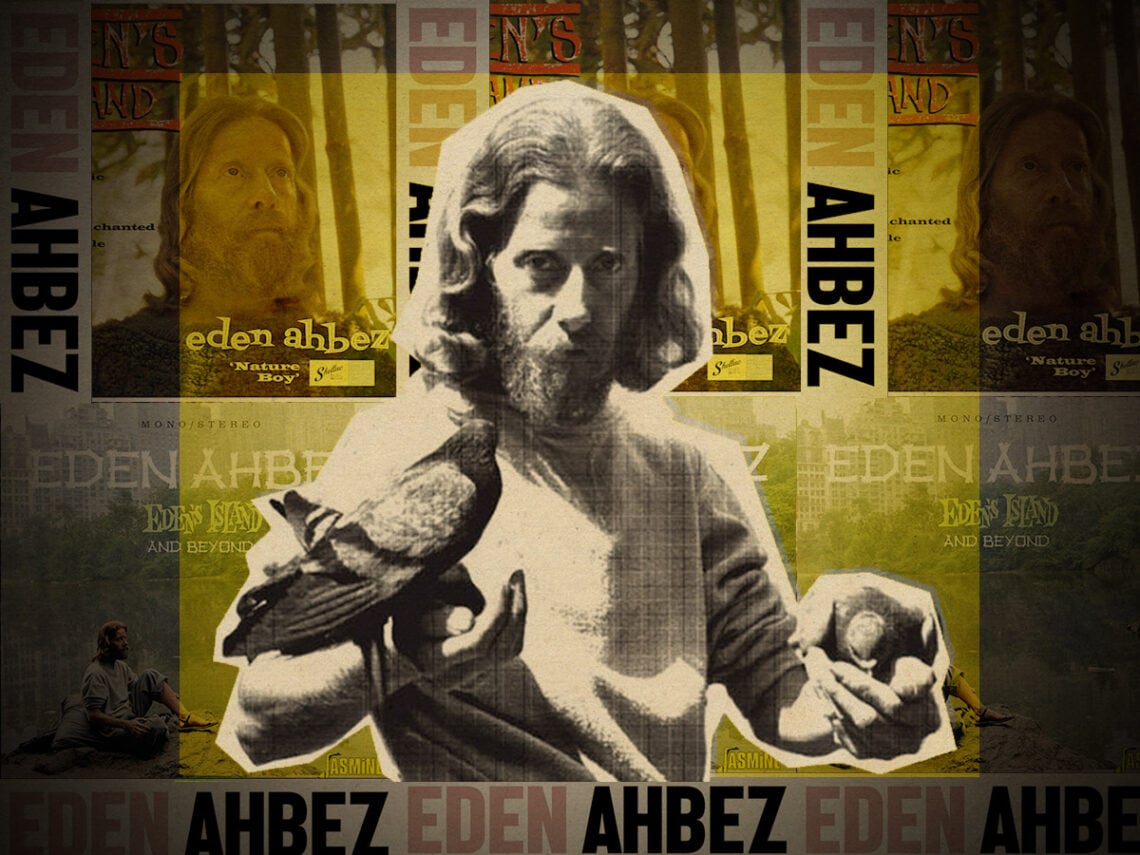
eden ahbez: The first hippie of the counterculture movement

“I look crazy, but I’m not,” said topping charts songwriter eden ahbez (he insisted during his life that his name not include capital letters, as those were reserved for God), AKA George Aberle, AKA George McGrew, as he explained his usual aesthetic in 1948, “And the funny thing is that other people don’t look crazy, but they are.”
Guys like ahbez wouldn’t inspire a second glance in Los Angeles these days, a thin, scraggly, vegetarian fellow with long blonde hair and whiskers, walking around barefoot, living off the land, practising yoga, and writing down song lyrics in a journal; this is the dime-a-dozen description of a million SoCal hippies, circa 1966 to 2026. What made him unusual was that he was doing his thing way back in the 1940s, making him a wildly unique and fascinating character to the press at the time, especially when one of his songs, the self-referential ‘Nature Boy’, became a number-one hit for singer Nat King Cole in 1948.
“And then one day,” Cole sings, describing his meeting with the “enchanted” title character, “A magic day he passed my way / And while we spoke of many things / Fools and kings / This he said to me: ‘The greatest thing you’ll ever learn / Is just to love and be loved in return’”.
According to legend, ahbez had gotten his song to Cole without any involvement from the usual showbiz channels. He’d simply slipped the sheet music to a doorman at an LA theatre where Cole was scheduled to perform, and it somehow found its way to the man himself, who recorded ‘Nature Boy’ a few weeks later. It took a lot of effort for Cole to track down ahbez and ensure he got to reap the rewards of his effort, not that the latter needed it. He was content to spend no more than a few dollars a week, despite having a new daughter to care for with his wife Anna.
“It’s not so much what you want,” ahbez said, referring to wealth and success. “It’s keeping away from the things you don’t want”.
As his story spread around the country, and curious reporters got to work digging into the proto-hippie’s past, it was revealed that eden ahbez was born George Alexander Aberle, and had spent his childhood in a Brooklyn, New York, orphanage. From there, he travelled across the US in an ‘orphan train’ and was given a new home in Chanute, Kansas, where he became George McGrew. His skills as a songwriter and pianist were developed during the Depression while he was living in Kansas City, and by 1941, he’d made his way to Los Angeles, where he’d famously set up a makeshift home for himself under the iconic Hollywood sign for a time.
The extra attention from the success of ‘Nature Boy’ got Ahbez a lot more work, writing additional songs for Cole, as well as Eartha Kitt, Frankie Lane, and Sam Cooke. ‘Nature Boy’ itself, however, became the focus of a lawsuit from Hebrew songwriter Herman Yablokoff, who claimed Ahbez had stolen the song’s melody and concept from him. He strongly argued that the two songs in question had nothing in common, but the suit was financially settled out of court. Years later, ‘Nature Boy’ would be covered by dozens of artists, from Frank Sinatra, Miles Davis and Sarah Vaughan to David Bowie, Massive Attack, and Lady Gaga.
ahbez lost both his wife and son at young ages, but continued to live and work in the LA suburbs well into his ’80s, dying from injuries suffered in a car crash in 1995, at the age of 86. His look and outlook on life were increasingly adopted by the younger hippies around him, who would all likely dig the simple philosophy ahbez shared with Capital News in 1948: “All words lead to that for which there is no word / All thoughts lead to that which is unthinkable / All paths lead to the heart, which is the end of paths / For to live in the heart is to live in the whole”.
