


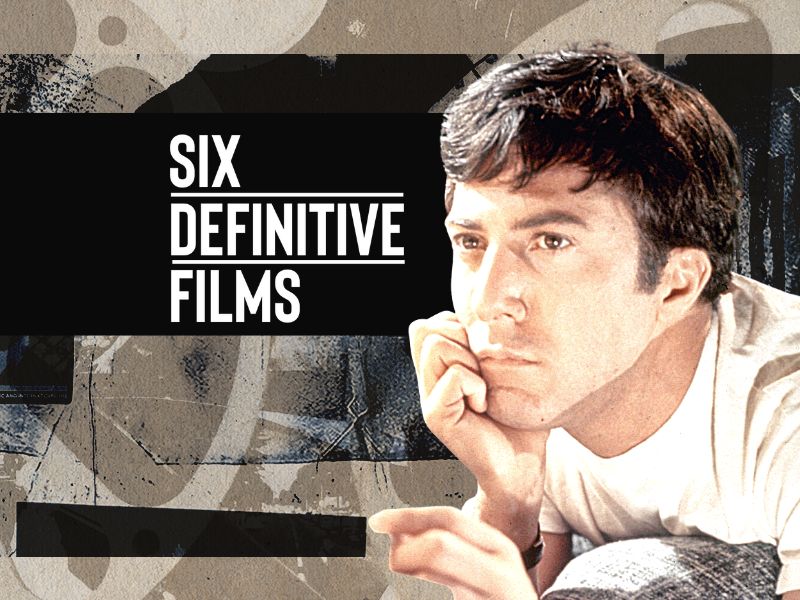
Six Definitive Films: The ultimate beginner’s guide to Dustin Hoffman

It’s easy to forget just how celebrated the American actor Dustin Hoffman was throughout the late 20th century, appearing in some of the greatest movies of the era time and time again. Whilst, in contemporary times, he lacks the star power of his fellow Hollywood actors, in the 1970s and 1980s, few performers could match his affable on-screen charm and dramatic power.
Often depicting a broken, middle-aged individual or a subversive wise-cracking character, Hoffman is a truly versatile actor, described by Robert De Niro as “an actor with the everyman’s face who embodied the heartbreakingly human”. Loved by creatives of the industry as well as audiences across the globe, Hoffman’s collaborations with the likes of Mike Nichols, Robert Benton and Barry Levinson has led to considerable success.
Stepping foot into the film industry over 60 years ago, Hoffman has forged an impressive career, influencing everything from political dramas to hilarious seminal comedies. Tracking every notable beat of his career, take a look at the six most definitive films of Hoffman’s career below, and revel in the filmography of a true American great.
Dustin Hoffman’s six definitive films:
The Graduate (Mike Nichols, 1967)
Busting down the door of acting through several TV performances, Hoffman leapt to cinematic success by appearing in The Graduate at the age of 29. A provocative comedy romance that follows the relationship between a college graduate, an older woman and her daughter, the Oscar-winning movie would establish Hoffman’s name in the history books of cinema, with the 1967 classic still being held in high regard to this very day.
Announcing himself on the world stage, Hoffman received some distasteful media attention about his appearance before proving such shallow comments were nonsense in the years to come.
As the screenwriter of the movie, Buck Henry, told Vanity Fair at the time, “A whole generation changed its idea of what guys should look like. … I think Dustin’s physical being brought a sort of social and visual change, in the same way people first thought of Bogart. They called him ugly”.
Midnight Cowboy (John Schlesinger, 1969)
Just two years after the release of the commercial and critical success of The Graduate, Hoffman would receive his second Oscar nomination, appearing in the seminal 1969 drama Midnight Cowboy opposite Jon Voight. Revealing a true humanism beneath its plot that follows a naive hustler who travels from Texas to New York in search of a fortune, the film was celebrated for the central performances of both Hoffman and Voight.
In a remarkably short space of time, Hoffman had managed to help create two of the most definitive movies of the 1960s, even having the time to star in John and Mary in 1969, plopping a cherry on the top of his decade at the top of the industry.
All the President’s Men (Alan J. Pakula, 1976)
Where Hoffman had proved himself as a force to be reckoned with in the 1960s, his career path in the subsequent decade demonstrated that his potential was almost underrated, once again forging a unique path through the industry. Starring in popular critical and commercial successes such as Straw Dogs, Papillon and Lenny, Hoffman’s first massive ‘70s highlight would come in the form of All the President’s Men.
Featuring alongside Robert Redford, Hoffman played reporter Carl Bernstein in this historical drama that followed the journalists who uncovered the details of the Watergate scandal that would lead to President Richard Nixon’s resignation. Recognised as one of the most important movies of the decade, the film won four Academy Awards, including for Best Adapted Screenplay for writer William Goldman.
Kramer vs. Kramer (Robert Benton, 1979)
Just as Hoffman had produced subsequent cultural classics at the end of the 1960s with The Graduate and Midnight Cowboy, in the 1970s, the actor would finish off the decade with both All the President’s Men and Kramer vs. Kramer, which would hand the actor his very first Academy Award. Adapted from the novel by Avery Corman, the film follows a work-obsessed Manhattan advertising executive who is forced to finally start parenting his child once his wife leaves him, prompting a fierce custody battle.
Providing one of the greatest performances of the ‘70s alongside Meryl Streep, who also won an Oscar for her tremendous role as the ex-wife in the film, Hoffman would finally win the award that had long evaded him, validating his years of success in the industry.
Rain Man (Barry Levinson, 1988)
Whilst he became one of the most celebrated actors of the time, this didn’t stop Hoffman from continuing to experiment, innovate and challenge himself, with his next role after Kramer vs. Kramer coming in the form of the comedy-drama, Tootsie. Kicking off the new decade with instant success, Tootsie would later lead Hoffman to appear alongside Tom Cruise in Rain Man, a classic drama that seized the imagination of contemporary culture.
Winning Hoffman his second Academy Award, the actor was celebrated for his performance as an autistic man with a gifted knowledge of mathematics, a skill that his selfish brother uses to his own advantage. Though his performance would trigger controversy in contemporary society, (why isn’t an autistic actor playing the role?) he undoubtedly gives his all to the role, entwining his physical skill as an actor with his effortless on-screen charm.
Meet the Fockers (Jay Roach, 2004)
Jay Roach’s Meet the Fockers may be far from Dustin Hoffman’s greatest movie, but there’s no doubt that the movie had a significant impact on how younger audiences appreciated the classic 20th century actor. For many, despite such aforementioned successes, this throwaway comedy, where he starred beside Robert De Niro and Ben Stiller, was the very first time that they’d seen him on screen, playing the eccentric father of the main character, Greg Focker (Stiller).
Undoubtedly, the release of the film in 2004 marked one of the actor’s biggest successes in quite some time, with the 1990s being something of a ‘hit and miss’ period for Hoffman. A role as the villain in Steven Spielberg’s 1991 fantasy Hook marked one of his only great performances in a decade that also included middling releases Accidental Hero, Outbreak and American Buffalo.
Though, let us be clear, there’s nothing wrong with a little bit of light comedy, with Meet the Fockers being the second of the successful trilogy that admittedly ended with the disappointing Little Fockers. Reaching cinematic heights in the late 20th century, Hoffman now enjoys the occasional romp, though remains known as one of the most celebrated American actors of all time.
