


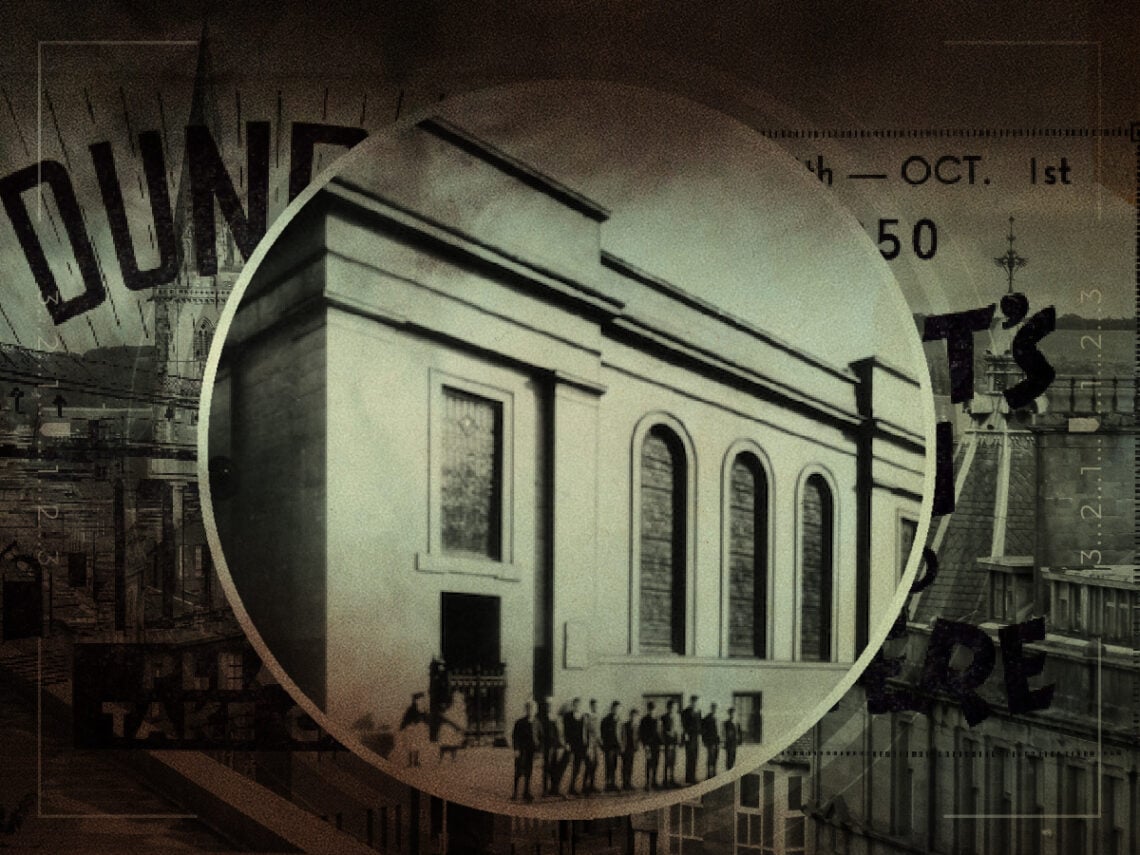
Dundee’s forgotten history as the definitive cinema capital of the UK

Racking my brains, I think it’s safe to say that I know precisely two facts about the fine Scottish city of Dundee: firstly, that I very much enjoy the cake named after it with all the raisins and stuff, and secondly, that it sports two football teams, only separated, rather ironically, by the word ‘United’. Perhaps if I visit, I would find out much more, like the fact that it used to be one of the foremost cinema hubs in the whole of the British Isles.
Geographically, that’s really quite surprising, because for those who aren’t very good at this stuff and have no idea where Dundee is on a map, it is in fact up on the east coast of Scotland, about two hours drive from the border, and so not the kind of place you’d really expect to find a centre for many things, unless it’s fish or marmalade apparently.
But back in the early 1900s, the city was indeed absolutely cinema obsessed, using early projection technology to stage screenings in theatres, makeshift trailers and even shopfronts. By 1906, they even had a proper cinema, one of the earliest, and over the first part of the century, demand grew so much among locals that at one point they had a cinema for every 6,400 residents, a ratio that outpaced much bigger and more famous Scottish cities like Glasgow.
As early as 1912, in fact, with the local fire brigade responding to the growing problem that these ornate buildings were now housing flammable material like film stock and velvet by posting a fireman at every screening, they were overseeing more than 100 such screenings a week in the city. Locals had a ritual; they would go to work all day in one of the many fibre mills producing ‘Jute’ and then pick up a fish supper before heading off to the cinema.
By the 1930s, enormous venues were opening up like Green’s Playhouse, an art deco building which featured an 85-foot tower and seating for 4,000 people in addition to a huge tearoom styled on a ballroom. Other cinemas sprang up across the city, and people had their preferred place to go, with each showing particular styles of movie.
Children in the city were equally excited about going to the cinema, and ingeniously discovered they could trade empty jam jars, with the city producing thousands of tonnes of the stuff each year, for entrance to see their Hollywood heroes.
But by the 1950s, people having televisions at home began to take its toll on the number of picture houses, some of which closed or were demolished, with others being converted into bingo halls.



These days, the city is home to two multiplexes, but also has a thriving arts scene showing independent films, shortlisted for the European City of Culture in 2017 and also playing host to a division of Rockstar Games, the video game powerhouse responsible for Grand Theft Auto and Red Dead Redemption.
The Scottish film industry as a whole, meanwhile, is definitely on the rise, on track to be a billion-dollar concern by the end of this decade and seeing major studio investment in location filming, often using the spectacular scenery for historical dramas and fantasy movies.
