


The drummer Eric Clapton crowned the best ever: “The greatest of our time”

Having worked with some of the biggest names in rock and pop, and being acclaimed as one of the greatest guitarists of all time, a good word from Eric Clapton is a respectable stripe for any artist, no matter their stature.
Lending his legendary fretwork to The Beatles, Phil Collins’ solo work, and sessions with Jim Keltner, Clapton has had ample experience working with world-class percussion pedigree to select the greatest drummer in his estimation with authority.
Surprisingly, even his former Cream comrade, Ginger Baker, didn’t reach the mantle of ‘greatest’. Routinely celebrated for his jazzy afrobeat stylings, fluid poly-rhythmic technique, and dismissing drumming stars like Keith Moon or John Bonham as mere “bashers”, the hotheaded Baker has received florid eulogies praising theirs and bassist Jack Bruce’s interlocking chemistry since he died in 2019, but the artist Clapton claimed was “the greatest drummer of our time” in 1974 has no lasting connection to the drum kit at all.
An artist who can truly be considered a child prodigy, Stevie Wonder was already a Baptist Church choir soloist at eight years old, mastering the piano, harmonica, and, notably, the drums before signing to Motown at age 11. Counting the label’s in-house drummer, The Funk Brothers’ Benny Benjamin, as a major influence, Wonder’s 1962 debut LP The Jazz Soul of Little Stevie primarily served as a showcase of the percussive prowess he learnt from ‘Papa Zita’s big band jazz approach, Wonder on the bongos for instrumental single ‘Fingertips’.
Jump to his classic album era of the 1970s, and you’re hearing Wonder’s impressive skills behind the kit whether you realise it or not. ‘Superstition‘, ‘You Are the Sunshine of My Life’, and ‘Boogie On Reggae Woman’ are all held together by Wonder’s inventive beat, and his distinctive use of the hi-hat has influenced many high-profile drummers.
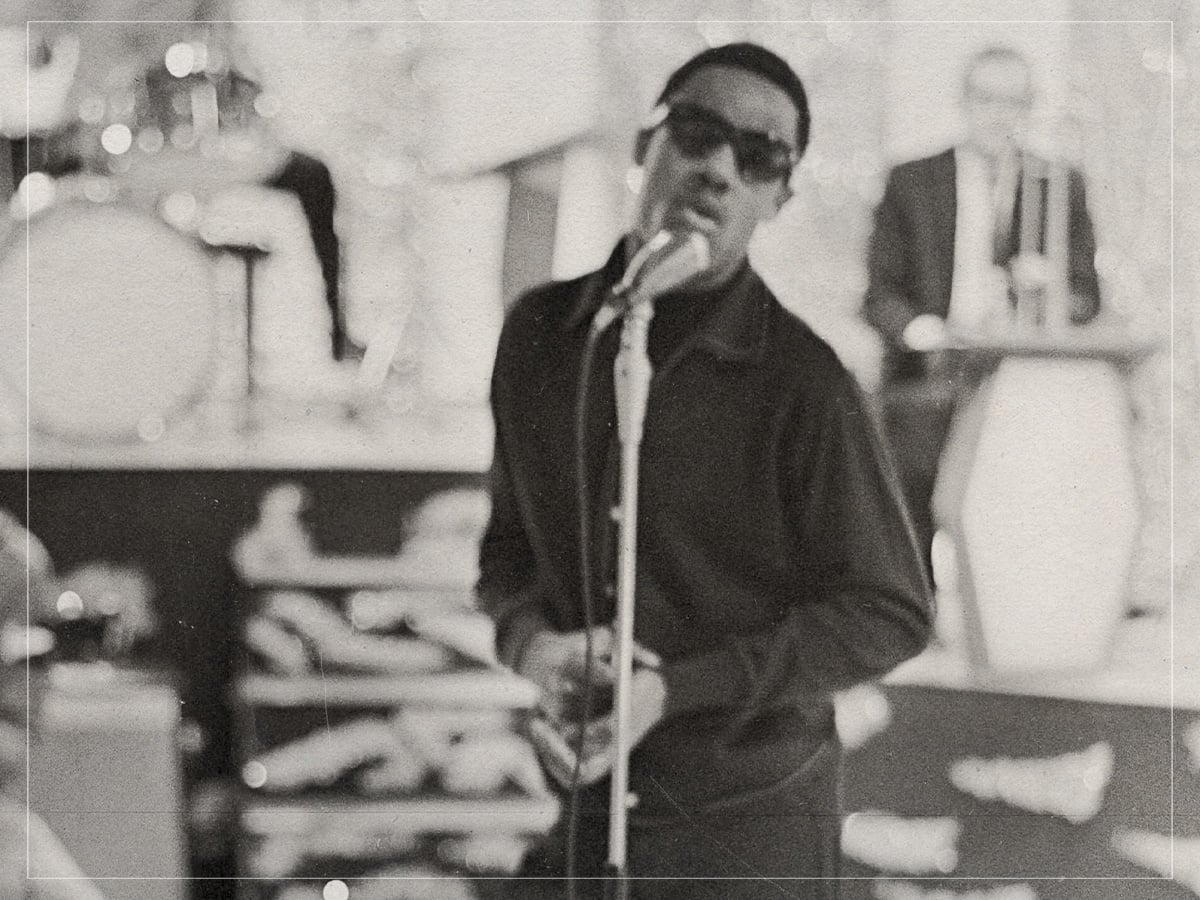
Speaking to DRUM!, The Beatnigs’ Kevin Carnes highlighted Wonder’s loose style: “One thing that strikes me about Stevie’s playing as a drummer is that it’s very relaxed – not so crisp and not so metronomic. He’s using different parts of the stick at different times, and his hi-hat parts change throughout the song. A lot of times, each chorus in a given song is played slightly differently, too.”
Carnes added: “He escalates a song over a long period of time, really growing the whole piece, instead of topping out [energy-wise] early; it gives the music somewhere to go. That, and the fact that he never allows the groove to disappear while adding little embellishments and variations throughout a song really had a huge impact on me.”

Buffalo Tom’s Bill Janovitz reaches the nub of Wonder’s exceptional drumming skills, celebrating his lack of expectation when behind the kit: “There is a musical inventiveness that might stem from being a well-rounded multi-instrumentalist, as opposed to someone who strictly defines themselves as a drummer.” Perhaps that’s his secret? Not being defined as ‘a drummer’ allowed Wonder to approach the instrument free from orthodoxy and stake new creative terrain.
That broader musical understanding is likely what impressed Clapton so deeply. Wonder wasn’t approaching rhythm from the perspective of someone trying to showcase technical chops or dominate a mix with sheer force. Instead, his drumming served the emotional shape of the song, instinctively knowing when to pull back and when to push a groove forward. For a guitarist like Clapton, whose best work has always depended on feel rather than excess, that sensitivity would naturally stand out above pure virtuosity.
It also highlights how frequently Wonder’s musicianship gets overshadowed by his reputation as a singer and songwriter. Most listeners immediately think of his voice, his keyboard work or his catalogue of timeless hits, yet albums like Innervisions and Talking Book reveal a musician capable of controlling every aspect of a recording.
Clapton’s praise may have surprised some fans at the time, but it underlined a truth many musicians already understood: Stevie Wonder wasn’t simply a great drummer for a singer-songwriter, he was one of the most musical rhythmic minds of his generation.
Whether born as a swipe to Baker as has been alleged, Clapton’s high praise for Wonder’s drumming expertise is another bow to the Mowtown legend’s long list of accolades.
