


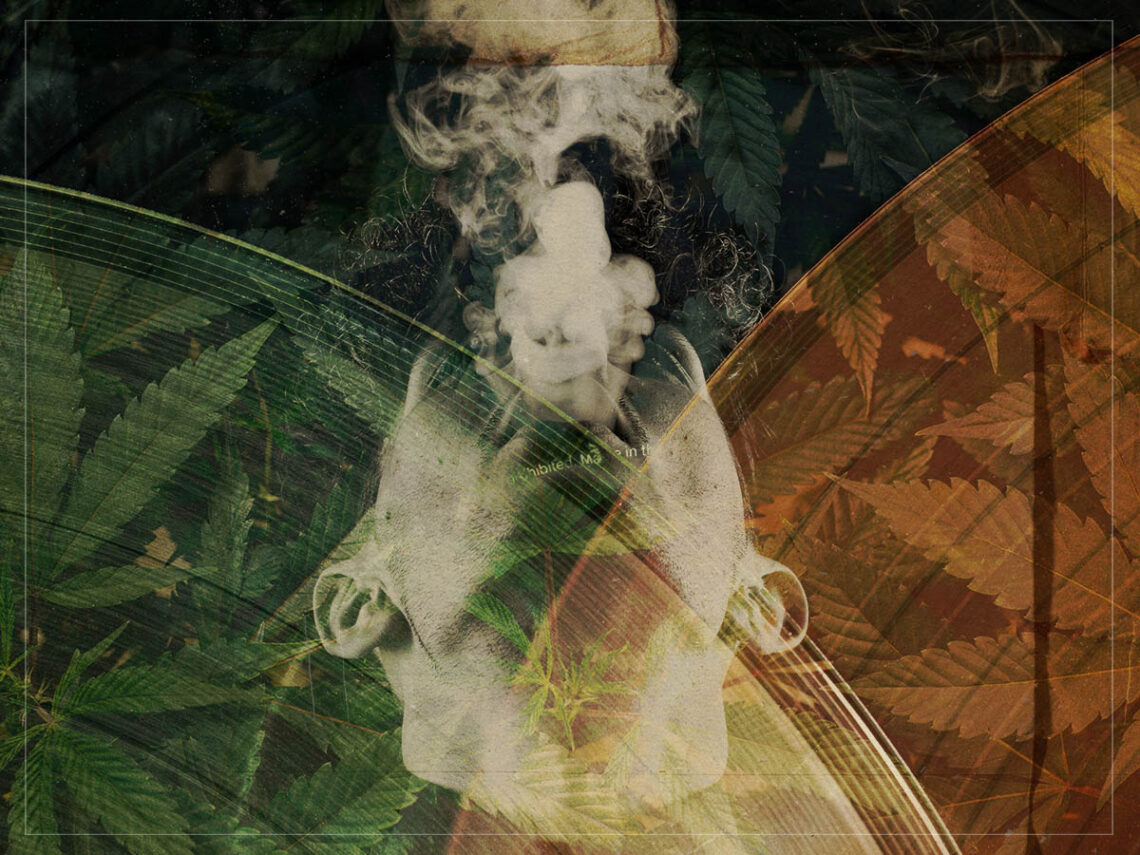
Does music sound different when you’re stoned?

“All my life existed then was going to sign on, get me cash, cashing me dole, going to Sifters, getting a record, buying some weed, going to Greggs, going back home and fucking blasting it out and getting soaked in it.” Those are the immortal words of Liam Gallagher, heard in the 2016 docu-film Supersonic.
OK, not exactly ripped out of the notebooks of William Wordsworth, but when uttered in the carefree voice of Liam Gallagher, there’s something deeply profound about it. He has that ability, doesn’t he? To state the undoubtedly obvious with subtle wit and genuine empathy, that it becomes something more than just pubroom tripe.
With that phrase in particular, there is one word that speaks to me more than most. Because listening to music, blasting on full volume while under the influence of mind-altering substances, is to be very much soaked in the moment. To feel the grooves of the vinyl etch into your skin, where the rhythm feels at one with your own, and the melody elevates you to somewhere entirely transcendental. To experience that is almost a rite of passage for music fans.
But is there any science behind it, or is it purely a symptom of your heightened state? A romanticised idea that music sounds better simply because you feel better? Well, last October, researchers at Toronto Metropolitan University conducted a study to find the answer. Titled ‘Exploring the interaction between cannabis, hearing, and music’, the paper hinged its arguments on the interview of 104 lucky participants. These brave souls, whose job was to simply get high, put some tunes on and kick back, are the soldiers who have just given stoners world over some much-needed legitimacy to their lifestyle.
The paper’s findings hinged on four pillars of argument: Altered Cognitive Processes and Reinterpretations, Auditory Perceptual Effects, Emotional Openness and Sensitivity, Embodiment and Immersion. These were the categories used to understand the answers of their participants who were tasked with describing the music, whose anecdotal responses mostly alluded to a hyper-focused listen of the production as well as a more profound connection towards the lyrics.
These findings are, of course, insightful, but again, why does it feel like that? Well, the psychoactive component found in marijuana, tetrahydrocannabinol (THC), helps release dopamine into the brain, which, in short, helps us synonimise music listening while high as a more positive experience.
However, the sense of immersion from listening to music stoned comes from a separate part of the brain. Cannabis essentially neuters activity within the hippocampus, which is the part of your brain that regulates your short-term memory. As such, your brain enters a more present state, devoid of all the stressful baggage of day-to-day life, which results in centring your focus on whatever activity engages your stimulus at that time.
Zachary Walsh, a psychologist at the University of British Columbia, explained, “It enhances present focus, it inhibits searching through memory, and it allows you to focus on music to make it seem more novel and interesting. The interference with the formation of short-term memories allows the listener to focus on the present moment, rather than searching the memory to predict what happens next.”
But the more anecdotal approach of Toronto University seems to go against the grain of a 2017 study conducted by the University College London, who actually used magnetic resonance imaging (MRI) to monitor reactions within the brain across 16 cannabis users, over three sessions. They found that the substance dampened the effects of music in brain regions sensitive to reward and emotion.
Regardless, what’s the best stoner album?
Despite UCL’s disheartening attitude, there are certainly albums that seem to strike a chord with the altered brain chemistry. Many market themselves as stoner albums, and to pick the best is a truly unanswerable question given the subjectivity of the entire experience. Largely, your own tastes are amplified, and you find new meaning in songs you already enjoy. Alternatively, the hyper-focused nature of the experience means densely produced albums that celebrate layer upon layer of texture take on an entirely new shape, while lyrically dense takes strike a philanthropic chord that perhaps may not have been noticeable in a more generic state.
The former is what makes classics like Dark Side of the Moon so deeply compelling, for it is a masterclass in how a myriad of ideas can be thrown at the wall to create a never-ending journey of sonic storytelling, while making time for the sort of airy, psychedelic melodies that soothe the inebriated brain. While the latter point makes the work of Kendrick Lamar so moving, or better yet, Dr Dre’s The Chronic, which celebrates both facets.
While honourable mentions undoubtedly go to Portishead’s Dummy, Talking Heads’ Remain In Light, and Funkadelic’s Maggot Brain, I’m going to take a stance that the more docile stoner would be proud of. In keeping with the structureless mantras of potheads all around the world, I will say there is no one true answer; instead, beauty is in the eye of the beholder, or in the ears and brain of the so altered.
