


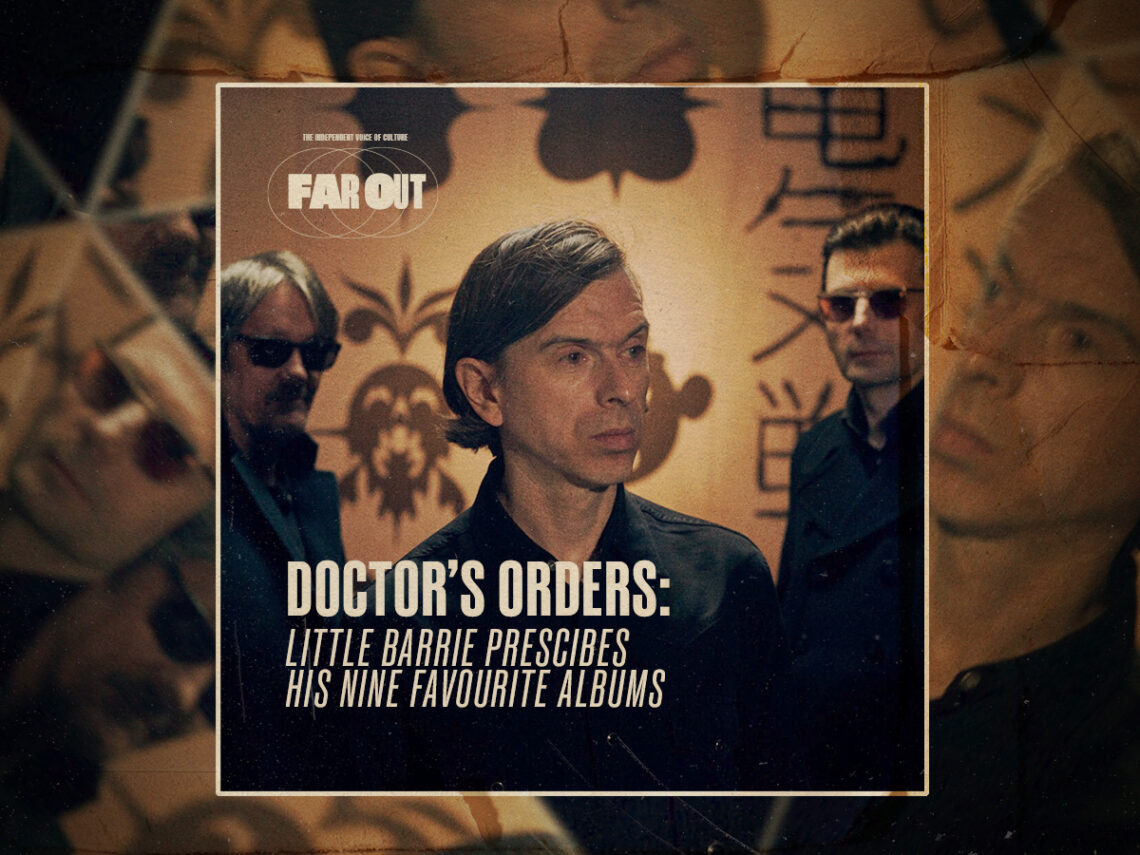
Doctor’s Orders: Little Barrie prescibes his nine favourite albums

It’s almost 25 years since Little Barrie first emerged with their first single ‘Shrug Off Love’ in the summer of 2000. Even in those early days before Barrie Cadogan had fully formed the group, the sound was notably singular. From krautrock to Motown, it seemed as though a century of guitar music was being distilled into one grooving act. Now, alongside Malcolm Cotto, Electric War seems to present the totality of that vision.
“I’ve been a fan of Malcolm’s drumming since I first heard him, likewise with Lewis’ bass playing,” Cadogan said, reflecting the ‘single entity’ sound of the group. “We go back a long way together, and you can’t fast-track that stuff. I wanted to see what we could do when we stretched out musically,” he explained. This shines through in shimmering style with jams that feel tighter than Robert Plant’s pants.
For their first record on Dan Auerbach’s label, Easy Eye Sound, they punted for purity. “I didn’t want to repeat ourselves in regard to a sound, so tried to strip things back more and get the most we could from just the original studio performances,” Cadogan said. This jazzy minimalist creates a sparse canvas where all the styles both Little Barrie and Malcolm Cotto have visited over the years can come to the fore.
So, in our ‘Doctor’s Orders’ feature in partnership with the mental health charity CALM, we take a trip back through the records that satiate Cadogan’s need for grooving soul and inspired him over the years. From The Stone Roses to Super Furry Animals, these are the nine albums that Bill Ryder-Jones loves more than most.
If you’re able, and if you can afford to, please consider a small donation to help the CALM cause. £8 can answer one potentially life-saving call.
Little Barrie prescribes his nine favourite albums:
‘The Stone Roses’ – Stone Roses

As the 1980s drew to a close, The Stone Roses heralded a new age with a debut album that brought searing musicianship, swaggering attitude, and lemons to the masses. The influence on Little Barrie was profound. “Being the age I am, this is just one of those records that seems to be a common thread amongst a lot of people back then. When this was released in 1989, it was everywhere, and it kind of subconsciously got to you. I got into it through my older sister who had a copy and it was definitely the record which made me want to learn to play the guitar,” he recalled.
Explaining, “They were all such amazing fluid players, and I was totally fascinated by the songs, the sleeve and those black & white pictures of the band on the inside with John and his Gretsch Country Gent guitar. The band image was a big part of it, too. This was pre-internet days, and you never really had much to go on when trying to find out about bands, so the whole aesthetic around the band just really drove the intrigue – this was definitely my way into more music and playing.”
‘You’re Living All Over Me’ – Dinosaur Jr

Family can be pivotal when it comes to shaping our earliest music tastes. That was certainly the case with Cadogan and this 1987 alt-rock classic from Massachusetts. “This was another early discovery through my sister,” Cadogan recalls. “I was aware of them at the time through the single ‘Freak Scene’ but listening to this, which was from a couple of years earlier really blew my mind.”
He added, “It was totally beautiful, chaotic and unpredictable but really melodic and after The Stone Roses opened the door to another side of guitar playing. Along with the ‘Roses it definitely marked my early days of geeking out about guitars and band gear. I was just as interested in the equipment J Mascis used and the sound and feel of the whole album. I still listen to this album a lot today and always think Murph and Lou Barlow were a really underrated rhythm section.”
‘Electric Ladyland’ – Jimi Hendrix

In 1968, Jimi Hendrix emerged with his third and final studio album. Was it also his best? Well, Cadogan certainly seems to think its his most complete. He explained, “This is from digging into my dad’s collection. When he heard me listening to ‘Shoot You Down’ from The Stone Roses album he said to me how much John Squire’s playing reminded him of Jimi Hendrix, and he played me his 45 of ‘The Wind Cries Mary’. We then listened to the three Experience albums in sequence with the third being Electric Ladyland.”
It was an emotional moment for Cadogan, and Electric Ladyland was a fitting pinnacle. “I know it’s an obvious choice for a guitar player,” he adds, “but it’s about so much more than virtuosity—It’s a complete piece of work with brilliant songwriting and arrangement. It also showcases early musical crossovers between rock and funk, jazz, folk and studio production with things like tape manipulation.”
Concluding, “There’s just something so mysterious about it in its feel. It just blew my mind in that it obviously took the spirit of early blues and blasted its way out into the future, and it still sounds otherworldly today. I think the whole feel production and even Jimi’s vocal, which in places are pure Curtis Mayfield, are often overlooked, too.”
‘Ege Bamyasi’ – CAN

At some indeterminate point in the late 1970s, Krautrock legends CAN became the litmus test for whether a musician was cool or not. Still to this day, if a band likes CAN, then they’re probably cool. Little Barrie like CAN, as Cadogan explains, “I’d never heard Can, but I’d seen a mention of their song ‘I’m So Green’ sounding similar to ‘Fools Gold’ in a The Stone Roses article, so I went see a mate who worked at Selectadisc in Nottingham, and he played me ‘Vitamin C’ which is the first track on one side of this album, and it got me hooked.”
He adds, “It was just the sound and feel of the record which got me. They sounded about as far from a regular rock band as could be despite the using a pretty conventional band set up. There just didn’t seem to be any prominence of the usual British or US musical reference points in there; they were totally unique and out there, and the production, sound and musicianship were astonishing.”
Concluding, “I actually got to play with Damo Suzuki once and meet him a couple of times, he was such a beautiful soul. He told me that all of the recordings he did with the band were improvised, and that ’s how he liked to make music. CAN were one of the first bands to make me think there was a musical world out there far beyond the usual rock boundaries.”
‘Fun House’ – The Stooges

in the long-running history of our Doctor’s Orders feature, Fun House is perhaps the record that has been picked more than any other. It might be manic, but it stimulates the mind in the best possible way, and clearly, it has opened doors for a legion of musicians, even if the proto-punk masterpiece only peaked at 182 in the charts.
That didn’t stop it from making its way to Cadogan, who explains, “I heard the first two Stooges albums at the same time, but Fun House just had something about it. The band are really cooking, I heard a story that when they recorded this they had a vocal PA set up in the studio so it gave the sessions the feel of a live performance which makes total sense, and apparently enabled Iggy to get the best our of the band being in the room with them.”
He adds, “It’s a record that’s got such an amazing feeling of forward propulsion, but it’s got a real groove and is super funky at the same time, it’s got that hypnotic, repetition thing going on which really hooks you. I got to know Scott Ashton a little when I was working with Primal Scream, and he told us they’d recorded the album in two weeks, which he thought was an amazingly generous amount of time to record a record! He was such a gent. Fantastic cover too—the image of them all in the gatefold is so cool, exactly how a rock ‘n’ roll band should look.”
‘Moanin’ in the Moonlight’ – Howlin’ Wolf

Has the blues ever sounded better than Moanin’ in the Moonlight? This 1959 Chess Records classic showcases Howlin’ Wolf‘s finest classics over the eight years prior to its release and it is appreciated by every musician worth their salt. Cadogan is one of them. He explained, “I think this is a compilation of some of Wolf’s ’50s recordings, including tracks he recorded at Sam Phillips’ studio in Memphis? It’s some of the most powerful and wild music I’ve ever heard.”
“It features some amazing players like Willie Johnson and Hubert Sumlin, who we met when we first went to New York – he told us all about playing with Howlin’ Wolf and then leaving to join Muddy Waters band but then returned to Wolf and then played together until Wolf passed. It’s such a pure and honest record both musically and lyrically, amazingly raw and explosive collection of songs which makes you feel that this is as powerful as music gets. It must’ve sounded off the chain at the time,” he recalled.
‘After the Goldrush’ – Neil Young

With humility and harmony, Neil Young ensured that folk and ‘mother nature’ had a place in the 1970s with perhaps his finest record. It is one that had a lasting impact on Little Barrie. “I remember a mate bought After The Goldrush from a second-hand shop,” he explains, “I was drawn in by the record’s raw spirit and electric guitar sounds and really quickly became fascinated with Neil. I’ve always been drawn in by records that are more on the underproduced side, and this is one of those.”
He concludes, “There’s such chemistry between Neil and those tracks featuring Crazy Horse – They keep it cool and simple but with such a groove. I’ve heard of some people being critical of Crazy Horse for not being accomplished enough musically which to me seems bonkers. They have the soul and that’s priceless. There’s definitely some magic at work on this album, such a pure collection of amazing songs too. I would’ve loved to have been sat in the corner when they were recording.”
‘Fresh’ – Sly & The Family Stone

Sly Stone was a whirlwind in the 1970s in every which way. His wild antics were only eclipsed by wilder tunes. Nevertheless, they were tunes with poise and purpose. As Cadogan explains, “This, like There’s A Riot Going On, their previous album, really felt like a shift in the way they went about recording and producing their albums. It sounds much drier and tighter than what they were doing in the ’60s and the opening track, ‘In Time’, still sounds like it was beamed in from the future. It’s just really hard to pin down where this music was coming from and how you even begin to compose such a song in the way the rhythm and instruments are arranged, combining drum machine with live drums, too.”
Cadogan adds, “I was always fascinated by the cover, that amazing picture of Sly supposedly flying through the air – I heard it was actually shot with him lying on the floor. As a band they were so dynamic too and even though it’s a really futuristic sounding record, it still very much draws from gospel and it’s all rooted by the charismatic vocal of Sly.”
‘Computer World’ – Kraftwerk

In many ways, Computer World, the eighth studio album by the German electronic pioneers, Kraftwerk, still sounds like music from the future—whether that says more about society or the ingenuity of the band remains hard to tell. But as Cadogan explains, its the emotive quality of the 1981 masterpiece that matters most.
“I had some school mates in Nottingham in the early ’90s who were into making music on analogue synths and listening to a lot of ’70s electronic stuff. I first heard and got into this record through them. Like the Sly album heard later, I was fascinated as to where this music came from – at the time, I was so into guitar stuff, and this had no apparent connection to conventional rock ‘n’ roll music. But it’s another record that just draws you in as it’s so soulful and melodic,” he recalled.
Adding, “I love the songs as well as the production, which to me felt different to their other albums, the whole mystique around them, seeming to exist in their own world and do their own thing. Those rhythms and sounds though. – I don’t think I can say anything that hasn’t been already been said about Kraftwerk and their influence on the music that followed.”
