


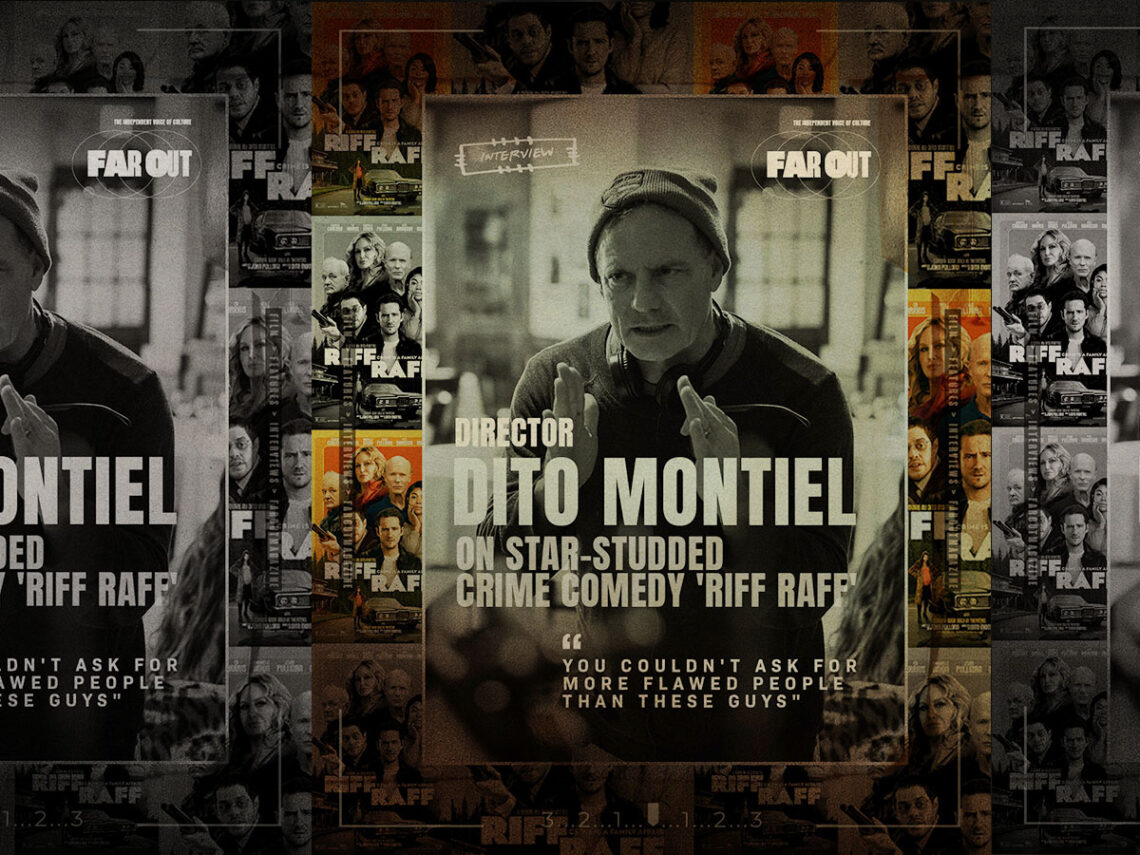
“You couldn’t ask for more flawed people than these guys”: director Dito Montiel on star-studded crime comedy ‘Riff Raff’

Musician, author, writer, director, and producer Dito Montiel lived at least one whole life before becoming a filmmaker, but with the black comedy crime caper Riff Raff marking his eighth feature since he debuted in 2006 with the adaptation of his own memoir, A Guide to Recognising Your Saints, it seems safe to say cinema has become his calling.
Making movies isn’t easy, though, and it’s been a long road to the screen for Montiel’s latest. Originally announced in early 2023 and shot later that year, Riff Raff underwent a couple of casting changes before premiering at the Toronto International Film Festival in September 2024. However, with the film set for release on February 28th, 2025, the director is thrilled that the finish line is in sight.
“It’s a little terrifying in a way,” he admitted of audiences finally getting the chance to see it. “Because you feel like you’ve been holding this little baby quietly, and now everyone’s got to have a picture of it. But I’m excited. I love the film, so that’s a good start, and now we’ll see how the world receives it.”
Riff Raff focuses on a dysfunctional family, with Ed Harris’ Vincent as the patriarch. He seems to be living an idyllic life out in the sticks with Gabrielle Union’s wife, Sandy, and her son, Miles J Harvey’s DJ, until the rest of his clan shows up unannounced and uninvited to throw a significant spanner into the works.
That includes Jennifer Coolidge as Vincent’s estranged wife, Ruth, Lewis Pullman as his wayward son Rocco, and Emanuela Postacchini as Rocco’s heavily pregnant partner, Marina. As it turns out, they’re not there for a family gathering: Rocco is on the run, having run afoul of Bill Murray’s crime boss, Leftie, who’s making a road trip of his own alongside Pete Davidson’s Lonnie to exact revenge.

Clearly, there are a lot of actors with proven comedy chops among the cast, and while Riff Raff leans into that, it’s not necessarily played for laughs. Montiel was aware that he had a gifted ensemble at his disposal, trusting them to bring their strengths to the material without resorting to the easy gag.
“I always try to think of the characters in it, and I don’t think they think it’s funny, so I try to go with that head,” he said. “And when you have Jennifer Coolidge and all these great actors, Bill Murray and Pete Davidson, I don’t think you have to worry too much about shoving it down everyone’s throat. We tried to stay away from that and just tell a story, and the situations hopefully dictate what happens.”
That said, PJ Byrne and Brooke Dillman play overtly comedic characters. The pair embody two overenthusiastic suburbanites who don’t seem concerned in the slightest that a pair of gun-toting criminals have broken into a house in their idyllic neighbourhood. Their scene is definitely played for laughs, and it’s one of Montiel’s favourite moments in Riff Raff.
“I loved filming that scene,” he confessed. “I mean, PJ Byrne is one of my favourite actors on Earth. When I read it, the first thing I said was, ‘Oh my god, I’ve got to call PJ’. And I called him up, and I said, ‘Hey man, we’re filming this in New Jersey. They’re only letting me hire locals. You’d have to fly yourself in, but please do me this favour. It’s with Bill Murray and Pete Davidson’. And he said, ‘I’ll be there.'”
It wasn’t the sort of offer he’d be likely to turn down, and as ridiculous as it may seem for two people to treat interlopers like old friends, Montiel relayed it to a memory from his personal life: “My friend used to drive a cab in New York, and he had a great quote.”
“He’d say, ‘Nobody realises when they complain to me that getting punched in the face is one of my options. They think I’m not allowed to sue them. I’m not allowed to throw them out. They don’t understand that one of the options is fucking killing them.’ So, to what you’re saying, I do think there are a lot of people who may not see that coming. These neighbours certainly didn’t.”
That sentiment encapsulates Riff Raff as a whole: it’s definitely heightened, but it’s not particularly far-fetched. It was a balance Montiel was aware of throughout production to keep one foot in each world without giving in to either, although he was ably supported by a cast who fully understood their roles.
“Hopefully, you let the situations dictate where it goes,” he offered. “Again, if you put Jennifer Coolidge in a particular situation where she’s waking up drunk in a house she doesn’t know, talking about what she’s talking about, I think pushing the comedy is maybe the last thing you’ve got to worry about. This family is definitely a bit more dysfunctional than most, I imagine, and a little more happens with them. But families that should not stay together often do, so this one might be a little more extreme.”
Speaking of Coolidge, she gets plenty of outrageous lines right up her street. On the other hand, Ruth isn’t there solely for comic relief. Everything she says has some degree of truth, whether it’s tied to the plot or the characters, with Montiel and the actor working closely together to guarantee that she was never reduced to a caricature who existed for the sole purpose of dropping one-liners.
“Funnily enough, the first thing I had thought of when I imagined her in the role, especially when she said she’d do it, was a scene that wasn’t in the script that’s in the movie, where she’s looking at all the wealthy things that Sandy can afford and she can’t. And it kind of broke my heart and made me love Ruth. I always thought of that scene as grounding her and hopefully making you understand the character and like her.”
“For some reason, that scene is one of my favourite scenes to film, and it was a last-minute improv,” Montiel continued. “It was something I had envisioned for a while. It was about Jennifer’s character, Ruth, not just being a joke to be laughed at. I enjoyed doing that, and then it set a bit of the tone for who she was.”

In the role of Lefty, Murray sinks his teeth into the sort of villainous role he doesn’t play too often. Knowing that he’s made himself famously difficult to track down and get a hold of, it seems only fair to ask Montiel how he managed to locate the notoriously elusive legend to get him on board.
“One of the producers, Adam Paulsen, had called me just a couple of weeks before filming and said, ‘I think you’re going to get a call from Bill Murray today; I’ll give you the area code’. And he goes, ‘If you see that area code, you better answer it.'” So far, so Murray, with Montiel fully aware of “this remarkably secret phone number” the actor used to make himself so hard to find.
“It rang, and it was one of those really exciting moments as a fan for my whole life, of course,” he confessed. “And then, funnily enough, I saw an interview with Bill Murray recently where I would say it’s true, having known him, where he says, ‘When you do a movie, we can be friends as long as we’re ready to work’. And he’s very serious about his role. Certainly, it seems, he takes it very seriously. He talked about every single line in the entire movie with me.”
“Sometimes, you’re a bit in awe. I’m thinking, ‘I can’t believe Bill Murray gives that much of a shit’. I mean, I certainly do, but it’s nice that he does, you know? And it was a pleasant surprise that a guy at that level would come and do a role like this and take it deadly seriously. And then, what a guy like him can bring to a line that you thought was interesting, usually a lot more interesting than whatever you had imagined.”
Montiel would be “sitting back at times and being like, ‘Oh, wow'” when Murray put his own stamp on the dialogue. “I didn’t know this line was going to be said that way. It’s like Christopher Walken or something. They rearrange your line, and it’s just quite a thing.” A lot of people who’ve worked with the enigmatic icon have a Bill Murray story of their own, but did Montiel walk away from Riff Raff with one of them?
“It was just that he was taller than I imagined,” the filmmaker self-deprecatingly recalled. “It was just such a pleasant surprise. I know this sounds like corny director crap, but it was a nice thing when a guy at that level shows up and is dead serious about a role. I’m one of those people that feels like they have to tell famous people who they are. You’re like, ‘Wow, Al Pacino’. They don’t need me to remind them, but I’m a bit excited because of who they are.”
“My only story about him was what a good actor he was and how he cared about everybody. I mean, he cared about every line that Pete Davidson said as much as he cared about his own. It’s a really nice thing when it’s a giving actor. I’ve had that quite a few times, and in these movies, it’s something I’m happy to receive.”
Riff Raff might have a stacked cast, but it’s Harvey’s DJ who provides the movie’s moral centre, with the young actor holding his own against so many illustrious co-stars. It’s a deceptively difficult performance to be the oblivious eye of an encroaching storm, and Montiel was thrilled with how he lucked out.
“I thought, ‘This movie is not going to work without DJ,'” he concurred. “I don’t care that as great as all these other people are, DJ was the anchor, and he’s the only person asking all these questions in the movie that he actually doesn’t know the answer to. We had these open call auditions, and I was terrified because when you sit at home when you write something, or when you read something and it’s kind of funny, you start hearing people. I’m thinking, ‘Oh my god, I don’t want this guy to sound like Urkel.”
Fortunately, despite Harvey shouldering plenty of verbose lines, he didn’t end up as the second coming of the sitcom staple. “These are very difficult words to say if they’re not in your vocabulary, and Miles walked in, and in three seconds, I said, ‘I’ve not felt more relief from any actor in this movie than when Miles walked in the door’. So as much as I love all the rest of them, Gabrielle Union and Ed Harris, who I adore, Miles, to me, was the anchor to feeling like, ‘OK, it’s going to be a good bride’, and I just think the world of him.”

At the end of the day, Riff Raff is a story about family, no matter how dysfunctional it may be. There are laughs along the way and several bursts of jarring violence, but it was always important for Montiel to have Harris’ Vincent at the centre, tying every major plot beat and character together, for better and worse.
“Vincent and DJ, everything comes back to them,” he elaborated. “Because one of them knows everything, and he’s the biggest liar in the family, and one of them knows nothing, and he’s the most inquisitive person. If your main plot point is in the hands of Ed Harris, you’re definitely safe.”
Vincent knows everything but says nothing, and DJ knows nothing but asks about everything. At first glance, that would make Sandy the straight woman of the movie by default, but it gradually becomes clear that there’s a lot more to her than simply being a happy wife and mother. Her arc is foreshadowed throughout Riff Raff, which saw Montiel and Union collaborate closely on its intricacies and nuances.
“I probably had more interaction with her about her role, which affected the whole film, than anyone,” the director agreed, tying it to the film’s explosive third act when bombshells are dropped and revelations are made. “When Gabrielle and I would talk through it, the main point was, ‘We know this, but today’s the day we’re going to have to talk about it.'”
“And I thought initially, that’s going to hurt the movie, but it was like that scary movie thing where you can do a jump scare, and it’s an incredible one-minute Michael Myers moment, or you can show Michael Myers watching across the street to the schoolhouse, and for ten minutes, you’re terrified, so a lot of the collaboration with Gabrielle ended up turning the film more into, ‘This is a family that knows more than you think they know, but today’s the day we’re going to talk about it.'”
Although Montiel conceded that the slow-burn approach was “maybe not the most pop way of going,” he stuck to his guns because he thought “it was a more interesting way, and it fit the film better.” He may have worked closely with Union on Sandy’s arc, but the filmmaker is open to suggestions from anyone he works with, regardless of their position on the call sheet.
“If a guy’s playing the toll booth clerk, I like to sometimes hear his backstory. Sometimes it’s a little crazy, but you learn your film by it. I’m always excited to hear an actor’s input. Or anyone, DP, craft services: if they have a good point, I’m happy to absorb it.”
With so many talented actors at his disposal and a premise that’s ripe for comedy, it stands to reason that Montiel would have allowed plenty of room for improvisation on set for the performers to bring their own flair to the table. While that’s true to a certain extent, his previous experience working with comedic legends let him in on a little secret.
“Having worked with Robin Williams and a lot of comedians or people that do comedy, I’m always surprised at what interesting actors they can be,” he shared before making an unusual analogy. “It’s like when you first move out, and you think ketchup is free, and you realise you’ve got to buy it: that’s what improvising is.” Fortunately, an explanation was forthcoming.
“You think it’s a joke. You know, it’s Bill Murray. Let him do whatever he wants. But, surprisingly, they’re saying almost everything that’s written. Once in a while, of course, it’s the way they do it, which is why we all know who they are. You sit at midnight, and you write some dumb line, and then when someone of that level says it, you’re like, ‘Oh wow, that was a really good line’. So there’s always a little bit of play, but it’s in the delivery.”

“Who’s going to say a line like Jennifer Coolidge?” Montiel asked entirely rhetorically. “I don’t care if you’re Meryl Streep; you don’t learn that. It’s like Shaq. You don’t learn seven-foot-four, do you know what I mean? You just are. It was a lucky break.”
As a filmmaker, Montiel has tackled drama, crime stories, thrillers, and comedies to varying degrees. Riff Raff operates on all of those levels at once, often in the space of a single scene, but the director never viewed the project as a deliberate opportunity to bring the best of everything he’d done before to the same production. Instead, it’s always about the material.
“Good writing is a drug for everybody,” he explained. “If something intrigues me, there has to be a personal connection. I see my mother in Ruth, and sometimes I see things like that, and I empathise with people who are kind of messed up. This passage of time has been an obsession of mine, whether it’s funny or a crime or a horror film; that doesn’t matter to me. It’s just a story, and if I can relate, I wish I related to bigger things. I might make more money, but I relate to characters that are flawed in a big way, and you couldn’t ask for more flawed people than these guys.”
In addition to the big names populating Riff Raff, Montiel has worked with the likes of Robert Downey Jr, Channing Tatum, Al Pacino, Gary Oldman, Dwayne Johnson, and Robin Williams, to name just a few. There aren’t any names he’s desperate to check off his wish list, though, with the filmmaker preferring great acting over the names who are giving the performances.
“This is a corny answer, but to me, I’m excited when they show up. When Miles Harvey shows up, or Lewis Pullman, who I didn’t know before this film or Emanuela Postacchini, I’m just as excited. To me, the bucket list is having good actors show up. Because I don’t care what good words you write, if they’re not said in a good way, it doesn’t matter. Hopefully, I’ll meet some more interesting ones.”
