


Who was the director kidnapped and forced to make propaganda movies?

There are some stories so bizarre a screenwriter could never concoct them, and the case of a renowned director being kidnapped while searching for his ex-wife – an actor who the exact same regime had previously kidnapped – is definitely up there with the most unbelievable.
Together and apart, Shin Sang-ok and Choi Eun-hee were hugely successful, becoming two of the biggest names in South Korean cinema throughout the 1950s and 1960s. They made numerous movies together, co-founded the Shin Films production company, and were one of the local industry’s premiere power couples.
No golden period lasts forever, though, and by the late 1970s, their personal and professional lives were on a downward slope. Under threat of censorship and interference, the government cracked down on expression and creative freedom in cinema. By 1978, Sang-ok was effectively ostracised from the industry after running afoul of the authorities, with his company shut down by then-president Park Chung Hee.
Sang-ok and Eun-hee had adopted two children together, but their union ended in divorce in 1976 when she discovered he was having an affair with a younger actor, Oh Su-mi. She was determined to continue her career without him, which unwittingly led her down the path to kidnapping and imprisonment.
Lured to Hong Kong under false pretences in January 1978 with the offer to direct a feature and potentially run a performing arts academy, Eun-hee was instead abducted by the perpetrators behind the ruse: North Korean agents who brought her to the country against her will. She may not have been confined to a cell and was treated well by all accounts, but she wasn’t there of her own volition.
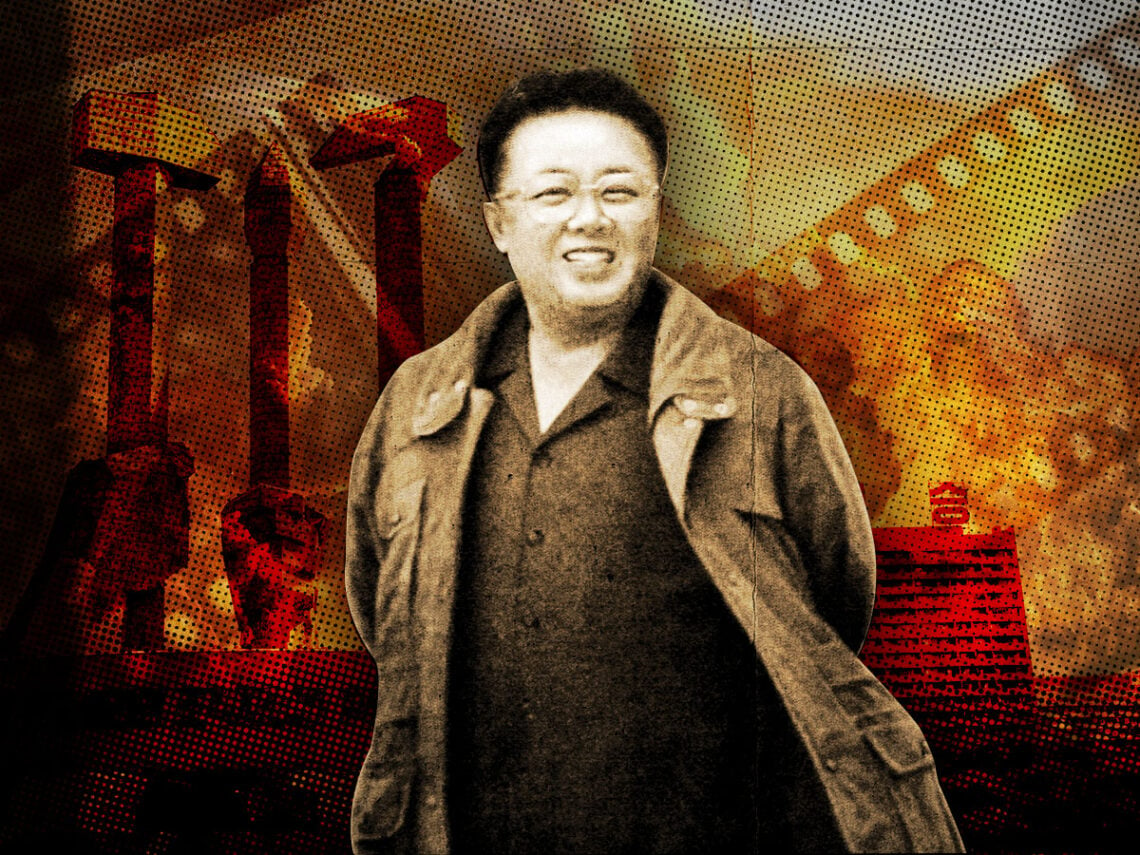
Neither did she know she was being used as bait, with Sang-ok the real target of Kim Jong-Il. An avid devourer of cinema in all its forms, the ruler had big plans for the North Korean industry and decided the best way to achieve his desired results was to kidnap Eun-hee and hope that her estranged former husband would set out to find her, which he did.
Even though he’d stayed with Oh Su-mi and had children with her, he started searching for his ex-spouse. Much like Eun-hee, it was in Hong Kong where he was captured by North Korean operatives, and after making two failed attempts at escape, he was sent to prison. Throughout all of this, he wasn’t informed that Eun-hee was also in the country, and it wouldn’t be until March 1983 – more than half a decade after her forcible stay had begun – that they were reunited.
Their reunion unfolded before a huge crowd in Pyongyang, and at Jong-Il’s urging, the pair were remarried shortly after. He wanted them to emulate the movies made in America, Britain, and Japan that captured the imagination and attention of audiences worldwide, in the express hopes that it would turn North Korea into a global cinematic force.
From 1983, Sang-ok helmed seven films in North Korea: the historical drama An Emissary of No Return, the musical Love, Love, My Love, the melodrama Runaway, Breakwater, the 1930s-set tragedy Salt, another musical in The Tale of Sim Chong, and perhaps most famously of all, the blatant Godzilla ripoff and cult classic creature feature Pulgasari.
How did Shin Sang-ok escape from North Korea?
As his failed escape attempts demonstrated, Sang-ok always had one eye on fleeing North Korea and even created a contingency plan should the best-case scenario unfold.
The director and Eun-hee would regularly carry a hidden tape recorder into their conversations with Jong-il in the event they returned to South Korea and were accused of defecting voluntarily. They were filmed in public saying they were there voluntarily on more than one occasion, but they had the evidence to confirm that wasn’t the case.
After being deployed to Vienna upon finishing work on Pulgasari on Jong-Il’s orders to find a financier willing to back a blockbuster about Genghis Khan’s life and times, they played the leader’s agents at their own game by setting up an interview with a journalist and instructing their guards to leave the room, which was a setup for the couple to flee towards the United States embassy.
In exchange for asylum in America, they told the CIA everything they had seen, heard, and learned in North Korea, eventually being granted citizenship to be reunited with their adopted children and Sang-ok’s biological kids he fathered during the affair that had originally split them up in Virginia.
He even tried to relaunch his directorial career under the new name of Simon Sheen, but the height of his Hollywood career came with 1995’s 3 Ninjas Knuckle Up, so it would be fair to say he never recaptured his former glories.
