


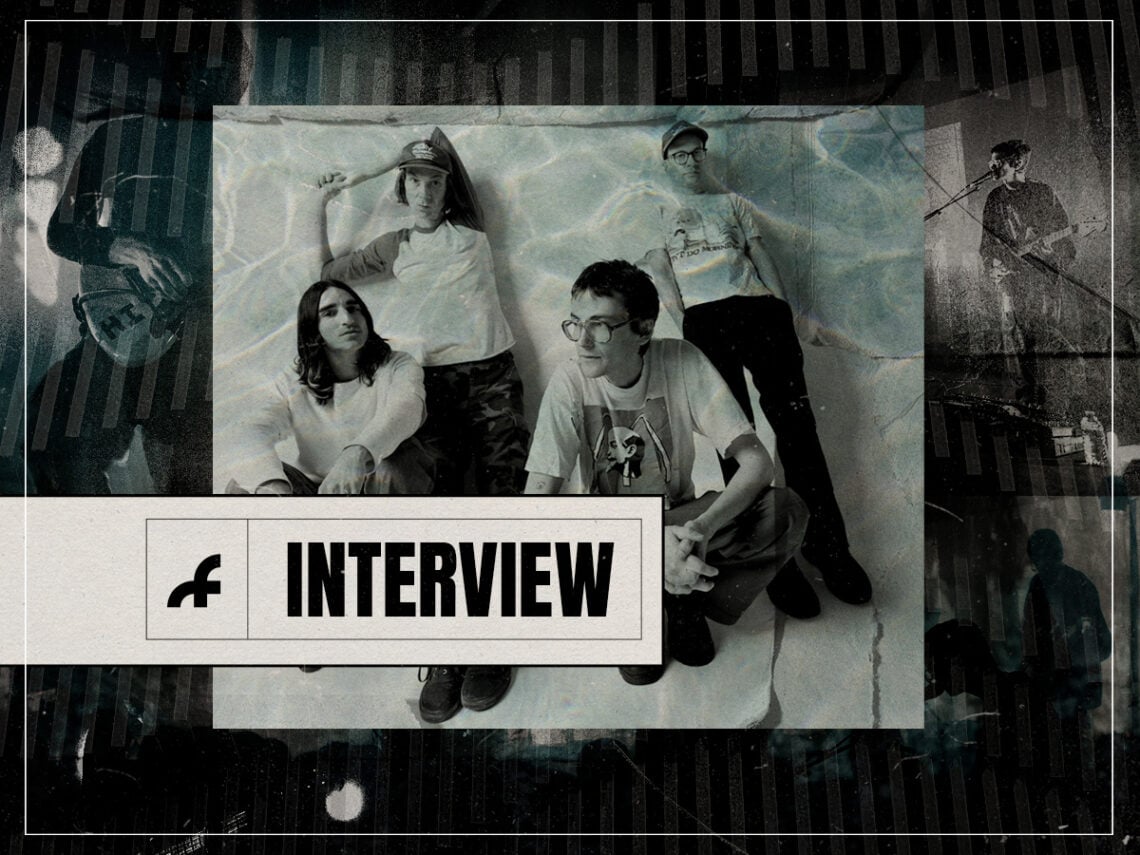
“People have lost their ability to critically analyse media”: DIIV on ‘Frog in Boiling Water’ and the age of a Zen Fred Durst

On their new album, Frog in Boiling Water, DIIV assert that we are very much the titular toad in the pot and capitalistic constructs constitute the bubbling liquid slowly hauling us to oblivion. The band’s most political and existential body of work yet, this tangible theme adds an entirely different dimension to their artistry.
Frontman Zachary Cole Smith’s incisive philosophy forms the lynchpin of the postmodern record. With wry, Francis Fukuyama-challenging lyrics such as “Our lives are done / The good guys won / And everybody had fun” and “we kill then we die” all found in just one song, the album offers a dense world of consequence. In true Smith fashion, though, his postulations are lifted by the subtle flickers of irony he has always been adept at.
Smith delivers a further stroke of sagacity by counterbalancing what would ordinarily be undeniably bleak messaging with a distinct glimmer of hope that pierces the raven clouds encircling.
After all, he became a father while making the album and could not bring himself to pen something so purely fatalistic, given his internal hopes for the future, regardless of the world carting headfirst into oblivion. This angle, in tandem with the record’s title referencing Daniel Quinn’s 1996 novel, The Story of B, creates a particularly robust cerebral palette, making us ruminate in ways that previous DIIV albums have not.
When the album was announced, the band informed us that if you drop a frog into a vat of boiling water, it will frantically try to escape. Yet, if you placed one in a pot of tepid water with the heat on low, the amphibian would enter a serene stupor, akin to a human in a hot bath, and be passively boiled to death with a smile.
It’s a grisly point, but the group understands this to be an adept metaphor for the slow and “banal collapse of society under end-stage capitalism”, with myriad cruel realities presently accepted as standard. Late capitalistic creations such as the internet, social media, and fast fashion act as the water, warmly encasing us in blissful doom as more nefarious actors swoop in unchallenged. Accordingly, the album is intended to be a series of snapshots presenting different angles of this perverse contemporary condition.

Wasting no time getting into it, the take-home line from album opener ‘In Amber’ is: “I want to disappear”, outlining common sentiment about the present. Sitting down with the band in a backroom of the Hoxton Hotel in London, we discussed the record and its themes. I asked them how they would disappear if they could. Hooded guitarist Andrew Bailey, quietly toking on a sweet-scented vape in the corner like a road-weary Strider in Bree, revealed that he once considered taking off when cruising in Southeast Asia but ultimately decided against it. The disinterest in going into further detail painted quite a picture.
While our discussion was far-reaching, touching on everything from the sanctuary of Minecraft to the band debating purchasing a seven-string guitar for their low drop-tunings, it was the issue of why and how they have lampooned the present that really stood out.
The group perceives the demise of people critiquing the provenance of the information they are fed as a component of this sluggish societal ruin. The single ‘Soul-net’ explores this by analysing the strange and often alarming world of online conspiracy theories. The group has gone one step further and masterfully brought this world to life with the website of the same name, a startling but ultimately sardonic domain.
The Orwellian project summarises the group toeing the line between graveness and humour on Frog in Boiling Water: “Are you starting to think this is all the same. The military-industrial complex picking and choosing what is cool where to go, what food to buy? THE BARBIE MOVIE? AND OPENHEIMMER AT THE SAME TIME? Are you a frog in boiling water?”
With the video for ‘Soul-net’ also featuring lifelike but immensely unsettling AI renderings of the band members, DIIV have jumped headfirst into the world’s present inertia, post-truth, and, of course, the fading skill of critiquing sources. Furthermore, the buzz they created around the video for the lead single ‘Brown Paper Bag’ sketches just how accurate their interpretation of the present is on the new record.
When DIIV announced the video, it was met with considerable excitement. From the teaser images and snippets, it seemed they had appeared on America’s late-night institution, Saturday Night Live, in an episode presented by Limp Bizkit frontman Fred Durst. They hadn’t, though. It was all a very clever ruse.
Before exploring the motivations behind such a shrewd move, it was necessary to understand what the nu-metal frontman was like to work with, given his cartoonish and controversial reputation. All four members chuckled when asked, with bassist Colin Caulfield stating, “He was amazing”.
Durst was not wearing the Dickies and Vans that went viral a couple of years ago, either. He cut a completely different figure to the one we think we know, setting an apt precedent for the ensuing conversation. There was no red New Era cap. According to Smith, the Limp Bizkit man was clad in flannel and hiking boots.

The frontman describes: “He lives in a really crunchy part of California, a very serene, beautiful place. He seems to have a lot of wisdom and Zen that can only come from having experiences over such a long period of time where, probably at first, your brain is fried, and then it coalesces into this wisened… he felt really serene and nice. Just completely the opposite of the character he played on TV for so long.”
This surprising disclosure confirmed that you cannot believe everything you see. If Fred Durst isn’t the man we’ve thought he is for years, then who knows what other falsehoods might have permeated as part of the broader late-capitalistic malaise?
Smith explains that DIIV got the idea for the fake SNL performance after they assembled the Soul-Net website. That was a fun endeavour and “really spoke to our interests and the world around the record, but it was a little bit too niche,” he notes. Therefore, when they were debating their next step, the group figured that the opposite of the nook of the internet they were “satirising” was “the biggest show on earth. We just thought, what if we were on Saturday Night Live?” The idea behind the stunt was to do “something subversive and lying to people but in a fun way”. Sure, they had fun, but Smith maintains they weren’t trying to make fun of anything.
The frontman expands the SNL stunt to the current societal torpor: “It’s a signifier of our era that you can really just say anything you want, and it can become true, and a lot of people do it for very sinister reasons. We did it a little deeper. We did the show, and we made the trailers, all the fake photos of us backstage or whatever, but also seeded websites into Google at the top of the search results so that people would Google, ‘Wait, Fred Durst DIIV’, and the first three results would be news articles that we wrote and paid $15 to plant.”
Smith continues down this trail of thought and hits upon the pressing point: “It was a little bit alarming. There really wasn’t supposed to be a butt of the joke; SNL wasn’t the butt of the joke. I feel like the butt of the joke ended up being people with like…,” he recentres. “People have lost their ability to critically analyse media because they plant themselves in echo chambers where they are like, ‘Okay, I agree with everything that happens in this space.'”
As expected, people saw the announcement of DIIV on SNL, thought it was terrific news and sent their sincere congratulations, a feverish sentiment exacerbated by being in an echo chamber of like-minded fans. Herein lies another issue. Smith notes: “Our little wink is that all they had to do was see it’s on a Monday.”
Famously, SNL airs on Saturday night. “It was a commentary on the idea that you can just say anything, and if we’re doing it for fun, there’s gonna people who are doing it for, you know…”
“It’s a veiled political thing,” Caulfield concludes. “We’re not necessarily extremely serious people,” he asserts, stating they also want to have fun when promoting the album. Undertaking projects such as the above is a way of addressing vital topics, but doing so playfully makes it more resonant, as it strikes out from the solemnity typically conveying issues of such gravity. “It feels more engaging to deal with it in this way.”
