


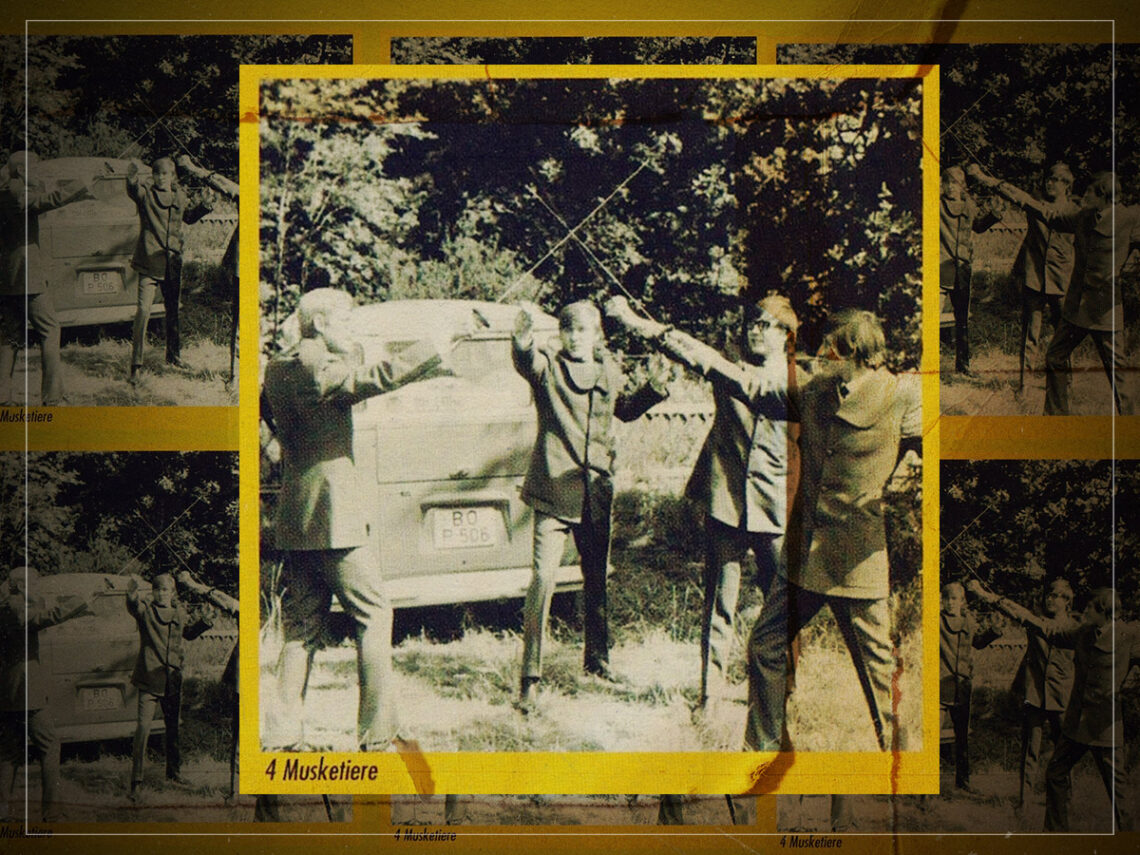
Die vier Musketiere: the forgotten German garage rockers who rivalled The Kinks

No band captured the youthful spirit of the swinging sixties quite like The Kinks. The songwriting mastery of Ray Davies coupled with the band’s penchant for mod rock, and tendency to act a little more wild than their contemporaries meant songs like ‘You Really Got Me’ and ‘All Day and All of the Night’ typified the beat rock sounds of London. However, the abrasive appeal of a group like The Kinks certainly was not limited to the clubs and venues of England’s capital.
Much like the mod subculture itself, which drew upon the fashion and style of the European continent, mod rock bands like The Kinks quickly found an audience in young people across Europe. In particular, the divided nation of Germany took particular solace in Davies’ blending of distortion and pop songwriting. The prevalence of groups like The Kinks on the airwaves helped to inspire generations of garage rockers all over Europe.
The West German city of Gelsenkirchen seemed an unlikely place to emulate the vibrant sounds of Carnaby Street, but a young music obsessive named Wolfgang ‘Archie’ Goth aimed to do just that. Along with some friends – guitarists Albert Hüllinghoff, Manfred Linne, and Karlheinz Wagner – Goth formed a garage rock outfit in 1963, initially emulating the rock and roll sounds of the USA, before switching their attention to the landscape of the British Invasion during the mid-1960s.
Dubbing themselves Die vier Musketiere (The Four Musketeers), complimenting their bizarrely medieval stage outfits, the young garage rockers began performing at local clubs and venues around their hometown. Like many teenage groups of the period, the band never scored a record deal, and recordings of their work are scarce, to say the least. In fact, the only song of theirs to have officially been released is titled ‘I’m Waiting For You’, which appeared on the 2004 compilation CD Ruhrgebeat.
So, why is it worth remembering this obscure teenage garage rock outfit? Well, not only does the existence of Die vier Musketiere reflect the global presence of British beat rock during the mid-1960s, but their story is one of rock and roll in its truest essence. The band were never going to top the charts, but they found a cult audience playing the music they loved in their own distinctive way.
This endearingly anarchic approach can be seen clearly in the one recorded performance of Die vier Musketiere that has survived all these years. By 1966, the young band had performed around Gelsenkirchen enough to become local celebrities, hailed by the youth of the region as harbingers of beat rock excellency. In fact, they were so notable that a documentary film was created about the band and the beat rock scene in the Ruhr region, which featured multiple performances from the group.
Most notably, the band performed storming covers of The Kinks songs like ‘You Really Got Me’ and ‘All Day and All of the Night’, to the rapturous reception of dancehalls filled with young Germans. These covers perfectly capture the youthful rebellion at the heart of Davies’ compositions, blending the coolness of swinging sixties mod rock with the energy and defiance of teenage garage rock.
That 1966 documentary explored tensions within the band, resulting from the members attempting to win the favour of a local girl, but it was actually conscription to the Bundeswehr (German armed forces) that broke the band up in 1967.
However, just before their split, Die vier Musketiere were given the opportunity to perform at Bremen town hall, as the opening act on a bill headlined by The Kinks. Reportedly, the reception to the opening band was so riotous that plain-clothes police officers had to try to calm the crowd down. Which group came out on top that day remains up for debate, but the German beat rockers certainly captured the rebel spirit of 1960s rock and roll.
