


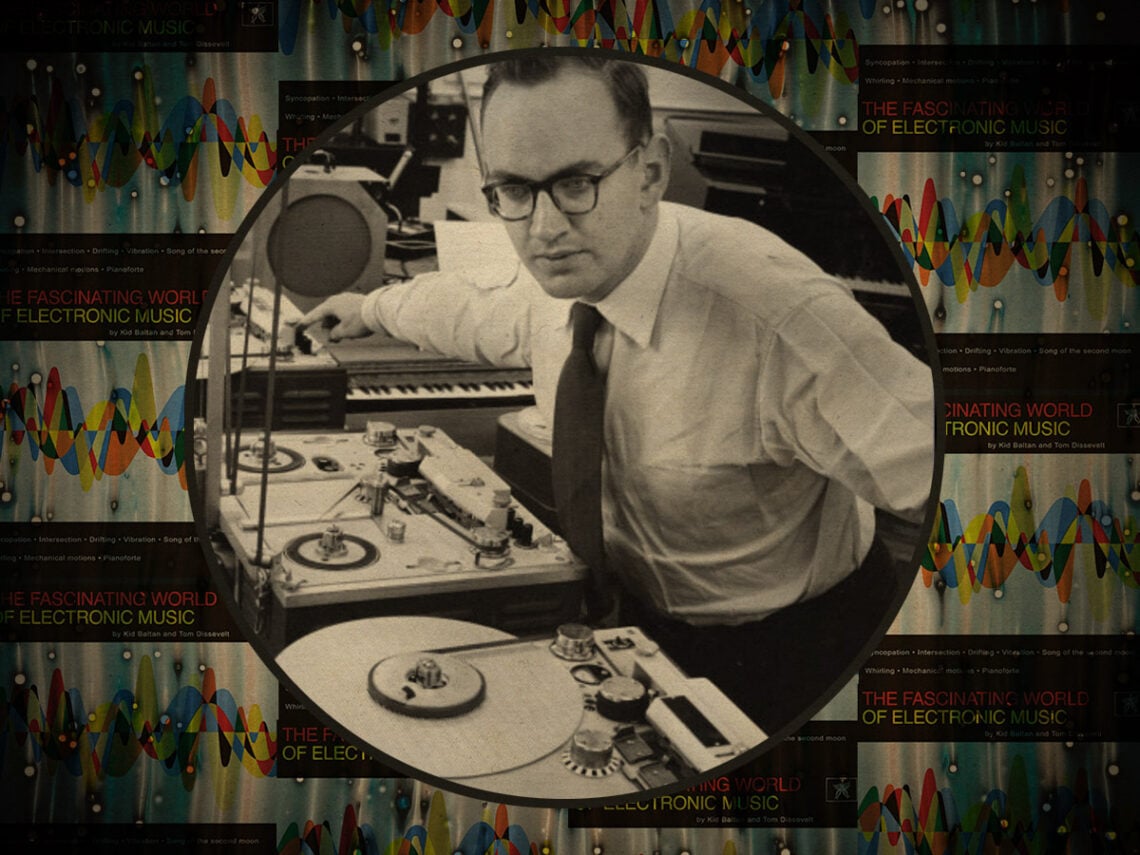
‘Syncopation’: Did the first electronic song actually arrive in 1958?

There’s no question that Kraftwerk stand as electronic music’s most foundational big bang, but the Düsseldorf quartet drew plenty from the preceding experimentalists that first stepped into such unknown terrain as far back as the late 1950s.
Reaching the early 1930s, vacuum tube technology helped yield the eerie whines of the theremin and ondes Martenot, followed a decade later by the rudimentary opportunities in tape recording and their later manipulations in the studio. Before long, the likes of Karlheinz Stockhausen and John Cage were realising the musique concrète electroacoustic collages, and the theremin would score the sci-fi and horror B-movie pictures in all its spectral kitsch.
Yet, while electronic music was fast becoming established in the realms of academia and Hollywood novelty, pop had yet to meet the weird machines blinking and whirring away in university campuses and the basements of artistic radicals. A bassist and arranger for The Skymasters big band group in the Netherlands, Tom Dissevelt became enamoured with the works of Stockhausen and managed to find creative work at the Philips company’s new Philips Research Laboratories, or NatLab, division in 1958, a new arm of the label entirely devoted to the burgeoning electronic music technology.
No expense was spared. Dissevelt found himself surrounded by all the latest hardware and ‘instruments’, oscillators, tone generators, tape recorders, reverb chambers, filters, and the editing means to splice and layer various recordings, all offered Dissevelt and his co-explorer Kid Baltan, the alias of Philips engineer Dick Raaijmakers, an ambitious scope to pull the machines closer to Dissevelt’s background in jazz swing.
Here, in the pair’s studio-come-laboratory in Eindhoven, the sonic possibilities of electronic music were pursued for the sheer aural whimsy of the sounds created over intellectual exercises or mere marvels of technological breakthrough.
Filled with bubbly cheer nearly 70 years later, Dissevelt and Baltan’s ‘Syncopation’, or ‘Orbit Aurora’ as it would be known in the States, stands as one of the finest electronic gems discovered in the NatLab petri-dish, an enchanting look to the stars teeming with twinkling bleeps, beaming melody lines, and a romantic cascade of multi-tracked magnetic textures surging through its electronic soar.
Such a piece was forged with accessibility in mind. Not a hint of avant-garde belligerence is to be found on ‘Syncopation’s electro-bounce; a firm jazz foundation ensures the sprightly satellite number firmly orbits the pop world, its very title a nod to a big band’s traditional horn sections that often interrupt a piece’s rhythm.



It wouldn’t make a dent in the Billboard charts, but the subsequent Electronic Music EP in 1960 and The Fascinating World Of Electronic Music two years later, with ‘Syncopation’ opening both, would make a decisive step into convincing a future generation of budding synthesists like Gershon Kingsley or Wendy Carlos that electronic music need not dwell outside the perimeters of the mainstream.
The electronic sphere and the earthy groundings of rock and pop would finally forge themselves at the end of the 1960s and with the advent of Dr Robert Moog’s namesake modular unit, but while Kraftwerk would later lay out the blueprint of electronic music’s essential template, they and the surrounding synth pioneers were all mastering the formula struck upon by Dissevelt and Baltan’s NatLab conjurings 20-odd years earlier.
