


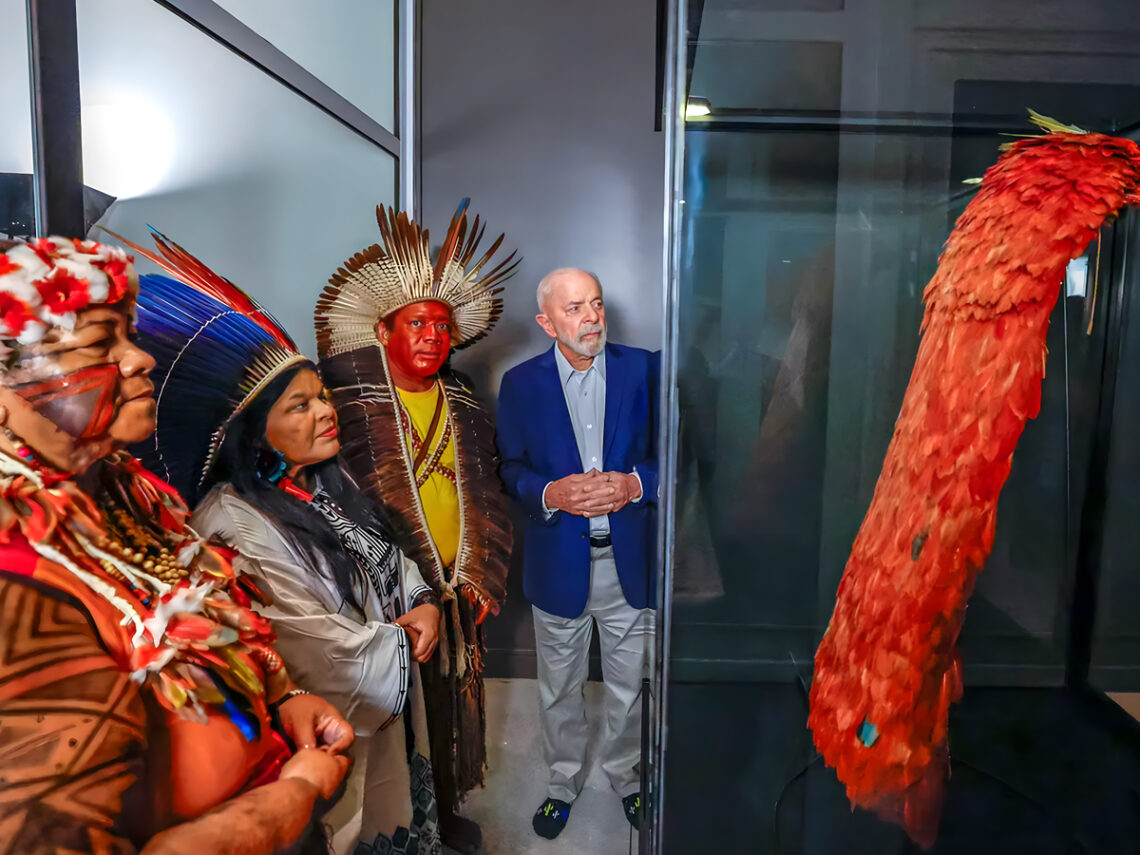
National Museum of Denmark returns Indigenous cloak to Brazil after 300 years

After over 300 years on display at the National Museum of Denmark in Copenhagen, a sacred cloak belonging to the Indigenous Tupinambá people of Brazil has finally been returned to its rightful owners. The cloak, constructed of around 4000 vibrant red feathers from the scarlet ibis bird, is nearly two metres in length and is of great historical significance to the Indigenous population of Brazil.
Originally, the cloak had been stolen from the tribe during the period of Portuguese colonialism in Brazil. Armies from Portugal first arrived in the South American nation in 1500, where they remained for over 300 years. It is thought that Dutch invaders stole the Tupinambá cloak around 1644, and it has been on display to visitors in Copenhagen since 1689. That was until last week when the cloak was unveiled at its new home in the National Museum of Brazil in Rio De Janeiro.
The unveiling of the cloak was accompanied by a ceremony attended by Brazilian government officials, including President Luiz Inácio Lula da Silva, as well as members of the Tupinambá tribe and other Indigenous leaders in Brazil.
Sônia Guajajara, the minister for Indigenous peoples, said at the ceremony on , “We are facing a time when history is being revised. I see the return of the cloak as the beginning of a process that has everything to establish protocols for access to countless sacred pieces for us, Indigenous people, both inside and outside Brazil.”
Meanwhile, Anápuàka Tupinambá, a representative of the Tupinambá people in Brazil – who, at one time, had a population of around one million people – told The Art Newspaper, “For us, the Tupinambá people from all over Brazil, it represents a return to our culture, restoration of the demarcation of our territory, not only physical but culturally.”
Although the return of the sacred cloak is undoubtedly a cause for celebration for Indigenous people in Brazil, its new home in the National Museum is still the cause of some controversy. By being placed behind glass in another museum, the cloak is still not technically in the hands of its original owners. “It should have gone straight to Ilheus in Bahia after the construction of an Indigenous cultural centre was completed,” Tupinambá argued.
In fairness to the Brazilian government, President Luiz Inácio Lula da Silva has also affirmed that the National museum should be viewed only as a temporary home for the cloak until it can be transferred to a location more befitting of its importance to the Indigenous tribe.
