


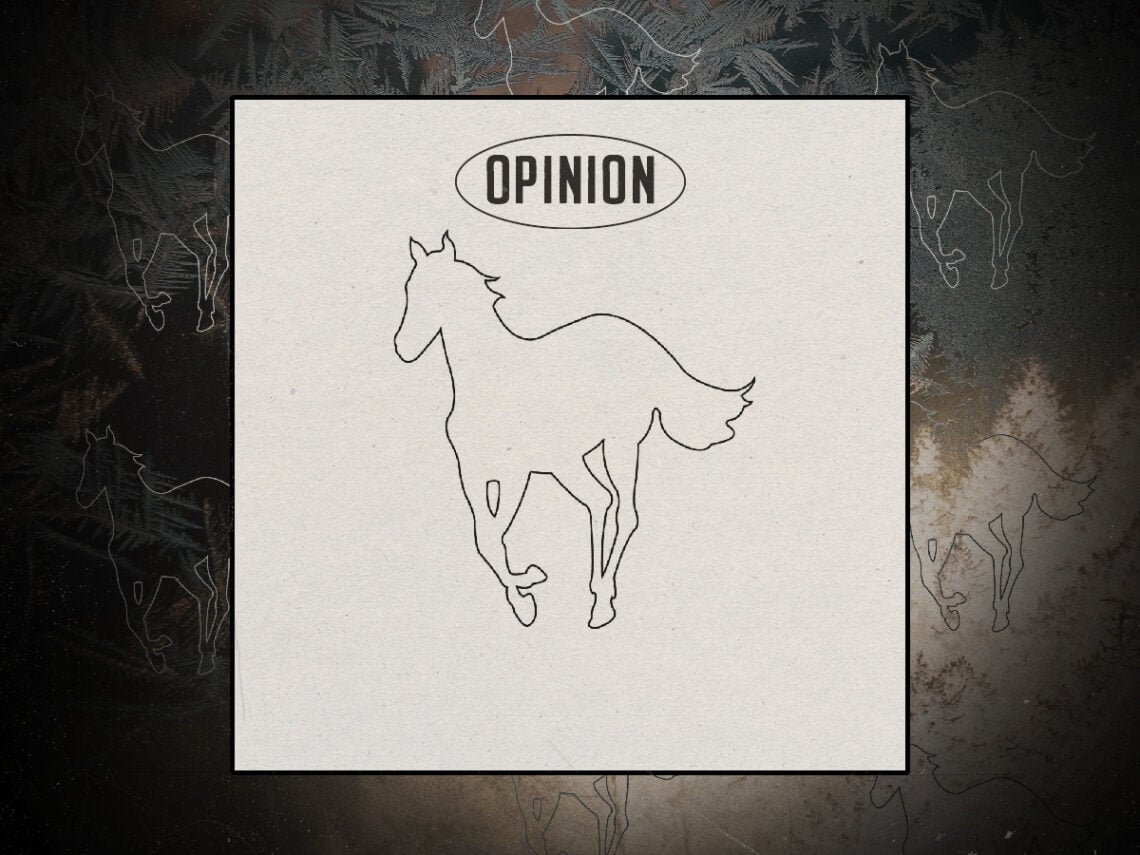
Hear Me Out: Deftones’ ‘White Pony’ is the perfect winter album

When winter approaches, some may be inclined to give into the season’s blues, opting for a more sombre, sedated sound.
Instead, recommended listening is one that leans into the season’s moody, understated, darkened world while reviving your spirit. In winter, you simultaneously want to sleep for approximately three months and feel alive again, getting the blood coursing through your veins and the colour returning to your face. For me, there is no album that harnesses the duality of winter better than Deftones’ White Pony.
Released in the middle of winter on New Year’s Day in 2000, Deftones entered the new millennium with an album that channelled their exact blend of morbid romanticism. White Pony’s cover art, a black stencil of a horse on a white background, has become a metal Bat signal, continually adorned on merchandise and tattooed on fans’ bodies over the last 25 years.
But, at the time, the state of metal was in a strange, unfamiliar territory. Limp Bizkit and Insane Clown Posse dominated a branch of the genre that was humorously bizarre. Their rap-metal hybrid was likened to Korn and Linkin Park, who inflected their melodies with a more electronic flair, while mall goths found their patron saints in Slipknot’s grime. Deftones, whose 1997 album Around the Fur was a pivotal mark of their potent anger, were still difficult to define in the age of nu metal.
With Around the Fur’s slow burn, Deftones, then comprised of vocalist Chino Moreno, bassist Chi Cheng, guitarist Stephen Carpenter, drummer Abe Cunningham, and turntablist Frank Delgado, took advantage of the continued space for innovation. In turn, they infused White Pony with a vulnerable, sensual edge in its lyrics and vocals, and a cool, industrial tone. Think of the literal metallic, cold and hollow. To me, White Pony sounds exactly as winter feels: sensitive, but abrasive at the same time. This sensation is most evocative on the album’s lead single, ‘Change (In The House of Flies)’, which remains their best-known song. The fuzziness of its opening riff could soundtrack a gothic noir, its echoing ambience foreshadowing menace. Moreno’s vocals, already infamous for its whispery sensuality, are so enticing that you forget the malice of his words, with lines like, “I pulled off your wings / Then I laughed.”
The isolation of winter warrants a confrontation of oneself, a dissection of our darkest moments. White Pony operates in a similar vein, becoming, as Moreno called it, a “cocaine concept album”. Coincidentally made in the same studio used when Fleetwood Mac was recording Rumours, drug-induced hedonism and reckoning permeate White Pony, continuing the soft and aggressive duality while taking it into a darker realm. ‘Knife Prty’ resembles actual violence, heard in the blood-curdling screams that echo as Moreno sings, “I could float here forever / Oh, anemic and sweet,” and Cunningham’s drums pulsate like the touch of a vein.
The lyrics came about in Moreno’s imagination, picturing an underground society where people indulged in erotic fantasies with knives. ‘Digital Bath’ unfolds a similar brutality, its guitars sounding at once distant and alive, like a literal rush of adrenaline surging through. When Moreno decides in a drawn-out chorus, “I feel like more!”, we suddenly do, too. Blood allusions continue on ‘Elite’, where Moreno warns in a seething scream, “When you’re ripe / You’ll bleed out of control”.
Winter comes and goes in a ghostly blur. There is a haunting energy that pervades the coldest months, and whether that be invoked by actual spirits or ghosts of the past, there is a forced conjuring. White Pony is haunted by ghosts of past and present lovers, as well as past selves. ‘Feiticeira’ (translating to “witch” or “sorceress”) and ‘Rx Queen’ lament femme fatales, as Moreno is subject to physical and psychological torture. Across White Pony, there is a fascination with the feeling of being alive, as well as the instantaneous possibility of death.
While not particularly comforting to the average listener, it is what makes Deftones continually fascinating. “I’ll steal a carcass for you / Then feed off the virus,” Moreno promises on ‘Rx Queen’, continuing that morbidly romantic poetry of his that is akin to a horror film: unflinching in its pursuit of holding a mirror to our darkest depths. “All you are is meat,” Moreno whispers in the final line on the album’s closer, ‘Pink Maggit’. Deftones reveal the flesh and bones of existence, and the gory aftermath of trying to purge oneself.
In keeping with the cynical, winter is, admittedly, a brutality that we cannot run away from. Rather, we can soundtrack the cold months with music that mimics the feeling but promises something more, hidden in its cracks. On White Pony, Deftones locate their own niche of melodic hardcore, one more languid in scope that maintains the necessary aggression to pummel them through their self-induced fog. Even during the album’s most harrowing moments, it still holds onto a romanticism, signalling an evolution beyond the monotonous.
