


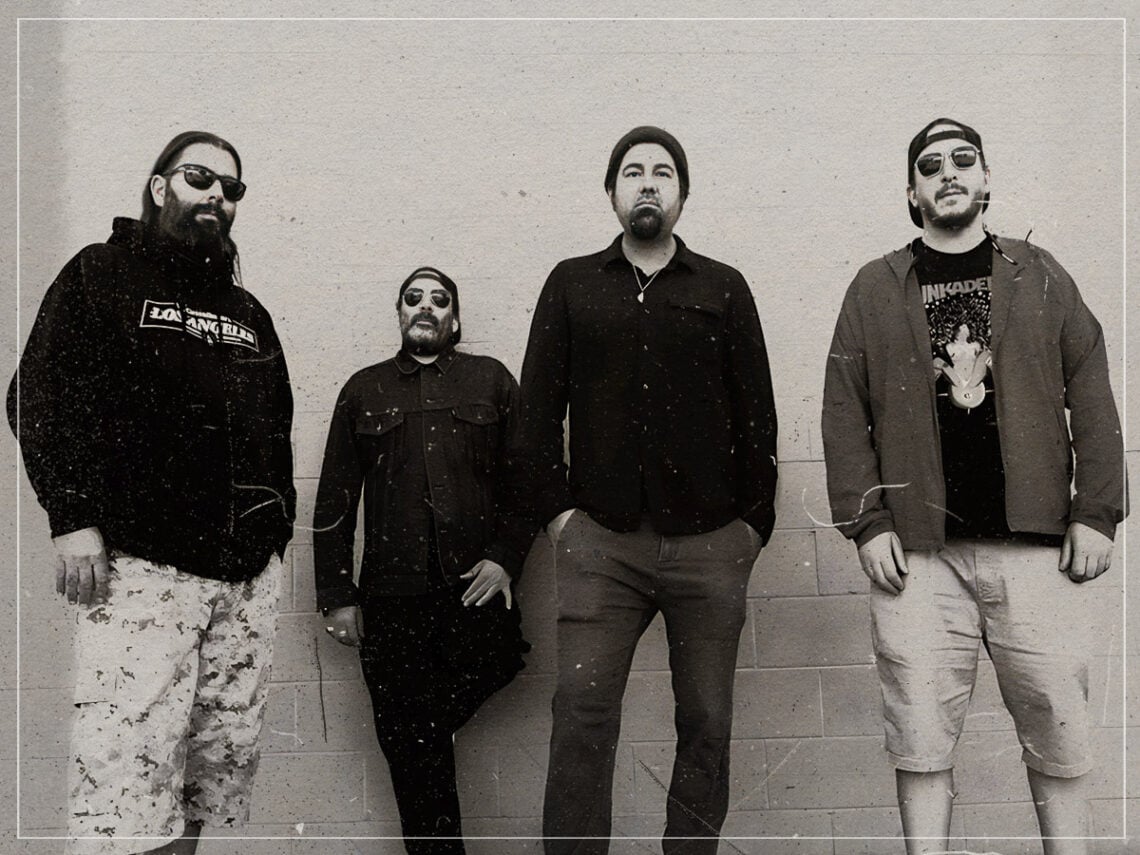
Postmodern alienation: the dystopian aesthetic of Deftones

At the nexus of light and dark exists Deftones. Fusing the post-punk of England’s wind-battered post-industrial north and punishing elemental riffs from frozen Nordic climes with fey shoegaze warmth and the electronic automation of hip-hop, the Sacramento band’s aesthetic continues to compel.
Existing in their own space at this confluence of opposing energies, Deftones are wrongly lumped into the nu-metal genre, which emerged at the same time as they. Apart from comparable de-tuned guitars and frontman Chino Moreno’s screaming, the Californian outfit does share another similarity with the movement that they are so keen to distance themselves from: alienation. Although it is a distinctly Generation X notion in this context, like with everything they have created, Deftones took this very 1990s feeling and ran into the distance with it, repackaging it in their image. Capturing the essence of the contemporary era, the alienation aroused is highly dystopian.
Although Deftones pull from many areas, the surreal and often bleak science fiction verses of Hum frontman Matt Talbott certainly went some way in informing their style. Regarding Hum’s widely influential 1995 album, If You’d Prefer An Astronaut, when speaking to The Quietus in 2010, Moreno explained that the band was a “big” influence on his outfit. Although tone-wise, this is clear, it has also affected Moreno’s lyrics and the overall aesthetic of Deftones.
Moreno explained: “I think the vocals are an acquired taste; he didn’t have the best singing voice, and he talk-sings, but the lyrics are very scientific. He sings about the stars and astrophysics, really odd topics, but the songs are really warm; there’s a romantic vibe there as well.”
That’s the thing about Deftones. Although their unique dystopia is partially constructed through opaque personal accounts of Moreno’s life in his lyrics and a technicolour mesh of musical styles, other more arcane, dystopian elements are at play. Echoing the evolving nature of the world, this uniqueness has changed over the years. What started out as a more straightforward Generation X reading has metamorphosed into more postmodern (and more fucked up) as Deftones have refined their style.

The aspect of Deftones’ career conveying this alienated, dystopian aesthetic most is their music videos. Pulling from the essence of their album covers and augmenting the music, whilst there are exceptions to this trend, many of their most notable visualisers have helped establish this sentiment.
Starting with the video for ‘Bored’, a track taken from their 1995 debut, Adrenaline, the jaded hopelessness of Generation X at the time is fully conveyed. Playing to a smattering of acquaintances in a dilapidated, graffiti-covered house, the fuzzy visuals speak to the nihilistic, end-of-history idea as Chino Moreno vocalises his generation’s stasis to full effect. Echoing Buzzcocks’ original punk anthem ‘Boredom’, Moreno repeats that he is at his wit’s end before breaking into a primal scream as the track climaxes, reminding everyone that he is very bored indeed.
Whilst there is a chilling element to what is conveyed in the accompanying video, it was with those visuals for the singles from the band’s 1997 follow-up, Around the Fur, that the dystopia became more full-frontal and violent. The video for the record’s lead single, ‘My Own Summer (Shove It)’, is a saturated masterclass where the then-quartet plays on individual platforms in the middle of California’s Pyramid Lake, surrounded by ravenous sharks cut from footage of the Great Barrier Reef and an overall frozen backdrop. It’s an ominous palette that juxtaposes a starkly digital, militaristic green bar that pops up with the frosty environment in which it was filmed. From the modern perspective, it can be deemed a nod to the coming epoch. Here, technology would infiltrate life to a microscopic and thought-provoking extent, with an imminent clash between humanity and nature coming due to complete environmental collapse.
Following this, the video for the second single, ‘Be Quiet and Drive (Far Away)’, strikes a different note but is nonetheless chilling. Directed by Frank W. Ockenfels III, it sees Deftones play in an off-colour, waterlogged warehouse. Aided by an assortment of brisk and loose shots, often taken from the mid-range, this clip, whilst traditional in that the band are performing, also speaks to mysterious impending doom. As Moreno sings at the opening, “This town don’t feel mine / I’m fast to get away, far,” he seems to imply that there is nothing in Los Angeles for him and that the dystopia here is a personal one, as the expansive emptiness of the warehouse evokes a feeling of convulsing isolation.
Moving into the band’s third album, their 2000 masterpiece White Pony, musically and aesthetically, this dystopian sentiment is more evident than in most other chapters. The video for the hit ‘Back to School (Mini Maggit)’ once again conjures almost Pink Floyd-esque feelings of dystopian alienation, wherein the students of a high school rebel against the powers that be, singing in defiant unison at the end, “Push back the square / Now that you need her, but you don’t / So there you go / ‘Cause back in school / We are the leaders of it all”.

Similarly, the video for ‘Change (In the House of Flies)’ evokes a personal dystopia not dissimilar from what Bret Easton Ellis and, more importantly, JG Ballard explore in some of their best-loved novels. Although Deftones are performing in what looks to be a sought-after Los Angeles property, the revellers are strung out on the comedown, with bottles and rubbish strewn everywhere and ants clambering over utensils.
It reflects the modern malaise, corruption and wasteland of the soul maintained by the trappings we have made for ourselves: narcotics, alcohol, and, more significantly, a promotion of ego and personal brands. Everyone at the party seems fashionable and edgy. However, it’s clear that none are satisfied having to maintain such a false pretence every day as they attempt to climb up the social ladder. It’s an anxious manifestation of something that has only become more pervasive in the 23 years since the video arrived, and social media has exacerbated the global situation. In one of his most profound analogies, Moreno sings in the chorus: “I’ve watched you change / It’s like you never had wings”.
Elsewhere, subsequent videos carrying on this dystopian aesthetic are 2007’s ‘Mein’, which sees the group play in front of towering Los Angeles skyscrapers. Whilst the slow-motion breakdancers are the clip’s central focus, the focused greys and greens are almost Matrix-like and make us think of the mechanical character of the postmodern era. Specifically, these lofty monuments to how humanity has advanced remain chillingly still in the background, unmoving and inhuman, alien even.
2010’s ‘Rocket Skates’ again prompts a feeling of the modern dystopia that starts with the self. The music conveys the hollow essence of modern life by bringing together an unnamed woman and Moreno in a hotel room bathed in shades of luscious red, bright yellow and narcotic purple. Again, this has only become more apparent as time passes. Seemingly, there’s a weightlessness and meaninglessness to everything.
Finally, the video for the title track of the band’s most recent album, 2020’s Ohms, is the most science-fiction-heavy and dystopian of the bunch. Directed by Rafatoon, the shots of the group performing are interspersed with chilling, graphic-heavy scenes of a cloaked figure exploring a strange, empty landscape that humans and their creations have indelibly marked. “We’re surrounded by debris of the past,” Moreno sings. “And it’s too late to cause a change in the tides / So we slip into our hopeless sea of regret.”
