


Remembering the ‘Death of the Hippies’: How a staged funeral marked the end of an era

The phenomenon of the Summer of Love saw its home of San Francisco transformed into a youth-driven culture of free love, experimental drugs, spirituality and anti-war protest. What began as a benevolent force, not so much a protest as an overarching sentiment, ended in a funeral – a staged funeral, that is.
In 1967, San Francisco saw quite literal waves of people (many of them underage runaways) flow in from their homes across the United States, seeking common ground among people their age who shared the peaceful, idealistic values that they did. Anchored by the teachings of the Beatniks before them, seeing the likes of Jack Kerouac’s On the Road as an unofficial Bible of adventure and nonconformity, the burgeoning hippie culture saw San Francisco as a new space for opportunity. While the movement reached its peak in the summer of 1967, the year began with the first Human Be-In on January 14th.
Led with an announcement on the fifth cover of the San Francisco Oracle of “A Gathering of the Tribes for a Human Be-In”, (which coincided with a new California law banning the use of LSD), the Human Be-In turned Golden Gate Park into a site of a peaceful rally, with speakers including psychologist and writer Timothy Leary, artist Michael Bowen and poet Allen Ginsberg expressing their shared countercultural ideas: leftist political beliefs, advocacy for psychedelic drug use, the importance of communal living, pacifist ideology and more.
As poet Allen Cohen described its ideals: “Beats, LSD, anti-materialist, idealistic, anarchistic, surreal, Dionysian and transcendental” (quoted in author and historian Dennis McNally’s 2002 book The Last Great Dream: How Bohemians Became Hippies and Created the Sixties).
Performances from local rock bands, just on the precipice of fame, included the Grateful Dead, Big Brother and the Holding Company, Jefferson Airplane and Quicksilver Messenger Service. Sustenance (if you can call it that) was provided to the masses by the clandestine chemist Owsley Stanley, who offered copious amounts of “White Lightning” LSD produced especially for the event, distributed by the Diggers, a community-action group comprised of street actors and activists, who also provided turkey sandwiches. Largely due to the promotion of the Human Be-In in the press, the rough estimates of the people who arrived at Golden Gate Park that day range from 20,000 to 30,000.
While the Human Be-In was, for all intents and purposes, a success in bringing people together to preach a peaceful, loving ethos, the event also marked what McNally described as “the beginning of the end of the Haight as a functional neighbourhood”. Naming the Haight-Ashbury area, as it was the epicentre of San Francisco’s hippie culture, McNally’s assertion was no exaggeration: by the time that the Summer of Love came around, the streets were filled with people who followed the teachings of the Human Be-In and its calls for community, searching for their own.
The problem, however, was the lack of resources the city had to handle the sudden influx of people, not to mention the dangers that came with having so many people hiding out on its streets, both adults and underage children, as well as the beginnings of rampant drug use that saw addiction become more common. Where there was an abundance of free love and a semblance of community, there was an increasing lack of control and an impending danger.
Government officials and law enforcement across San Francisco attempted to slow the influx of people arriving in the city, especially once the school years ended as summer came along, but this only warranted more interest in both travelling to the city and subsequent reporting by journalists, who were eager to report on the growing numbers of “hippies” arriving. To counter this, local residents (including the aforementioned Diggers group) established the Council of the Summer of Love, giving the season an official name.
Headlines capturing the essence of San Francisco’s shift followed: Newsweek printed “Dropouts on a Mission” that February and followed with “The Hippies are Coming” in June, while Time published “Love on Haight” in March. Hunter S Thompson renamed Haight-Ashbury as “Hashbury” in The New York Times Magazine. The following year, Joan Didion would describe San Francisco as the place “where the social haemorrhaging was showing up”, in her essay ‘Slouching Towards Bethlehem’.
By the end of the summer, the tides had shifted: people began to return to their homes, resume their studies at school and look for steady work. The one-time glamour of travelling away from home, living communally and preaching love and peace, suddenly ceased. Surely, the building law enforcement presence did not help people’s desire to return to the familiar. As reported in The Atlantic that September, “Such clear proof of the failure of the law to meet the knowledge of the age presented itself to the querulous minds of hippies as sufficient grounds to condemn the law complete.”
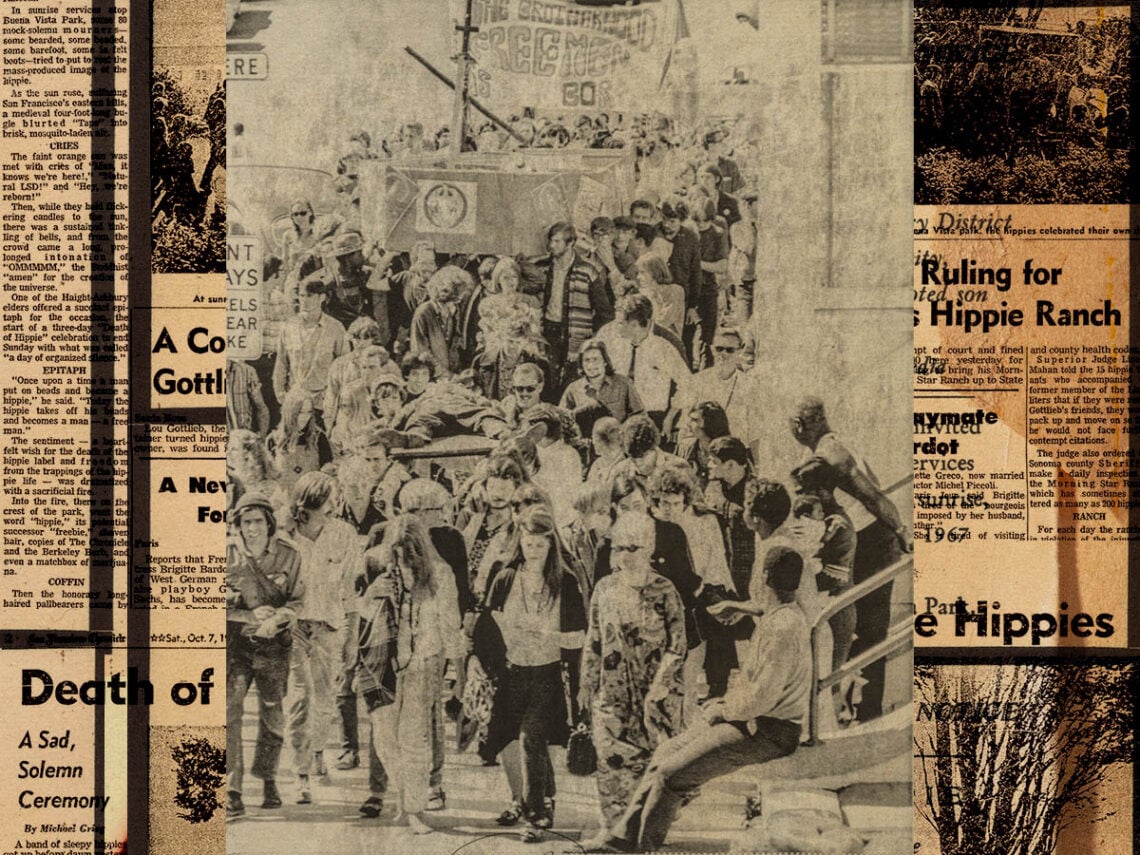
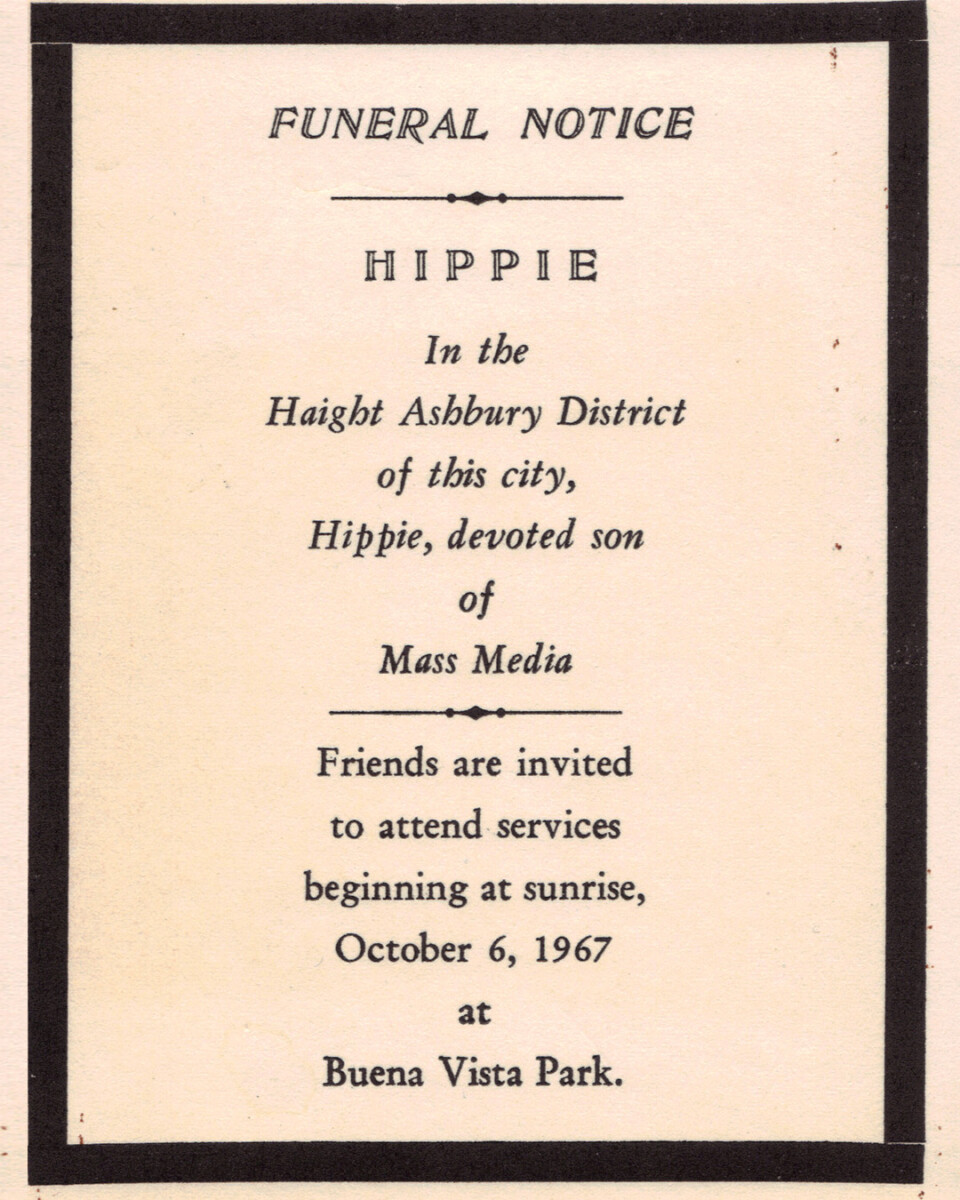
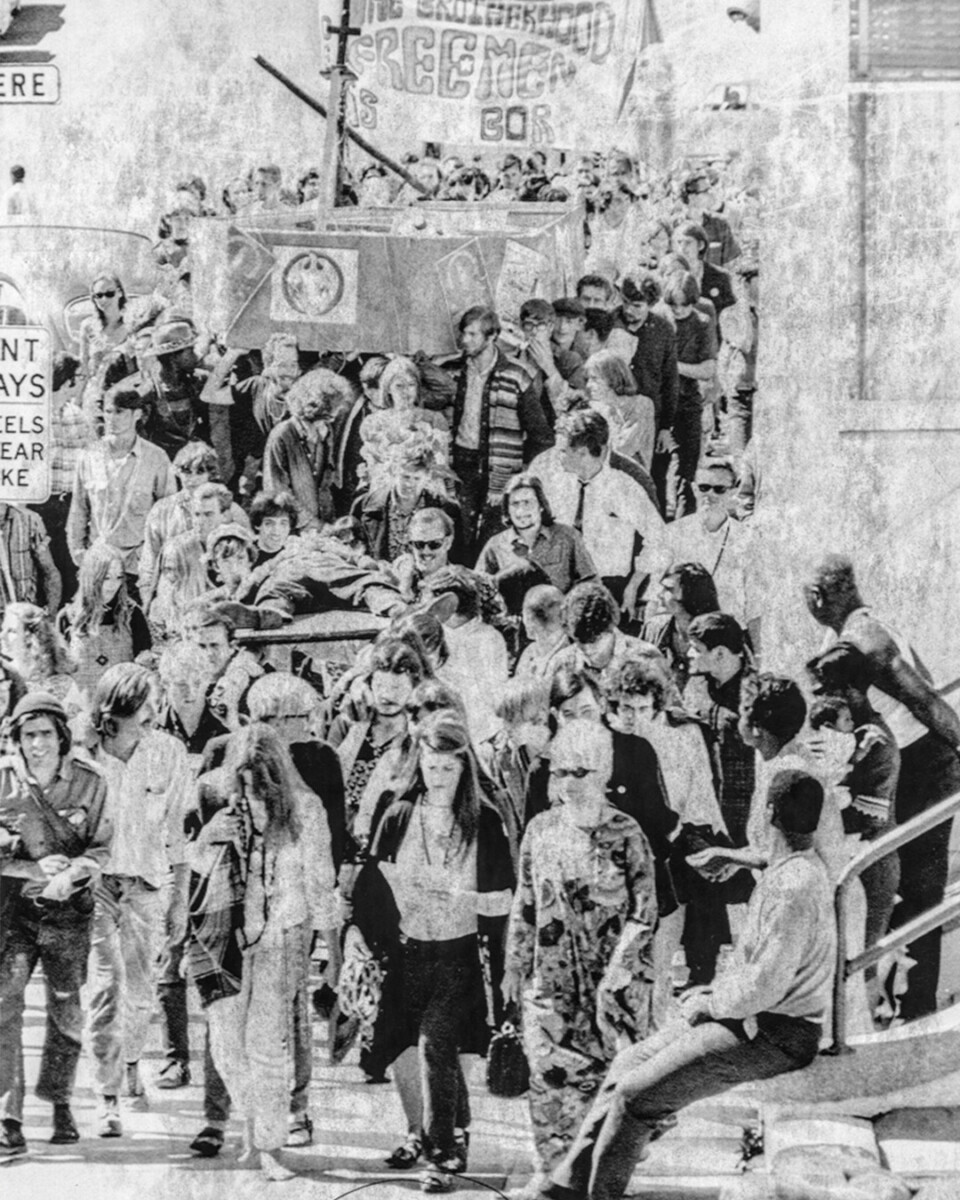
The following month, members of the Grateful Dead were arrested on October 2nd on drug possession charges. Two days later, Ron Thelin announced a faux funeral procession, handing out flyers that condemned the commercialisation of the so-called Summer of Love. Ron, co-owner of the Psychedelic Shop with his brother, Jay, was also a member of the Diggers and a contributor to the Oracle, thus immersed in the community that, after a vibrant summer, began to experience the very haemorrhaging that Didion followed. With a grey casket emblazoned with “Summer of Love,” Ron and over 100 of his fellow hippies walked through the Golden Gate and Buena Vista parks, joined by more along the way. As reported by the Chronicle, the back of the casket read, “Hippie, devoted son of mass media.”
“[Haight Ashbury] was portioned to us by the media police, and the tourists came to the zoo to see the captive animals,” Ron said, quoted in the San Francisco Chronicle, “and we growled fiercely behind the bars we accepted, and now we are no longer hippies and never were.” Photographs by Barney Peterson in the Chronicle show Ron smiling as he hands out flyers, crowds carrying the casket on their shoulders alongside moving cars, people sat in the park, circled around memorabilia – beads, an American flag and photographs, among others – with white lit candles, and the casket, filled with similar items. Ron encouraged that the day be one of “organised silence,” commemorated in the end with a ceremonial fire. The night marked the “Death of the Hippies,” as the Chronicle called it.
“We wanted to signal that this was the end of it, don’t come out,” organiser Mary Kasper explained in the PBS documentary series American Experience. “Stay where you are! Bring the revolution to where you live. Don’t come here because it’s over and done with.”
“Hippies: Where Have All the Flowers Gone?” Time asked, in its headline, following the days after the event. “Thus last week in the mecca of mindlessness did the hippies proclaim their own demise,” Time wrote. “It was probably inevitable,” he later called the event “an attempt to purify the movement”.
While somewhat harsh in its wording, Time’s assessment was somewhat true: the movement had begun to lose its way to the effects of addiction, disease and incessant media coverage, resulting in a waning optimism and a loss of broader identity. While the hippie culture persisted in the years that followed, unfortunately, as Ron’s funeral suggested, it saw the ending of a chapter in countercultural history.
