


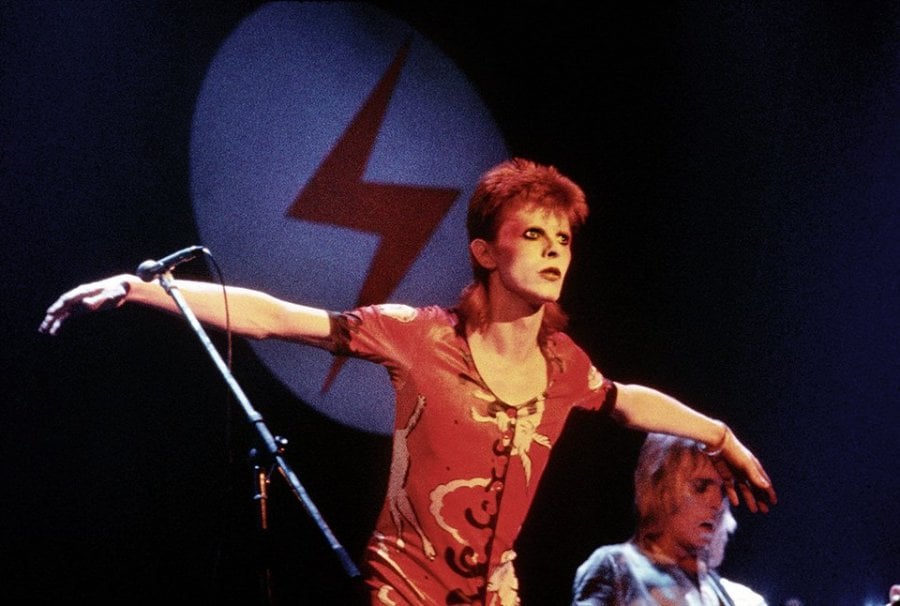
Mick Rock: A photographic history of David Bowie’s rise

“I do not use the word ‘genius’ lightly, but if David Bowie is not a genius, then there is no such thing.” — Mick Rock
On a US chat show, David Bowie once joked, “I reinvented my image so many times that I’m in denial that I was originally an overweight Korean woman.” The chameleonic reinventions that Bowie swirled through like an alchemist of identity were a calling card for his ethereal artistic talent. They were not just character studies or quirky conduits for creativity; they redefined what was possible in rock music.
Throughout Bowie’s astounding career, his androgynous look imbued him with a captivating sense of enigma. He outwardly embodied his music and art with a miasma of creative mystique. It is fair to say that he seemed like some lauded pariah of humanity, a creative freak in the most endearing sense of the word. And while the music was so far beyond merely good that the question of whether it could stand alone was rarely asked, it was, nevertheless, all part of the same artistic gestalt as his otherworldly image, where sound and vision entwined.
In order to ensure that his “the whole world is a stage” view on pop culture was espoused to its full seismic potential, he needed his carefully curated characters to be captured with equal artistry. That is where the late, legendary photographer, Mick Rock came in. 50 years later, his images still define the aesthetic of an era as he charted the early ascension of the star man.
The images below charter the famed Ziggy Stardust tour of 1972-73. While the narrative of his life has now been blurred by the lofty heights that he reached, prior to this tour and even after it to some extent, Bowie was virtually an unknown entity amid the wider public. His 1971 record, Hunky Dory, which is now rightfully considered by many to be a masterpiece reached number three in the UK but a measly 57 on the far side of the pond.
Then, in 1972, when David Bowie’s Ziggy Stardust first appeared on TV, he looked down the camera in his androgynous otherworldly guise and he seemed to impart a new way of life on the youth watching with slack jaws, bulging eyes and addled minds. The rest was history, but as is always the case it unfurled slower than anyone thought. By no means was Bowie an overnight hero like Elvis Presley before him. Nevertheless, something a creative pandora’s box moment had occurred and the wormhole that Ziggy burst through could never be sutured closed.
Then boldly, before he had even established himself as chart presence, Bowie began to live up to his mantra of: “Never play to the gallery. Always remember that the reason you initially started working was that there was something inside yourself that you felt that if you could manifest it in some way, you would understand more about yourself and how you coexist with the rest of society.” And he retired his Promethean rock creation on July 3rd, 1973.
At the end of the show at the Hammersmith Odeon, Bowie’s shocking speech overshadowed the performance. “Everybody, this has been one of the greatest tours of our life,” said David Bowie, standing on stage clad in a sheer mesh top and glittery trousers, panting as if the gravitas of the situation had just dawned on him.
“I’d like to thank the band, I’d like to thank our road crew and I’d like to thank our lighting people,” he added, “Of all the shows on this tour, this particular show will remain with us the longest,” he said, to an even louder cheer. “Because not only is it the last show of the tour, but it’s the last show that we’ll ever do. Thank you.” And with that, the end of Bowie’s first chapter was over, and it was a detonation of artistry that Mick Rock snapped all the way.
Bowie was both his muse and master as he found his own artistic feet. As he recalled of their first meeting: “When I got to Birmingham Town Hall, I think there were 400 people there that night. But I went backstage to meet David, and then it was, ‘Oh, yes, I like your name Mick Rock’, and I said, ‘Of course mine’s my real name and I know your isn’t’…” After that they got talking, Bowie was fascinated by Rock’s connection with Syd Barrett and the shooting started there.
Rock was also ground-breaking in his own regard in this way. Like a member of the band, he was an established fixture in Bowie’s creative oeuvre and captured the pioneering Ziggy Stardust phase like a Gonzo-photographer. Such a life lead so closely attached to the stars of the day meant Rock was often regarded as a pivotal member of the rock and roll explosion. But it wasn’t without its pitfalls.
At the time, Rock was indulging in the same debauched splurge that fuelled the post-Woodstock scene that Bowie was helping to craft. He took drugs, smoked, partied and repeated with minimal sleep and lunch breaks in between, because “food was just a drag”.
However, as he told Luxury London, “Those altered states definitely helped me develop my eye.” But much in the same way that Bowie’s Ziggy creation would soon become psychologically inescapable and later mutate into the hedonistic torture of The Thin White Duke, Rock’s creative trip down substance lane was pitted with the same potholes. “Sure, [the creativity of the 70s] was a lot about the drugs,” he explains, “But not just about the drugs, so much as about the wider culture.”
Adding: “And probably that era wouldn’t have been what it was without [those mind-bending drugs and practices either]. But then I nearly died – and, well, that seemed to change things… It was a tap on the shoulder. ‘Oh, it’s him…’” Fortunately, the reapers tap would be a wake-up call rather than a final word and Rock cleaned up his act and continued his work, becoming known as The Man Who Shot the ‘70s.
The unique collection of images from the Taschen novel The Rise of David Bowie 1972-1973, exhibit a glorious collection of Bowie finally coming to the fore after fallow years where he had considered quitting. The same can also be said of Mick Rock himself, who found himself swept into the eternal inspiration of his subject and basked in the bohemian world presented. As Rock once said: “I do not use the word genius lightly, but if David Bowie is not a genius, then there is no such thing.”
You can find out more about the Taschen novel, The Rise of David Bowie 1972-1973, by clicking here.


