


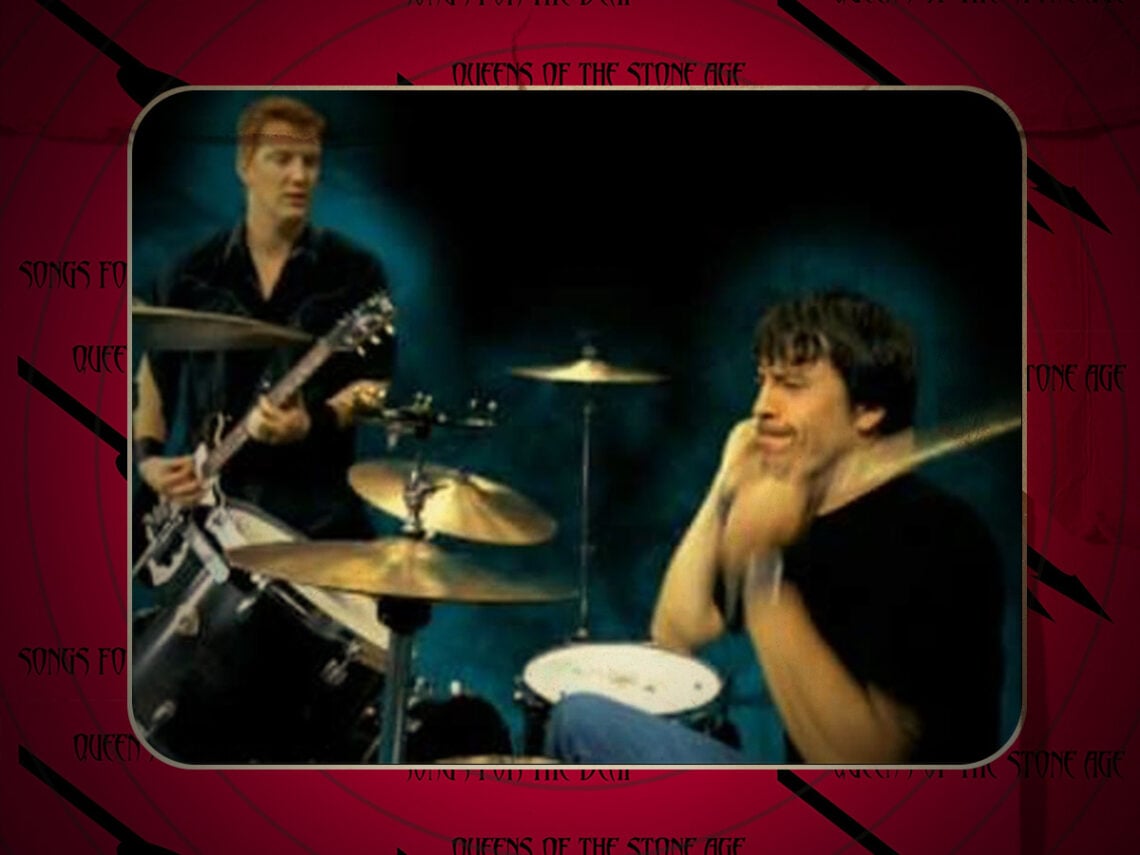
Dave Grohl, QOTSA and the story of the greatest drums in rock

Is it really that much of a stretch to say that Dave Grohl can play any instrument that he gets his hands on?
There are plenty of artists who have managed to be multi-instrumentalists throughout their career, but whether he was laying down the groove for Nirvana or standing at the lip of the stage with Foo Fighters, Grohl could be equally lovable or dangerous whenever he had the right song to work with. But even if he put down the sticks for a while when Foo Fighters took off, there was always going to be something calling him back.
To be fair, drums were always where Grohl felt the most comfortable. Even when talking about his greatest guitar riffs, he always equates the guitar to a drum set half the time. The high strings are the cymbals and the low strings are the kick and snare, which explains why there’s a certain mathematical rhythm to the way that a tune like ‘The Pretender’ starts before the beat even comes in.
And while Grohl had no choice but to play drums on the first Foo Fighters records, it’s not like other opportunities weren’t out there. He already turned down Tom Petty to do his own thing, but when he had the idea to work with Queens of the Stone Age on Songs for the Deaf, his ears did perk up a little bit. The Foos were already becoming one of the biggest bands in the world, but given how much of a fanboy he was of Kyuss before, he knew he couldn’t pass up the chance to jam with Josh Homme.
Grohl even admitted to being a little bit jealous that he hadn’t been asked earlier, saying, “I had joked before that I was pissed off they didn’t ask me to play on Rated R. Their music is really fun to play drums to because I’m used to playing more back in the back 4/4 sort of stuff. So this was a lot more interesting.”

But that’s not always the way that QOTSA works. Homme might have a more stable lineup this time around, but by the 2000s, the band was still an ever-evolving idea. Every song had the potential to have a different lineup, but when listening to any other drummer in the world, was there any reason to think that Grohl wasn’t the right guy for the job?
By the time that he came down for a few recording sessions, even Homme had to admit how quickly they got final takes for many of the tunes, saying, “I called Dave and said, ‘Can you come right now?’ It was noon and he said, ‘I’ll be there at 6:30 PM. By 8 PM, we had already tracked a few songs.” The freedom of not having the spotlight probably helped Grohl, but he hadn’t pulled out these kinds of chops since the Nirvana days.
Homme still has a great track record of being one of the most consistent artists of his time, but Songs for the Deaf is one of the most percussion-heavy drum records in the band’s discography. The frontman might have written a lion’s share of the material, but all of Grohl’s parts could have been rhythmic hooks on their own, like the way that his pummelling groove takes over ‘The Sky Is Fallin’ or the insane fills that come and go throughout ‘No One Knows’.
Judging by the way that the riffs fall on the beat as well, this is the closest thing to an alternative-prog record that Grohl ever made. A lot of the more adventurous music he made would usually be reserved for the likes of Them Crooked Vultures after the fact, but hearing them make a 5/4 groove sound so natural on tunes like ‘Hanging Tree’ or working with strange guitar tunings throughout the record is what keeps repeat listens an absolute trip. You’ll be listening to a song that you think you’ve heard a million times, and then Grohl will surprise you with a totally new idea that you never caught.
Although this isn’t looked back fondly as the best time in Foo Fighters’ career, Grohl really needed this gig with Queens to help come out of his shell a little bit more. He had spent years as a frontman and was starting to get bored, but with one record, he could find a way to get excited about his own band again and remind everyone that a percussion god still walked the Earth.
