


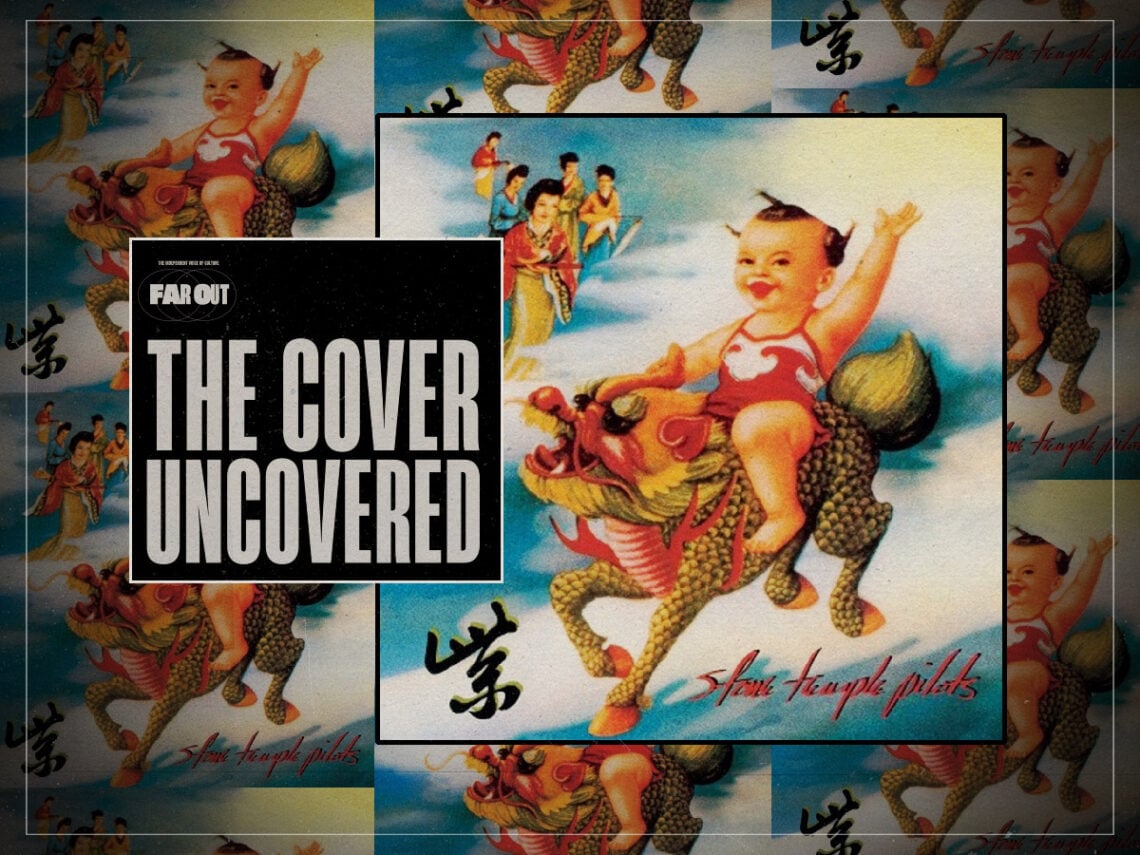
The Cover Uncovered: The dark imagery of Stone Temple Pilots’ ‘Purple’

After tireless touring for their instantly successful debut album, 1992’s Core, Stone Temple Pilots reunited in Los Angeles in early 1994 to conceptualise the song structures and arrangements for what would become their sophomore album, 1994’s Purple.
By then, the band had two of Purple’s songs completed: the expansive tale of alienation on ‘Big Empty’, submitted for the 1994 film The Crow’s soundtrack, and the romantic toxicity on ‘Lounge Fly’. They finished the recording sessions in Atlanta, Georgia, in three and a half weeks, but the sessions were done in a fractured state between frontman Scott Weiland and his bandmates. Weiland had begun to struggle with his substance use, combating an addiction to heroin.
“That was the first album I made completely strung out,” Weiland told Blender, quoted in 2005. “I was all business, though. As soon as I got what I needed, I was back at my flat, writing my melodies and lyrics. I was completely compulsive about it. I just dived into it.”
The majority of the lyrics of Purple hear Weiland grappling with balancing life with the effects of his ill-fated relationship and growing addictions, from the aforementioned ‘Lounge Fly’ to its second breakthrough single,
‘Interstate Love Song‘, a piece that grew from chords and melodies played by bassist Robert DeLeo in a hotel room, into a mournful reckoning with honesty, or lack thereof. “Promises of what I seemed to be,” Weiland wails in its chorus, “Only watched the time go by / All of these things you’ve said to me.”
The album fluctuates from searing riffs on ‘Silvergun Superman’, another song of reckoning with addiction, to haunting acoustics on songs like ‘Pretty Penny’, which Weiland described to RIP magazine in 1994 as being “a special song, personally, one of those songs you write because of some form of defence mechanism that’s subconscious”. Born from a turbulence that, tragically, would be ongoing for Stone Temple Pilots, Purple is a brilliant achievement with some of the band’s greatest performances of the dual sadness and vitality that defined their sound.
The cover of Purple shows a painting of a child riding a Qilin (a combination of two characters: qi, or “male”, and lin, or “female”), a hooved chimerical creature appearing in Chinese mythology, said to appear when there is imminent arrival or death of a sage or distinguished ruler. Five fairy-like characters float above the child and Qilin, among hazy clouds. Only on the cover is the album’s title written as a Chinese character, zǐ.
The backstory for the artwork remained a bit of a mystery for a time, until its illustrator, Dale Sizer, offered his perspective. “As I remember… I was hired by designer John Heiden to replicate an old Chinese opium label that one of the band members had,” Sizer recalled to Justin Beckner of Ultimate Guitar. “Before I got started, they ran out of time and got a retoucher to clean up the original image and used that. I added background clouds and sky to the image to fill out the package.”
Beckner theorised that the album’s title, Purple, is a reference to a particular strain of opium, in line with the image’s source material. Opium poppies grow in a number of colours around the globe, with one of the most common being purple.
There is an eeriness to Purple’s cover, the mere idea of a child featured on an album saturated with ideas of addiction, sorrow and contempt. The imagery, then, becomes sort of uncanny, a joyous figure representing an album that is desperately trying to find the same emotion in the midst of destruction.
“As an artist, I felt like I was writing the best material of my life, but in a lot of ways, I was going into a real dark place,” Weiland told Blender, concluding, “I just wish I had been able to enjoy a lot of what happened.”
