


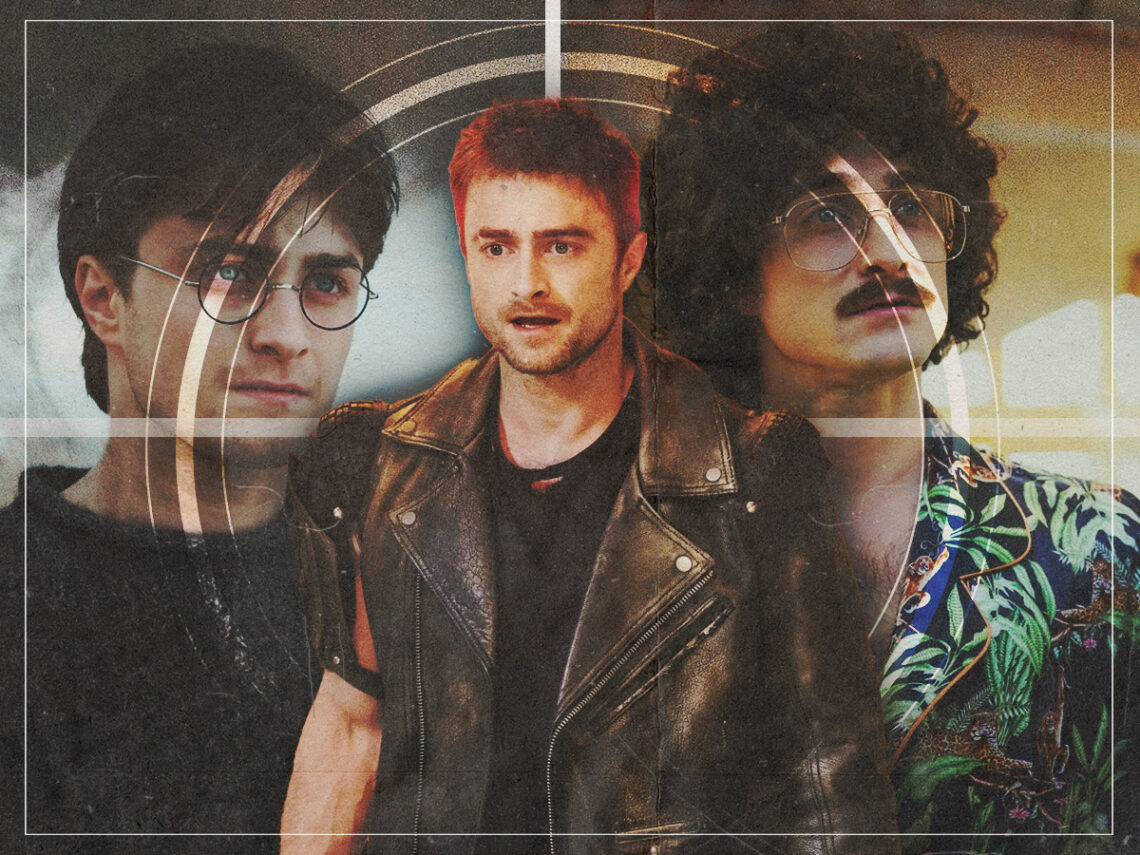
How Daniel Radcliffe quietly became the most interesting actor of his generation

By the time Daniel Radcliffe had left his teenage years, he’d already earned more money than the majority of people will see in a lifetime, and the intense scrutiny that had followed him everywhere he went since childhood meant that nobody would begrudge him stepping back from the limelight.
As the face and title hero of the Harry Potter franchise, he was one of the most famous actors on the planet, and history is littered with tales of youngsters thrust into the limelight who fail miserably to evolve into the next stage of their careers. His acting as ‘The Boy Who Lived’ wasn’t exactly great – wooden and very stilted, even – but he’s somehow become the most interesting performer of his generation.
There are plenty of stars in a similar age range who’ve alternated between big blockbuster gigs and unusual character-driven parts – with Robert Pattinson, Nicholas Hoult, Austin Butler, and Taron Egerton among them. However, none of them has showcased as much variety and versatility across a number of different mediums as Radcliffe.
Everyone assumed that when Harry Potter ended, he’d be typecast for life and never be able to outrun the shadow of his career-defining gig. As much as that’s true to a certain extent when it’ll always be the first thing that comes to mind whenever the conversation pivots in his direction, it feels as though Radcliffe took it as a challenge he was going to go out of his way to ensure he overcame.
In the world of film, he’s played Allen Ginsberg in Kill Your Darlings, a demonic dickhead in Horns, anchored a rom-com in What If, played a farting corpse in Swiss Army Man, and gone undercover with white supremacists in Imperium. He has also firearms bolted onto his hands in the batshit Guns Akimbo, led the biographical survival drama Jungle, taken to the skies as a drug-running pilot in Beast of Burden, embodied a South African political prisoner in Escape from Pretoria, and gunned down Pablo Escobar for kidnapping Madonna in Weird: The Al Yankovic Story.
On the small screen, he’s co-starred with Jon Hamm in the period-set black comedy A Young Doctor’s Notebook and played a wildly different character in all four seasons of the anarchic anthology Miracle Workers. The latter unfolded in the office responsible for handling God’s affairs, the Dark Ages, the Oregon Trail, and a post-apocalyptic hellscape, respectively.
Radcliffe has also trodden the boards in Martin McDonagh’s The Cripple of Inishmaan, the Shakespearean subversion Rosencrantz and Guildenstern Are Dead, and the Stephen Sondheim musical Merrily We Roll Along, the latter of which won him a Tony for ‘Best Featured Actor in a Musical’. It’s an astonishing body of work that’s evocative of a concerted effort to leave absolutely no stone unturned in the pursuit of trying his hand at every single thing performing has to offer in its myriad forms.
With the greatest of respect, Radcliffe won’t be remembered as his generation’s finest actor in the conventional sense, but on the other hand, there’s nobody else in his age bracket doing the sort of off-kilter, eccentric, idiosyncratic, and remarkably consistent work across film, television, stage, and screen. He shot to fame as ‘The Boy Who Lived’, but looking at what he’s been doing ever since he put it behind him, he’s now ‘The Man Who Thrived’.
