


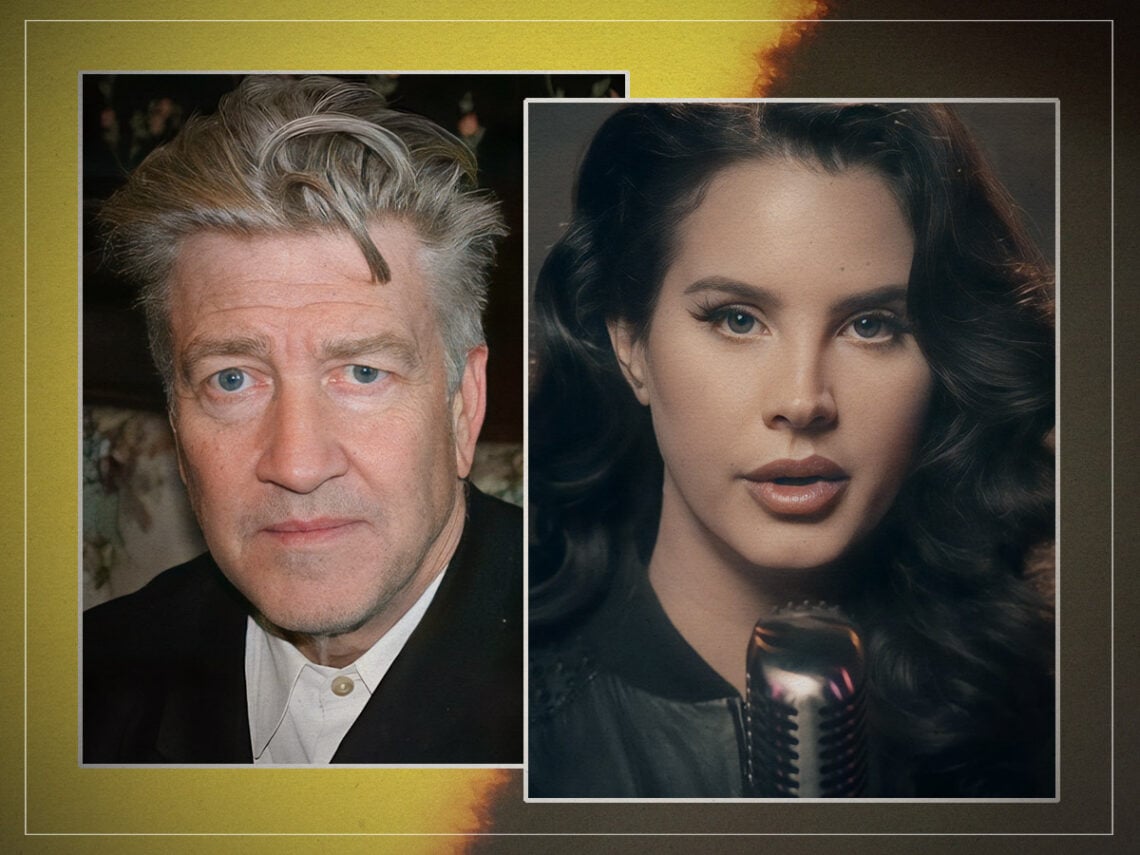
The creative ties between David Lynch and Lana Del Rey

On Lana Del Rey’s 2012 EP, Paradise, the singer delivered a sultry rendition of ‘Blue Velvet’ by Bobby Vinton, nodding to her vintage influences as much as she was referencing David Lynch. The filmmaker was known for deconstructing the ‘American Dream’ with his surreal movies, which dramatically inspired the musician, and you can find countless parallels between the pair’s work, even in the most unexpected of places.
While Lynch was born in the 1940s and Del Rey in the 1980s, both seemed to share a common interest in a bygone period of America. While Lynch lived through those dying embers of Hollywood’s golden era, coming of age as cinema transitioned into a more gritty and modern landscape, Del Rey has always looked back more nostalgically, as though she were born in the wrong generation. Still, neither looks back without acknowledging the tragedies that came from this period of supposed American glamour and opulence, with both artists referencing the harsh treatment of women that transpired during this time.
In Del Rey’s ‘Lust for Life’, she sings, “We dance on the H of the Hollywood sign, yeah/ ‘Til we run out of breath, gotta dance ’til we die”, seemingly referencing actor Peg Entwistle’s suicide, which saw her leap to her death from the H. In the song (and its video), however, she becomes the “captain” of her own “fate”, refusing to give in to the powers that threaten to lead her towards destruction. In a way, this optimism, set against the backdrop of a dark Hollywood night, brings to mind the fantasies of Betty in Mulholland Drive, although Lynch’s movie ends much less optimistically.
Instead, Mulholland Drive breaks down the futility of the American dream, with Hollywood the ultimate symbol of this unreachable ideal. Del Rey might have taken a surprisingly optimistic route with 2017’s ‘Lust for Life’, but many of her earlier tracks played into this Lynchian world of searching for meaning and belonging among violence. Take ‘Carmen’, for example, which even includes the line, “Her mind is like a diamond”, which is a direct reference to the quote “Windom Earle’s mind is like a diamond” from Twin Peaks. The song tells the tale of a girl who relies on alcohol and attention from others to get by, messily swinging from party to party and captivating everyone around her.
“She says, ‘You don’t wanna get this way/ Famous and dumb at an early age’”, Del Rey sings, “Street walk at night and a star by day”, and it feels as though she’s describing a young Hollywood actor hoping to break through into the world of fame and fortune. The ‘American Dream’ seems to be just a myth in Lynch and Del Rey’s work—romance is complex, drugs and alcohol are rampant, men are often brutal and mean, and getting by is difficult.
‘Carmen’ also feels like a song that could describe Laura Palmer from Twin Peaks. Like the protagonist of the song, Laura is 17, and she depends on drugs and alcohol to distract her from the pain of existence. On the surface, people think she has it all because she is popular, but behind closed doors, she suffers abuse from her father, as well as spending much of her time working as a prostitute. Laura is Lynch’s most carefully-crafted character—a troubled young woman whose life is cut short by the violence that surrounds her—but Lynch gives her the justice she deserves through Twin Peaks and its prequel film, Fire Walk with Me, which Del Rey also references in ‘Sad Girl’, singing, “He’s got the fire and he walks with it”.
Alongside Laura, Lynch also explored troubled women through characters like Nikki in Inland Empire, Diane in Mulholland Drive, and Dorothy in Blue Velvet. With themes of abuse running through much of Lynch’s work, it’s no surprise that Del Rey has resonated with it, having penned several songs about domestic violence, like ‘Ultraviolence’. If you think about Lynch’s characters, like Laura or Dorothy, while listening to Del Rey’s complicated tales of troubled relationships and existential dread, doused in facades of external beauty and glamour, it’s easy to see the parallels between the two worlds each artist inhabits.
How deep does the thread run?
The cinematic nature of Del Rey’s work, particularly the baroque pop of Born to Die and the sizzling jazz-inspired instrumentation found on Honeymoon, feels indelibly linked to the work of Lynch’s closest musical collaborator, Angelo Badalamenti. His use of haunting ambience, moody guitars, and lush orchestration feels akin to much of Del Rey’s opulent sonic worldbuilding, and it’s a true shame we’ll never get to hear a collaboration between the two.
Lynch once commented on his own appreciation for the singer, telling Artinfo, “Lana Del Rey, she’s got some fantastic charisma and – this is a very interesting thing – it’s like she’s born out of another time… She’s got something that’s very appealing to people. And I didn’t know that she was influenced by me!”
It seems as though the pair share many of the same influences from times gone by, with Del Rey nodding to The Wizard of Oz in her ‘Lust for Life’ video, with the red shoes and the bed of poppies, which is a film that shaped Lynch’s whole oeuvre. You can see several references to the classic film in Wild at Heart, a movie that also shares its name with one of Del Rey’s songs from her 2021 album, Chemtrails Over the Country Club.
Lynch’s film follows devoted lovers on the run, a theme that Del Rey has explored through songs like ‘Live or Die’, and even tracks like ‘Off to the Races’ and ‘Without You’, which speak of being utterly dedicated to another in a Bonnie and Clyde kind of way. Additionally, Nicolas Cage’s character in Wild at Heart is obsessed with Elvis Presley, and this feels tied to Del Rey, too, who has referenced the classic American singer many times throughout her career.
The dreamy but often bleak and surreal worlds that both Lynch and Del Rey have created over their careers have attracted those with a love for finding beauty in the darkest of places. Hollywood is the ultimate embodiment of American freedom, but both artists unmask its corrupt nature, often playing with stereotypical archetypes, like the femme fatale or the ingénue, only to subvert them to explore a world unbound by expectation. Del Rey’s songs ‘Kinda Outta Luck’ and ‘Serial Killer’ name-drop these archetypes, while Mulholland Drive explores them in depth, with Rita, the dark-haired femme fatale, and Betty, the blonde ingénue.
Evil certainly lurks in many corners of the world, even in pleasant-looking suburbia or glamour-ridden Hollywood, but there is also romance and salvation to be found, even if it feels impossible. Lynch and Del Rey’s worlds balance surrealism, opulence, darkness, and romance in ways that feel intrinsically connected. Perhaps, in an alternative universe, Del Rey played at the Roadhouse during the third season of Twin Peaks, honouring the spirit of Laura Palmer.
