


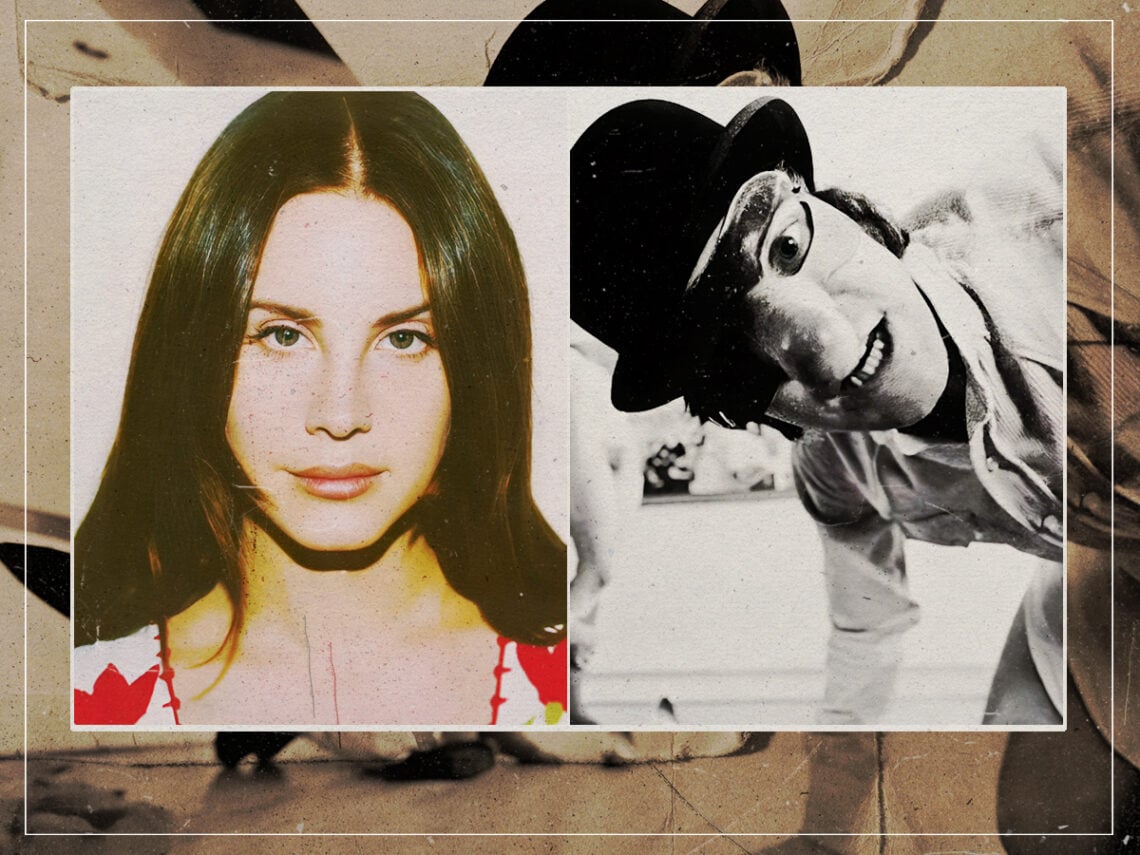
The connection between Lana Del Rey and ‘A Clockwork Orange’

Lana Del Rey’s world is one of poetry and controversy. Since her debut, a record in which she sang about drugs, Lolita, and groupies, her lyricism has been met with critics who seem to find insults in her glamour. Never shying away from more risky reference points, including banned literature, her second album took inspiration from A Clockwork Orange, a story so violent British cinemas banned all screenings.
From the start, voices of opposition have been raised against Del Rey. Some people saw her glamourised Tumblr aesthetics as anti-feminist or attempted to attach her to the Republican party due to her use of heavily Americanised imagery. However, when it came to her sophomore album, Ultraviolence, the negativity ramped up. “He hit me and it felt like a kiss,” she sings on the album’s title track. While referencing The Crystal’s controversial song, Del Rey was met with the same criticism that they were. People believed she was dangerously romanticising domestic violence by singing about abuse in a seductive love song.
When considering the source material, though, the controversy is essentially the whole point. The song’s title originates in Anthony Burgess’ infamous novel, A Clockwork Orange. The satirical dystopian novel centres around the protagonist, Alex, and his gang of “Droogs” as they go on a violent rampage through their town. Throughout, they communicate through a made-up language called Nadsat, with one of the most notable terms being “ultraviolence”.
“Ultraviolence” means precisely what you’d expect. It’s extreme and unnecessary violence that serves no purpose other than bringing the characters a thrill. The characters also use the word “horrorshow” instead of good, furthering the book’s romanticisation of violence and evil. When Stanley Kubrick got hold of the film rights and made his 1971, it was even more glamourised as he set scenes of extreme violence or assaults to swelling instrumentals.
Adding the word to the track’s over-the-top lustful voice helps Del Rey build a world of complete and utter, twisted devotion. It helps her further capture a kind of reckless love that comes from toxic situations. Or, in her cast, it gave her language to try and explain the cult mindset she found herself in.
“I used to be a member of an underground sect which was reigned by a guru,” she said of the song’s origins. “He surrounded himself with young girls, and he had this insane charisma I couldn’t resist as well. So I was in this, I’ll call it sect, because I was longing for love and security. But then I found out that this guru wasn’t a good but a bad person. He thought that he had to break people first before he could build them up again. At the end I left the sect.”

Just as A Clockwork Orange plays with the reader’s perception of its protagonist and draws you into his violent world through his charm, the use of ‘Ultraviolence’ links the romanticised moral questions in both Del Rey’s experience and the source text.
The book has been a source of inspiration for many since its release. Andy Warhol’s film Vinyl was based on the text, David Bowie referenced it throughout his career, Guns N’ Roses used it as inspiration for the ‘Welcome To The Jungle’ video, while New Order also used ‘Ultraviolence’ as a song title. Stanley Kubrick also directed an adaptation of Lolita, a favoured story of Del Rey’s. All of them serve as inspirations to Del Rey, making her engagement with the novel almost inevitable.
As a lyricist, Del Rey regularly references her points of inspiration. In her discography, she’s shouted out Allen Ginsberg, Elvis, T.S Eliot, and Sylvia Plath, to name just a few. Always driven to share where she gets her influences from, ‘Ultraviolence’ is simply another nod towards her library.
As for the critique that the title glamourises violence, that was exactly the point. The word appealed to Del Rey because of its contradictions. “I like that luxe sound of the word ‘ultra’ and the mean sound of the word ‘violence’ together. I like that two worlds can live in one,” she told Variety. Fans have also suggested that the word is likened to ultraviolet light and the way light can reveal something gruesome or hidden.
Despite the track’s clear literary origins and Del Rey’s considered use of glamour when discussing violence, the line has since been retired. In conversation with Pitchfork in 2017, the singer discussed her decision to drop the line when singing live. “I don’t like it. I don’t. I don’t sing it. I sing ‘Ultraviolence’, but I don’t sing that line anymore,” she said. “Having someone be aggressive in a relationship was the only relationship I knew. I’m not going to say that that [lyric] was 100 per cent true, but I do feel comfortable saying what I was used to was a difficult, tumultuous relationship, and it wasn’t because of me. It didn’t come from my end.”
Just like how Anthony Burgess’ protagonist Alex is reformed at the end of the film, it seems Del Rey has, too.
