


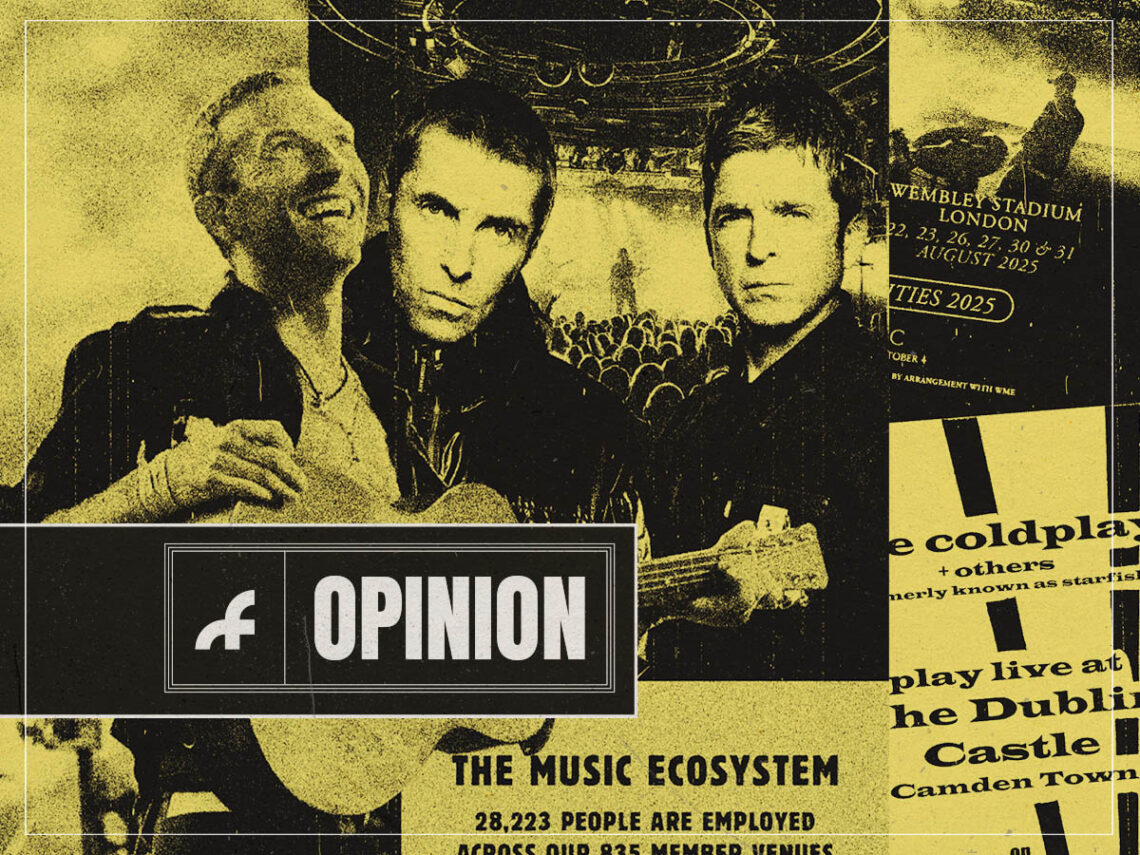
Coldplay vs Oasis: How to enjoy success while honouring the path you took to get there

Coldplay recently announced that they will embark on a mini UK tour to raise money for the Music Venue Trust charity. Their tour will see them perform at Wembley Stadium and Craven Park, which is usually home to the Hull Kingston Rovers. The Music Venue Trust is an organisation that aims to protect grassroots venues across the UK, keeping them open and creating new and exciting talent as a result.
The room you think of when you hear the term “grassroots venues” is the backbone for everything you love about music. Regardless of what you like, the band you’re obsessed with, the music you make, all of it has started in an independent venue. They remain one of the most essential parts of the music industry, as people are continually working out their sound, better understanding the artist they want to be, and also inspiring the musicians of tomorrow.
The Beatles? Blondie? Nirvana? Oasis? Coldplay? It doesn’t matter who you’re into; if not for the small venue, none of them would exist. Do you think a track like ‘Live Forever’ happens overnight? It’s the by-product of watching music, becoming obsessed with it, making it yourself, and then dying on your arse, realising a song doesn’t land and then re-writing it and re-writing it until it’s perfect.
Mark Davyd, the CEO of the Music Venue Trust, has had a career that centres around live music, as he has been in bands, opened his own venue, tour managed bands, started a label, met his friends, his wife, had his entire life shaped by the power of live performance. “All of it started, really, from wandering into the 100 Club from the age of 16 to go and see a band called The Sound, which was my first decision to buy myself a ticket, and I’ve never really wanted to be anywhere else,” he said.
“I go to festivals, and I go to big gigs, but they just don’t have the same thing. I like that feeling that the singer might attack you at any moment, and the sort of element of when a room kicks off,” he added, “In a small venue, it can properly kick off. You get 300 people watching a band and the band plays a song and the room goes up, even the bar staff are on the bar. That can happen at a small venue. The whole thing has just got that raw community spirit.”

Davyd has kept that love of small venues close throughout his career, and while that career has seen plenty of highs, there have also been a plethora of lows, as he has had a front-row seat for the hardships that grassroots venues are continually put through. This led to him starting the Music Venue Trust, which has always been intended to help provide funding for grassroots venues so they can keep their doors open, helping to shape the bands of tomorrow and inspire future musicians.
“Me and a lot of other people that owned or ran one of these venues started realising that people that we’d known for a long time, we weren’t seeing anymore,” recalled Davyd, “Then when we checked their venue, it had gone. The big difference was that instead of it being that their venue had gone, you met somebody else or they’d gone somewhere else… that town… it was gone. I’m thinking of places like The Windsor at Old Trout or Princess Charlotte in Leicester, or the Leeds Duchess of York. They weren’t replaced.”
He continued: “So, sort of from about 15 years ago, we all started saying that this is terrible and someone needs to do something about it. That went on for about seven years, to be honest, until we said, ‘Oh, nobody’s going to do something about it, so we better do something ourselves’, so Music Venue Trust is the ultimate grassroots venue organisation.”
MVT’s mission is a noble one, but it’s not one that they can carry out on their own. Their work has revolved around asking for government backing to help keep venues open and asking for bigger bands who have come up through small venues to honour the path they took to achieving fame. One of the most disappointing things to witness through the work of MVT is how many bands quickly forget those routes in favour of a healthy payday.
Oasis are a prime example of this. The country was shaken to its core when the band announced they were reuniting as they have a sound which is British culture personified. Working-class lads from Manchester learnt to play instruments and then put together albums that focused on community, parties, and wanting more out of life, something that people up and down the country could relate to. They’ve always been heroes of the working class in that sense, but their clear disillusionment and greed was reflected in their use of dynamic pricing, which was a clear representation that the Gallagher brothers were embarrassingly out of touch—shadows of the men that were initially championed by the British public.
As ticket prices for the reunion reached sky-highs in excess of £350, the idea of the next Oasis being able to attend the reunion shows was shot dead. Their reunion tour acted as another stoic reminder that the working class is perpetually priced out of the arts. Moreover, the venues that working-class people can go to are consistently closed down, as the MVT can attest to.

Oasis could have used their platform, ethos, and stance to do something good but decided against that in favour of making themselves richer. When called to task, rather than own up and make things right, they denied all involvement. “It needs to be clear that Oasis leave decisions on ticketing and pricing entirely to their promoters and management,” they wrote in a post on social media, “And at no time had any awareness that dynamic pricing was going to be used.”
It’s a pathetic state of affairs. We see this far too often, bands and events using the fallback excuse, “It has nothing to do with me, I don’t like these big companies either, I’m still one of you.” They say this while sipping champagne from a penthouse in New York. If they ever truly loved the art form they profited from and cared about those who contribute to ticket and record sales, there would be a conscious effort to give back, but we don’t see that.
Enter Coldplay. The Chris Martin-fronted outfit is a band that continues to divide opinion. We at Far Out are no strangers to criticising the band, and yet their influence is undeniable as they continue to sell out stadiums around the world and top the bill at the biggest festivals out there. Additionally, regardless of your thoughts on the band, their recent announcement that they would be donating proceeds from their new run of shows to MVT can unite music lovers everywhere.
Out of all the money raised from the gigs, 10% will go towards helping Music Venue Trust, and it doesn’t stop there, either. Coldplay have also confirmed that money will be given to the charity by the concert promoters, the band’s booking agents, and the official ticketing agents. It stands as a testament to the fact that when you have enough skin in the game, you can make an active difference. Who knew that even famous musicians are capable of independent thought, and some bands don’t need to rely on management to help them do everything from set ticket prices to change their parkas in the morning?
Mark Davyd has spoken about Coldplay’s decision, thanking the band for contributing to the organisation. “Coldplay are the perfect example of a UK band who came through the grassroots circuit on their way to worldwide stadium-filling success,” he said. “It’s fantastic to see them celebrating their own pathway to Wembley by giving back to the grassroots music venues that supported them and recognising the artists and promoters that are struggling more than ever to build their own careers.”
Out of the 34 venues that Oasis played on their 1994 Supersonic Tour, only 11 remain open. This is a sobering kick in the teeth. These venues don’t just provide a stage for bands on the up; they give smaller bands support slots and the time they need to develop their sound. They also offer accessible gigs to working-class people so they can continue to be inspired by music and contribute their voices to it without being priced out.
Like Coldplay, more bands need to act to support Music Venue Trust and independent venues nationwide. If they don’t, we will lose the backbone of the UK music scene, and the idea of future bands reaching the same heights as Oasis and Coldplay will remain exactly that: an idea.
